
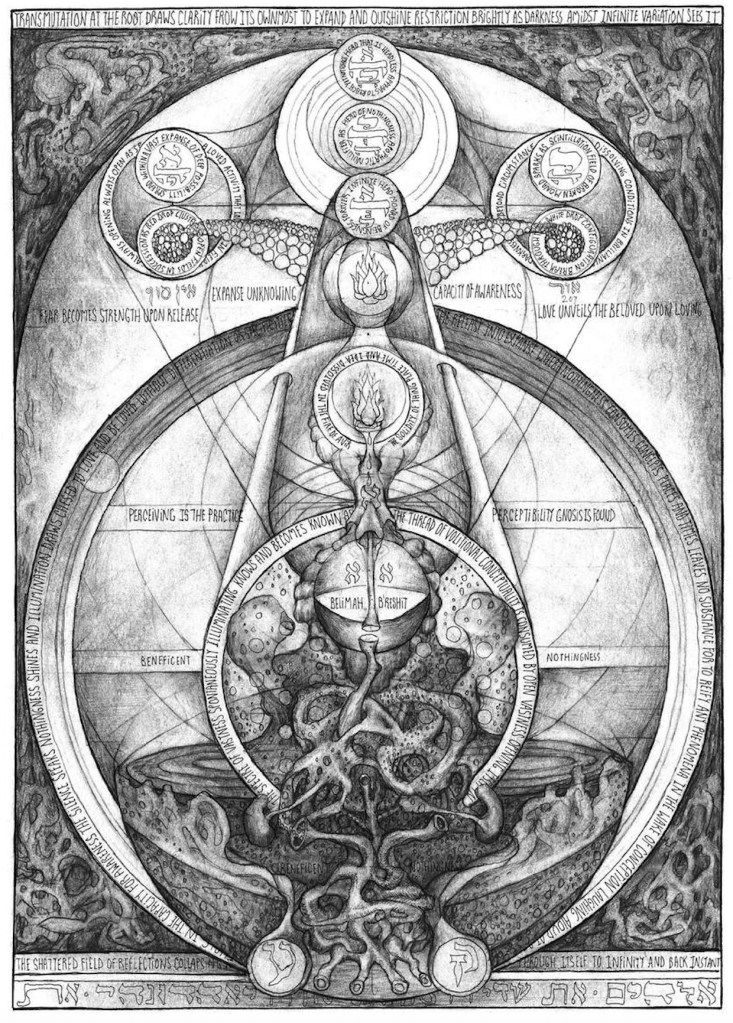
In various esoteric traditions, the Moon is a powerful symbol of transformation, reflection, intuition, and the depths of the subconscious mind. Governing the tides of emotion, it embodies the cyclical nature of existence and represents the receptive, feminine aspect of the psyche. Within the Zelator grade, the Moon serves as a metaphor for the Aspirant’s journey into the veiled and often uncharted dimensions of their inner nature.
The phases of the Moon—waxing, full, waning, and new—mirror the stages of personal growth and transformation experienced by the Zelator. Each phase reflects a distinct aspect of the Aspirant’s development. Just as the Moon does not generate its own light but reflects the radiance of the Sun, the Zelator contemplates the inner light and the knowledge imparted through the curriculum. The Moon’s cyclical rhythm mirrors the Aspirant’s path—a journey of rise and fall, expansion and contraction, where progress is not a straight ascent but a continuous flow of integration and renewal, triumphs and setbacks, effort and repose. Through these cycles, the Zelator learns that true advancement requires both movement forward and the assimilation of past insights.
The Moon’s dominion over the subconscious mind underscores the Zelator’s task of navigating the hidden recesses of the Self. This path demands the confrontation and integration of the shadow, leading to a more complete alignment with one’s Pure Will. As the Moon governs intuition and emotion, the Zelator must learn to perceive and master these forces, refining instinct into insight. Emotional discipline becomes a vital aspect of this work, for only through understanding and directing the tides of feeling can the Aspirant bring their subconscious into accord with the sovereign governance of the Will.
Within the A∴A∴ system, the association between the Zelator and the Moon emphasizes the imperative of introspection, emotional cultivation, and the cyclical nature of spiritual refinement. The Zelator, as seen on the Tree of Life, is for the first time freed from the Earth’s gravity and its influence, and at first glance, this path is significantly eased and elevated by a completely new body in its stellar journey. The value of the Moon lies precisely in the fact that it is close enough to make us feel safe and under the protection of the familiar surroundings, yet far enough for us to believe we are entrusted to the vast and glittering unknown. The Moon, therefore, serves the Sun and is its extended hand of action. It does not radiate light on its own, but shines in the same way as the other planets in the system, yet it is the brightest. It is the light that a child’s soul, frightened and unsettled by the dark expanse, upon stepping into the unfamiliar part of the city, can accept openly because it gently brightens the way, dispelling fear. Just enough for them to see, but weak enough that they do not become reliant on external help, it teaches that the path ahead is long, perilous, and unyielding. The Moon is much like a parent steadying our bike as we learn to ride. At just the right moment—once we’ve eased into trust—they let go, and without even realizing it, we continue riding on our own, confidently and joyfully. Forward, inspired, devilishly brave, devilishly fast.
Yet all these generalities offer us little of true value—nothing particularly useful, I would say. What we need is a scent to follow, something that will drive us relentlessly, like a bloodthirsty hound, forcing us deeper into the savanna of the soul, in pursuit of the mind’s prey. Memorized verses and endless recitations about vast mental landscapes and the boundless rivers of the Self will not quench our thirst. On the contrary, they will only make us thirstier. We need something else—something alive. A different, more natural, more personal way of seeing things. Sometimes in our art, we do not need a clinical term for the female reproductive organ; we need a cunt. We do not seek sacred tantric union; sometimes, we just want to fuck. Pure, unambiguous, raw, beautiful fuck.
We do not need the phases of the Moon to remind us of the existence of our mutable emotional apparatus, the existence of the entire concept of change that is an integral part of every existing cell of the soul. The problem I foresee in advance is that, among all the dry theories and postulates about the necessity of the transformation, transcendence, and the evolution of our nature, the now tiresome proclamations such as “the only constant is change,” is that from such boredom, all these cells now undergo a completely wrong transformation, for from the immense monotony, they have become cancerous, devouring the very organism for whose well-being they initially began to change. Therefore, I would suggest a more personal approach, one that strikes at that feeling of instability within us, that acid which corrodes our being, which tightens and presses us every time we think we have achieved peace and a state of constant happiness, when the feeling of anxiety and unease arises in us, without any reasonable explanation. Just when we have mastered the ritual, struck the perfect vibration, held Asana for an hour without a single hidden itch or flicker of pain—just at that moment when we whisper to ourselves, “success!”—like some twisted echo of the amateur’s pride, the Universe responds. His triumphant “success!” ricochets through the farthest corners of existence, only to return, unmistakably clear: “no, failure.” You have certainly already encountered that peculiar dark humor of the Universe, where whenever things go well, something worse appears. It would never have appeared if there had not been something good in the first place, as though it were some evil and corrupt game, in which you are the subject of cruel, mocking humor between divine heights and the darkest hell.
But if you are fine, then nothing.
This change, poetically, mythically, and with a juicy, romantic expression embodied in those beautiful and magical phases of the Moon, the Aspirant observes not as an objective truth, but as a subjective lie. In other words, they reflect light in exactly the same way, showing that change and entry into phases are actually experienced by us alone. The Moon reveals exactly what we are; it does not enter any shadow from which the light of the entire sphere cannot be seen. What is not whole is ourselves, who project this incompleteness onto another body. But even that other body, if it exists, is part of our system, in which our Sun is the master, around which everything revolves. The Moon is only a mirror; its phases are only our own.
The Neophyte’s approach to neurosis already carries the imprint of Moon’s nature, a theme explored in depth in my previous book. The Zelator follows the same route but will disembark at a far more distant station—one much farther north, where the cold bites deeper and the darkness grows heavier.
The psychology and psychotherapy of our time, with all its endless directions and variations, has given us a wonderful pill that, once swallowed, convinces us that the pill is responsible for everything, even that it made us swallow it. Moreover, it is to blame for all our flaws, projections and neuroses, fears, and all the destruction we express outwardly as much as toward ourselves. It is no longer fashionable to remain unaware of the darkness we harbor; we have, at last, named the villain—and mercifully, it is no longer us. We observe that this is some process within us, which has a reason and a mechanism of its creation, its appearance, and its operation, but our role is reduced to that of mere witness: to recognize and become aware, never to intervene. We have found all these foreign bodies, invented the telescope, and now we know that the new Moon is the same size as the full Moon, only that light illuminates it differently. The eclipse of the Moon is now a fully understood phenomenon, as is the eclipse of the sun, but when the topic is the eclipse of the mind, the eclipse of our nature, then it is time for another pill and another carefully measured forgetting.
Today, it is entirely acceptable to acknowledge that our own processes are the ones causing the problems, and that the evil within us is, in fact, a repressed and distorted form of good. However, the Zelator begins to realize that it does not matter what is happening with the celestial bodies at the moment of the great eclipse. What truly matters is how much they can exploit the darkness for whatever benefits it may bring. While everyone else keeps their gaze fixed high above, they are the only one who crawls, observing everything around them like a divine thief, daring to steal nothing less than the fire of the gods, precisely when no one is watching. It is not about what happens, how it happens, or to whom it happens. The crucial thing, my boy, is what you choose to do with all that damn chaos. That’s exactly it. And the Zelator knows precisely what he will do and how he will do it. It is his sacred duty—to act without hesitation and to forget with deliberation, free of regret, free of doubt.
The Zelator does not seek a culprit; the Zelator hides their own tracks, for they know that they are the perpetrator. From the perspective of the Universe’s mechanism, the Zelator is not an ordinary witness; they do not testify to things that do not interest them. They are a false witness, testifying only to what suits them or to what benefits someone else more. For the Zelator knows that no matter how hard one tries, no one can know the One Truth, and so every testimony is both true and false, except in one case, of which there are infinitely many. It can be said that for the Zelator, the Moon is neither a sphere nor a dwelling, but a refuge and sanctuary. It reflects and deflects what gives us the possibility of illusion, self-deception, and lies. It presents us with light, as the idea of the highest enlightenment, without which no lie could be established, making every perception, even the perception of truth, a subjective and limited filter. Thus, the Moon is the whisperer of deceit, the midwife of corruption.
It is quite convenient to think of the Moon as a layover, a connecting flight to our final destination, for which we have purchased a one-way ticket. It would be disastrous to mistake the Moon—and all those astral realms that stir the soul with a spectacular tremor and evoke a singular euphoria through their nature and utterly distinct landscapes—as anything crucial enough to divert us from our course toward the Sun. This is wisely reflected in the placement of Yesod on the Tree of Life, which serves as a mere waypoint along the Middle Path leading to the Sun. It is as if our ancient brethren left this marker on the map—there to be found, yet harmless—positioning these experiences so transiently that we may gather them without even slowing the course of our chariots of fire.
Indeed, Aspirants can remain blinded for years by this magnificent plane of the Universe, which is nothing but an unexplored partition of their own mind, a passage to a neighboring area they have never walked through, simply because they have never had any reason to do so. Yet, those few who are aware know that this passage is itself the destination. It holds a reason that is enough to guide us not to pass through it and go somewhere further, no, not at all. Instead, it compels us to stay in that passage, for within it lies a city where we live upside down. This passage offers an entrance to a completely foreign city, an underground landscape with its inhabitants who never go outside. And all these inhabitants are like us—our neighbors, who have never used this passage, just as we never did, because there is truly no benefit or logic in it. It does not shorten any possible rational path, it does not cut through any street, it has no traffic, nor can it be used to escape the urban chaos. There is no convenient space to park a car when it is impossible to do so anywhere around during rush hour. In fact, the Great Architect, whom the Zelator will meet, created this secret passage precisely because he wants those who gain no benefit from it. Those who use it only for their own fantasy, as some Feng Shui for their mental perversions. It is precisely such people that the Great Architect calls to be the elite guests of this lower city, down below, deep in the inverted underground. And down there, the city takes on its true, vast dimensions. For all that is interesting and good is found down there, deep below.
Indeed, the Zelator does not draw strength from the idea of “dwelling” as does the Neophyte, who studies and masters the ability of lucid dreaming, a concept whose essence is symbolized by the Ritual of the Pyramid. Instead, the Zelator draws strength from the idea of “passage,” which in turn embodies the idea of the “Ritual of Passage through Tuat.” The essence is not so much the realm of Tuat but the act of “passing through it.” The Zelator’s ability, which they refine to the extreme, is not lucid dreaming, but passing through veils—through the fine layers of sleep, through the veils of the mind. The Zelator will perfect the prolongation of their stay in lucid dreaming to the utmost, and will also learn to maximize the clarity of the astral plane, to such an extent that the surface and contours of the dream will become so solid and real that they will have to resort to special tricks to break or to pass through them. The ability of teleportation, or the sudden change of dream scenarios, is of particular importance to the Zelator, a topic we will approach more carefully later in the book. However, we have already covered this well and in detail in the book on the Neophyte, so we will not linger here except to mention it for clarity. The idea of “passage” will be further elaborated by the Practicus, who will master a completely different method of experiencing other planes, one that is entirely specific and so different from lucid dreaming: the art of scrying.
The idea of “passage” will find its foundation equally in the skill of Asana and Pranayama. Through Asana, the Aspirant will pass through the experience of their own physicality by altering their perception of the body, thereby changing their own consciousness within that physicality—passing through the layers of the coarsest physiology, the itch, the pain in tendons and ligaments, the spine and neck, all the way to the subtle sense of wholeness, which leads to automatic rigidity, and finally, when both their consciousness and physicality become merely carriers of the Self, they will pass, through persistent practice, from the gross to the subtle, from the manifested to the complete cessation of body awareness, pain, or position—all within the vast emptiness and the aphrodisiac of Sunyata. With Pranayama, they will pass through various rhythms, tempos, and methods of breathing, awakening the subtle energy to the level of physical sensation. Thus, they pass through all of this—through waves of breath, through the trembling of internal heat, through flickering sparks of energy—but without becoming attached to them, without euphoria, without sanctifying the process. For therein lies the trap: what should be a passage in many modern schools and systems becomes a stopping point, transformed into dogma beneath various titles and cloaks—Yoga, Kundalini, Tantra, or Kriya.
The automatic consciousness that the Zelator attains, and which is especially important in their work with Pranayama and in the precious aspect of working with Asana, is a process that is gradual, patient, and above all, conscious. The stiffness of a stone statue, for instance, is possible as a very gradual achievement, in which the Aspirant remains present with their attention throughout, and where they observe the change in their bodily experience, which would be impossible without their attention to that change. It appears slowly, and this slowness increases drastically if it is awaited with the desire to rush. It is almost impossible to achieve complete stiffness in Asana in a short time, no matter how experienced the practitioner is. Unlike some other achievements, which may even seem miraculous when viewed through the eyes of an uninitiated amateur, such as scrying, Enochian invocations, or even the transfer of consciousness into the Body of Light—the achievement of Asana still requires a longer period. For it is precisely in this time, in this “passage” through the gates of time that alter perception and even change awareness completely, I would say even the subject itself, that contributes to the fact that it is always so gracefully accepted. At least by those who learn to perform it correctly, while for those who experience it as a dry lesson in algebra or a task in grammar, all of this becomes a demonstrative exercise in suffering.
Automatic consciousness, or rather alertness, embodied in the idea of the Moon, contains the complete assimilation of that idea, just as the Moon appears in two vastly different Atu— “The Fool” and “The Moon.” The automatic actions that characterize the Zelator are not limited to the solid and material Moon, as the parallels in the practice of Asana and Pranayama. In the aspect of The Fool, it is a matter of working on lucid awareness, containing a special kind of conscious and uninterrupted transition toward dream, where the ultimate goal is completely opposite to sleep. It is awareness and alertness, but on a different ground from where alertness is normally found. In the lucid experience, we are certainly awake, even overly awake, but within the dream’s frame. The entire world and environment where this wakefulness manifests changes completely. We have covered this in depth in the instruction for the Neophyte, but here we will focus only on the detail that is particularly important for the Zelator, and which can transform any of their sleep into a supreme astral experience, which, in its specifics, has distinctive value for this grade. This detail concerns the deeply ingrained habit of moving and opening the eyes after waking. This habit is so ingrained in us that even mentioning it evokes a certain sense of absurdity. It is completely impossible to assume that a person could wake up without moving or without opening their eyes. Yet, persistent practice completely breaks this outcome; all that is necessary is to repeat an affirmation before sleep, so that we wake up without moving or opening our eyes. The affirmation is always in the present tense, always in the potential that is realized, not one that will be realized.
Therefore, the affirmation should not be: “When I wake up, I will remain still and without opening my eyes.” The correct form is something like: “I wake up without moving or opening my eyes.” If we fully adhere to the instruction about positive potential, then we can transform this into: “I am awakening in complete stillness.” In terms of the magician’s creativity that defines our artistry, we need to introduce one more detail and link that will support the manifestation of the affirmation, like a lighthouse guiding our nature through the dark waters of unconsciousness. This detail is the emphasis on “remembering,” or that we will “remember” to stay still and not open our eyes as soon as we wake up. That small detail acts like a lever in the transfer of weight, easing the entire process. The focus is not on simply hoping that we will wake up without moving, which may happen tomorrow, a month from now, or perhaps never. The repetition of the affirmation must be supported by a clever detail that will bring about the condition, and that is that we will remember. And we will remember as soon as we wake up. Therefore: “I remember to remain still and without opening my eyes as soon as I wake up.” Also, avoid completing the affirmation with something like “after every waking,” because our unconsciousness at these moments does not recognize the language and ideas available to our waking consciousness. Hence, “after every waking” is a broader and more indefinite concept than “as soon as I wake up.” Our intention holds a passport of the moment— “as soon as I wake up” belongs more to the land of immediacy than “after every awakening,” which feels more like a resident of tomorrow.
Also, ease the entire process by using tactile stimulation for what is contained in the affirmation. This means, lock the position of the physical body from the moment you give the affirmation. Simply, do not move from the moment you give the suggestion until the moment you wake up, at which point the affirmation will activate, now with all the necessary conditions to be fulfilled, not by random predictions but by active recognition of the correspondence, which your unconscious nature does almost automatically. This is the process that is so crucial for the Zelator—automatism.
Making an affirmation is glued to the determination not to move, so our body will remember the affirmation along with the position, which, being unchanged and motionless, reinforces the affirmation and intention to stay still after waking up even further, rounding off the idea at a much wider and more compact scale. In a way, repeating the affirmation with a determination not to move until we have fallen asleep seems to lock information about the continuity of the position in the body, which will automatically turn on after waking up. It is simply unimaginable to guess how many miracles there are in front of our noses if we manage to do such a simple thing. Such a small thing triggers a myriad of mechanisms that make it possible to experience something that sheds an entirely different light on everything we do in life. All the rituals, meditations, techniques, everything we perform in our art is really nothing compared to the realization of lucid consciousness that begins with such a nebulous instruction, such as the instruction to remain motionless with our lids shut after waking up.
Those golden moments of our existence, those first few seconds after waking up that separate us from the just-completed REM phase, which adorns the widest and deepest functions of our being, are so easily discarded by our habit of almost panicking as we leave the bed, rushing into a world we often face by force and necessity—work, university, obligations. Once we move, once the brain receives the assurance that we have escaped the sleep paralysis and are finally awake—ready to take on the process of self-maintenance that we both desperately need, constantly, daily, endlessly, it cuts off every opportunity and possibility for us to return to the sphere of its natural habitat, where we can perform such fantastic, miraculous things. We flee from the bed as though it contains traps and diseases, as if it were cursed, teeming with pestilence, when in truth it is our throne—the sacred domain where we reign closest to our Selfhood. Therefore, the most important, crucial thing for the Zelator, as well as for the Neophyte still in their lucid dreaming practices, is to establish the vital habit of awakening without moving and opening their eyes.
We must not turn the affirmation into a button or a command for self-destruction. The affirmation must live; it must nourish the mind with its liveliness, which will then play to it like a beautiful melody. The mind will accept it with pleasure, beginning to dance and skip, forgetting the time and its remaining duties, living in that melody and dance as if nothing else matters. To achieve this, we must avoid the parrot-like repetition that leads to boredom and rejection of the affirmation. We need to enrich the practice with small details, embellishments, and ornamentations in the music of the mind, which the fine details will embrace with joy. It will truly become the beat to which the mind will not only dance but also enjoy such a divine play, a magnificent waltz of the Self.
Say the affirmation incredibly slowly. Try to pronounce it so slowly that the slowness gradually intensifies, as if you want to stretch it out infinitely, never allowing it to come to an end. We need to maintain the essence of the sentence without letting it drag on excessively; imagine it like a record that has malfunctioned, making the words stretch endlessly, like “laaastttiiiiing… for… sooooooo… looooong…”
Another powerful technique for ensuring an affirmation resonates deeply within our unconscious mind is to vary the pace of its repetition to an extreme degree. Begin by repeating the affirmation at a normal pace for a few minutes, then gradually increase the speed until the words become almost indistinguishable. The key is to eliminate any pauses between words, allowing each sentence to flow seamlessly into the next without breaks or full stops.
“IamawakeningwithoutmovingIamawakeningwithoutmovingIamawakeningwithoutmovingIamawakeningwithoutmovingIamawakeningwithoutmoving.Iamawakeningwithoutmoving.Iamawakeningwithoutmoving.”
After a while, and it only takes a few minutes, a specific state will be created—a feeling in which the frantic repetition of the sentence sculpts our mind in a unique way, as if a quick mumble has filled the void with a distinct sensation, subtle yet relatively constant. Now, stop repeating the affirmation and focus on nurturing that feeling. This is the imprint of the affirmation in our mind, resonating like an echo. If you keep this sensation in your mind, it will deepen the affirmation’s imprint, even without the need to repeat a single word. Simply maintain a gentle and pleasant focus on the feeling that arises after the rapid repetition of the affirmation, and the process will be complete. You may even sense a tension in your brain, almost burning from the intense repetition; all it takes is to nurture that flame with your attention and let it spread—this is how you can repeat the affirmation in a more advanced way, without the need to utter a single word.
An excellent technique for imprinting the affirmation into the mind, which is extremely effective and, in many cases, can bring success in using the affirmation for waking up without moving or opening the eyes, sometimes after the first few attempts, is repeating the affirmation with emphasis on different words.
“I AM” awakening without moving.
I am “AWAKENING” without moving.
I am awakening “WITHOUT” moving.
I am awakening without “MOVING”.
It is important to highlight the manner in which the affirmation is spoken. In addition to repeating it aloud or silently, a highly effective way to impart the affirmation is by voicing it in a whisper. When using this method, our attention is stimulated and provoked to increase, lifting it and, in turn, allowing the intention to be better imprinted into the mind. Another, highly penetrating method involves repeating the affirmation through all three conjugation forms, which helps to avoid limiting subjective perception and helps anchor the affirmation more firmly within the depths of the unconscious.
First person–the classic form of the affirmation, where the focus is on one’s own identity: “I am awakening without moving.” Second person–addressing oneself as an external entity, like advice coming from beyond the internal dialogue: “Dušan, splendid! You are awakening without moving.” Third person–observing oneself from a neutral perspective, which gives the affirmation additional objectivity and imprints more powerfully: “Well, well, Dušan is awakening without moving,” or: “Look, Dušan is awakening without moving.”
The last method proves especially effective, for it bridges different levels of inner perception, making the entire process shift through the lens of the aggregate states of the Self–I, You, and He/She. The first person singular directly activates identification, the second person singular allows the acceptance of the suggestion, while the third person singular shapes the affirmation as an observable fact, reducing the ego’s resistance and allowing for a seamless penetration into the subconscious. It is precisely in this combination that its power lies–the affirmation is no longer just something we try to believe, but becomes something that already is, not only for us, who might not believe, but also for someone else who is united with us in the same conviction, making us solidify our intention, as much in the faith, as in the fact.
But the seeker of our Academy approaches affirmations and autosuggestions through the lens of scientific enlightenment, never as a mechanism of parrot-like commands, where we simply hope the whole thing will succeed on its own. For us, affirmations are much more than mere mental exercises–they are tools for shaping the Will, a finely tuned instrument that can bridge the interval between who we are and who we aspire to become. Their power lies not only in the words, but in the way we use them. The aim is not just to utter the words, but to imprint them into the very structure of consciousness. When the affirmation becomes part of the living flow of thoughts, it stops being a possibility and becomes a certainty. At that moment, we do not use the affirmation to attain something–we use it to remember something that was achieved long ago. We do not need to do something, but to remember when we did it. Not to succeed, but to remember when we succeeded last time.
The nature of an affirmation is fundamentally different from that of a mantra, and much of its weak impact or failure can be attributed to the Aspirant’s misunderstanding of its function. Repeating an affirmation in the same monotonous manner as a mantra yields only initial success; the mind quickly becomes desensitized to it due to its predictability, repetition, and lack of engagement. Therefore, it is essential to infuse affirmations with vitality, movement, and flexibility, as previously described. Even singing an affirmation can significantly enhance its effectiveness and manifestation.
It would be wise for the Aspirant to use all these methods, introducing their own variations or modifying the ones mentioned above. The more varied the methods employed, the deeper and more vividly the affirmation will be imprinted in the mind, making it more effective. Affirmations and the mind are like fish and a pond; a fish can be caught in many ways, and the more different baits and rods we have, the better our chances are. However, it is not enough to just catch the fish, we must also strive to keep it alive once it is in the net. Similarly, endlessly repeating the affirmation is not sufficient; we must ensure that our mind receives and nurtures it so that it begins to bear fruit. Repetition that is too static and uninventive will create resistance to successful techniques, which will be evident in our work. We must continuously and consistently advance our methods, constantly introducing new elements and changing forms and routines.
We must never repeat an affirmation during the day, nor shall we think that such repetition will increase our chances of success. On the contrary, in this way, we are causing our being to resist and create a habit of interpreting the entire affirmation as a routine, distant thing, which is absolutely unacceptable for us, like relying on a prayer for salvation rather than using a GPS to navigate more efficiently through the tempest ocean.
It is of great importance that the affirmation is made with conviction and with the feeling as if we have indeed awakened and are motionless all the time once we have woken up, suggesting this we are experiencing a false present—such a small detail makes such a big difference from the mere hypnotic and parrot-like repetition of the suggestion. From the moment we start making an affirmation until we fall asleep, we must remain in a single position without moving, thus giving importance to the idea of continuity of immovable position, which will eventually continue after waking up. In fact, with all these elements, we frame the immobility of the body and the continuity of one position on both sides of dreaming, both before and after the dream, providing additional inputs to our unconscious mind that will drastically increase the chances.
After working with the affirmation for a while in the lively and vigorous way we have presented, we should try to fall asleep without moving, just as we would expect to wake up. Two outcomes are possible.
The first, quite likely, is to wake up moving and opening our eyes, get up and go to the bathroom, or start preparing breakfast only to realize that we have missed the opportunity and that the affirmation was not that deeply enough imprinted to be able to attack the habit of moving and getting up. As soon as we realize that we have failed, we should go back to bed immediately, pretending to have just woken up and been amazed at how we found ourselves motionless and with our eyes closed. We should act out that situation as if it has just happened and as if we have achieved success. Pretend that we are very surprised, excited, and happy to have achieved stillness and our eyes closed. Even if we have made minimal movements after waking up, it is very important to calmly return to the position we got up from, as if we were reminding ourselves of the command we were supposed to do, then pretend to have woken up and that we managed to stay still with our eyes closed. It is as if we are creating quite a new past, cutting all unfavorable future, and pasting over the present we choose. After this, we are free to return to our daily routine; it is an equally valuable imprint as if we managed to remain still, which will manifest its mechanism in the coming days. Each time we find ourselves having moved upon waking because we forgot to stay still and keep our eyes closed, we repeat the same process—slowly return to bed, as if rewinding a scene in a film, gently lay our head back on the pillow, and with full intention, cut through the timeline of our failure to insert a new reality, one in which we succeeded. We should understand this movement as the cut-copy-paste option of our lucid computer, a way to override the default reaction with the version we consciously choose to reinforce.
Sooner or later, we will come across a second possibility in which we have invested days of effort; one morning, we will wake up and find ourselves staring into the blackness of our eyelids, remaining still, instantly remembering that it should stay that way. It is a truly wonderful moment that will not bring us so close to a lucid dream as it will show us a very clear path—the one we can follow. It will show us that one mechanism is starting to work; it is a special joy that spreads through our being once we realize that our dormant structures are exactly the same as those of others, and that the experience being described will be exactly as ours. We will almost feel that wonderful scent of a lucid dream, which, literally, is only a few tens of seconds away in those moments. However, it is quite certain that at that moment, we will be so euphoric about success, just as we will be the next few times, that we will ultimately wake up due to such euphoria. And that is what we need the least. Our euphoria and increased attention will do to our being what moving the body and opening the eyes do; it will throw us out of a position where we would continue to move lucidly. Body movement is stagnation in a dream, and likewise, movement in a dream implies complete bodily stagnation and stillness. Repeating the affirmation should become our evening routine; in fact, whenever we go to bed, even during an afternoon nap, let it be our habit to repeat to ourselves that we will remember to wake up without moving and opening our eyes. The afternoon nap is the only exception to the rule of avoiding affirmations during the day. It is a hidden goldmine for lucid dreaming attempts, as discussed in my instructions for the Neophyte and later to be revisited in the Practicus grade.
When failure happens, when we move and open our eyes in the morning, or even completely forget about everything and walk to the bathroom, or even leave the house for our morning duties, we should gently tell ourselves what we could have done better, not to correct ourselves but to improve. This is not a reprimand, but encouragement. It is so important to feel the different energy of such guidance. Simply go to the mirror, look yourself in the eyes, and tell yourself that it was a wonderful attempt, but that now we need to push ourselves just a little further—not to succeed, but to try even better, and that everything will be alright. We should be proud of our attempt, not scold ourselves for not reaching the potential given by the affirmation. It is crucial that our magic not fall into that anxious feeling of failure, especially when we have prepared everything carefully, done all as planned, or as someone else claimed brought them miracles, only to find that nothing has happened.
We must understand that “nothing” is a much wider, much deeper gift than we think. That within this failure lies the unrecognized success, which is the beginning of the process or even perhaps the day before the nectar will burst, giving ambrosia that only yesterday tasted bitter, terribly bitter, and spoiled. This is the same liquid that tomorrow will taste the sweetest, with the most wonderful fragrance, and will grant us immortality. But not of the body, rather of the moment in which every pore will be immortal and without decay. Not because it is indestructible, but because it will no longer have the potential to last. It will always be here and now, alive and healthy, without thoughts of tomorrow’s aging. We must learn to accept failure as part of the game. The fact that there is no Angel, that the invocation was clumsily done, is exactly what we need. Why should we experience failure in the invocation any differently than we would experience playing hide and seek? We just have to find the being that has been here the whole time, but has cleverly hidden itself. And the better it is hidden, the better the game. You see how now, the same outcome radiates with a completely different light. Not the gloomy color or shade of failure or loneliness, but the light of approach and encounter. Even when there is no Angel, perhaps it did not hide, maybe we hid from it, and it has been searching for us all along while we sit silently, laughing in the corner of the Universe, trying not to be noticed. Because that is how we agreed, those are the rules of the game, and we find ourselves happy and joyful not when the Angel arrives, but when we remain unnoticed. Its arrival would spoil the game and even bring dissatisfaction. Therefore, everything that happens, every failure, you must feel exactly as that—rules of the game, because it is exactly as it should be, and nothing else.
This important habit, this transition, this journey of the Zelator from the waking state into the state between wakefulness and sleep, which contains nothing of these two worlds except that it is elevated and full of potential, is the rarest, most precious brilliant in the entire spectrum of everything the Aspirant will gain through their diligent work. And what is especially important for us now is that it will perfectly unite the idea of the Moon, the idea of the mind and the magical Dagger, the idea of thought, the idea of passing, and finally, the idea of the Shadow and the “demon on the threshold,” which will be provoked in their ideal environment—the sleep paralysis. So to speak, this cunning practice brings so many other significant achievements for the Zelator; it is like a wild card that sweeps the deck, claiming the strongest hands.
One of the main trump cards in this deck of achievements is the encounter with the previously mentioned Shadow during the sleep paralysis. Many people have experienced this phenomenon once in their lives—an overwhelming fear that arises after waking up, during which we are completely paralyzed, unable to move. This is certainly a hallmark of the REM phase, in which our wakefulness arrives somewhat unexpectedly, like an intruder into the realm of automatic mechanisms that dwell within us, as a result of inherited brain functions from ancient times, something that will be thoroughly explained in the section on sex magick. For that reason, and to avoid redundancy, we will refrain from a detailed examination of the mechanisms and causes behind this phenomenon. What is important for the Zelator is to undergo this experience directly—to step into it, rather than merely contemplate it. The entity that our mind projects and creates within the realm of sleep paralysis—in a sort of mental limbo, which, for the purpose of its assimilation, requires form, volume, and dimension for spatial reasons, wants to meet with us. It wants to step into the light. The only problem that prevents such an encounter is the appearance of overwhelming dread within us, which is merely a side effect of the sleep paralysis, where our primal fears, along with the onset of auditory hallucinations, simultaneously conspire in creating the being of the Shadow.
In general, all experiences in sleep paralysis, or even in the “area” of the Void—when you learn to wriggle out of the paralyzed position of the body, rolling to the side, which is usually always the easiest and most effective way to move out of the physical location and step into the realm of dream—when you find yourself in a very peculiar space of emptiness, without vision but with a clear tactile sense of touch, are tied to the idea of the Shadow, darkness, gloom, or twilight. When you finally achieve vision, you will often, from the area of the Void and sleep paralysis, under the influence of that phantasmagoric, gloomy atmosphere, step into a similar visual scenario: it will be your room in the dark, or any location in twilight, with usually dimmed lights, or mist, with subdued, depressive lighting, and most importantly, a special eerie feeling that will follow you throughout the astral experience. Because that feeling is something you have created, and it immediately projects itself like the clay of the Cosmos into everything around you. In fact, in a lucid dream, as in all other higher, lower, deeper, or subtler planes, you are essentially observing yourself in a quantum mirror, so to speak, and all you see are reflections of a small, fantastic particle of light. All of this is you, with what you have that also prevents you from perceiving that light, which is always and only fear. But not the fear of the darkness, or the eerie emptiness surrounding you, but the fear of the light. Your own light.
This is a realm specifically created for the Zelator and their development. The appearance of the Shadow in the Void or sleep paralysis is like an encounter with the main monster in a film. There is no need to wander aimlessly through the dark halls of this terrifying castle. The punchline of the scenario being played out is the encounter with the dreadful being that resides there. Encountering such a being, which only takes on the cloak and form of the Shadow, provides a completely unique training ground for Will, whose depths and dimensions are entirely fantastic. The phenomenon of the Shadow, also known as the Dweller at the Threshold or the Hat Man, is frequently encountered during episodes of sleep paralysis. This enigmatic figure occupies a liminal space between folklore, psychology, and the supernatural. Typically described as a tall, dark silhouette wearing a wide-brimmed hat, the Shadow has been reported by individuals across cultures and generations. It is more than just a figment of the imagination; it is a recurring presence at the threshold between wakefulness and sleep, where reality blurs and the mind is both vulnerable and alert.
The Shadow often stands at the edge of the bed or in a corner of the room, silently watching with an unsettling stillness. Its mystery lies in its silence and lack of action, which paradoxically amplifies the fear it induces. Although it usually does nothing, its mere presence conveys a threat far more terrifying than any explicit act. It becomes a mirror, reflecting the fears of the subconscious back at the individual, making them more real and immediate. When it does move, it is slow and deliberate, as if it is solely fixated on the Aspirant’s awareness and wakefulness, like a cunning predator stalking its prey. In this figure, more than a mere Shadow, one finds the embodiment of dread itself. Though its form is indistinct, its presence is profoundly felt, as if it carries the weight of countless nightmares. During moments of paralysis, when the boundaries between wakefulness and the dream world blur, the Shadow becomes a manifestation of the mind’s deepest anxieties. The fear it induces is not just of it, but of the helplessness that sleep paralysis engenders—the terror of being trapped in one’s own body, aware but immobile, with only the darkness and this looming figure for company. Some Aspirants perceive the Shadow as a guardian of this liminal space, a sentinel who stands at the boundary between the waking world and the dreamscape. Others view it as a malevolent entity, a demon who exploits the vulnerability of those in sleep paralysis, feeding off their fear and helplessness. This duality adds to the mystique of the Shadow, making it a subject of both fascination and horror. We surely can explain the Shadow as a manifestation of the mind’s attempt to make sense of the paralyzed state. In this view, it is a projection of the mind, a shadowy figure that symbolizes the paralysis itself—a way for the brain to personify the experience of being petrified in fear.
We can observe that phenomena and experiences of alien abduction are often reported in the early morning hours, particularly just before dawn. This timing coincides with the final REM phase of sleep, which is both the longest and the lightest stage. It is well established that REM cycles progressively lengthen throughout the night, with the final one occurring right before waking. During the REM phase, the body experiences intense atonia—muscular paralysis—which can give rise to a peculiar phenomenon: a deeply embodied fear that often takes shape as vivid hallucinations or perceived encounters, such as alien abductions, making this a particularly fertile window for such experiences.
I witnessed when Aspirants, having dedicated their entire lives to the exploration of extraterrestrial phenomena, were struck by intense experiences of sleep paralysis. Instead of the Shadow, their sleep paralysis manifested as a specific horror in the form of mysterious light, often in orange or red hues, radiating from behind windows, doors, and through the gaps of doorways. Accompanied by the sounds of humming and vibrations throughout the entire apartment or house, the Aspirants, like children, especially those raised on a diet of science fiction and alien abduction tales, attributed these experiences to their own abductions by extraterrestrials. Convinced of their otherworldly nature, many devoted their lives to searching for these elusive entities. It was only through our shared practice of lucid dreaming that they began to reencounter these same phenomena, this time almost indistinguishable from the natural occurrence of sleep paralysis. The result was often enlightening for the Aspirants. Although they shattered the myth and even childish belief in extraterrestrial life, they discovered a completely new clue, one that would eventually lead them much closer to the truth. Instead of extraterrestrials and life beyond Earth, they uncovered innermental beings, and the life within their own minds.
All that is needed to encounter the Shadow is to think about it before attempting a lucid dream, preferably before sleep, writing this intention in your action plan. The striking contrast between the ease of making this encounter and the difficulty of enduring the fear that will shatter every atom of the Aspirants being in this phantasmagoric event is astonishing. All the while, as you were reading this, your mind has carefully and insidiously already prepared everything necessary. The idea of the Shadow has already been implanted within you.
Sleep paralysis, often referred to as a state of vibration, naturally occurs after waking without moving or opening the eyes, simply by waiting, doing nothing. In fact, any action in that moment would lead to awakening, and we are heading in the opposite direction. Therefore, wait, but with active anticipation, awaiting any change, remaining quietly attentive to any shift, any sign that something is beginning to stir. It could be a strange humming sound that begins to appear, a peculiar sensation in your body perception, a feeling as though a warm blanket is covering your body, or the sense that you have shifted position, that you are in a different posture from when you first woke up. At that moment, simply remember everything you read here. You do not need to summon the Shadow, but rather, just gently recall the desire to summon it, which is a completely different approach. Remember how you wrote down your wish to meet the Shadow in your action plan before sleep. Never invoke the Shadow—rather, recall the last time you wished to call upon it while awake. That is the entire formula. You will notice that the experience of sleep paralysis changes significantly and transforms according to this recall, this desire for contact with the Shadow, which impacts the course of events like sudden turbulence that immediately affects passengers, who now begin to grip their seat handles more tightly, rolling their eyes and exhibiting fear and insecurity. This is the kind of idea we need, one that inhabits the Aspirant’s mind and acts like poison for the entire experience, changing it to such an extent that everything that happens thereafter in the lucid experience will be perceived through the influence of that powerful and startling current.
After this drastic shift in atmosphere, which will be undeniably felt, the Aspirant should immediately leave the body, distance themselves as quickly as possible from the location of their physical body, and begin constructing a vision. We will not linger here on the ways of doing this, as that would take too much space; all the necessary details about lucid dreaming and astral projection, which contain much more careful and practical guidance for the entire process, can be found within the Neophyte’s Compendium. Once the vision appears, the Aspirant should once again briefly and clearly think about the Shadow, and then pay attention to everything that will begin to happen. In short, the Shadow will come in a way that is uniquely magnificent and terrifying. Writing about all of this in advance would have too much of an impact on the future lucid experience, which would lose its authenticity. Therefore, it is best for the Zelator to experience all of this firsthand and allow the Shadow to manifest in its authentic, unique nature.
However, the entire lesson and the complete instruction that I wish to convey through this collection of words is essentially contained in the fact that one must endure until the end in the experience that will occur once the Shadow manifests. Never give in to the onslaught of that terrifying fear and retreat from the lucid dream by returning to the body. Truly, nothing more than that, which is far from being simple. The trick is for the Zelator to understand all of this as their birthday. Indeed, they are celebrating that lovely day and have invited the entire Cosmos to come—pulsars, black holes, stars, and nebulas, all these magnificent things. They summoned the entirety of existence—the wondrous, the vast, the unknown—to join and have a party. But the Cosmos is slow, it prepares, it tries to carefully and slowly beautify all the darkness from the farthest corners of its existence, to choose, and to buy a proper gift for the Aspirant. And in the midst of all this rush, it decides to send a single being. That one that comes to the birthday party because all the beings in all the worlds simply cannot fit on the guest list is the Shadow. And with it arrives a carefully wrapped gift—fear.
It is certainly necessary to say something about the way the Shadow appears in the lucid experience, once the Aspirant has clearly expressed the intention to see it, sealing that intent by writing it into the action plan the night before going to bed and attempting the lucid dream. No matter how clear and sustainable the scene and vision of the lucid dream may be, full of good and stable energy, the appearance of the Shadow causes a significant heaviness in the experience. Everything slows down; there is a feeling of a completely foreign force watching the Aspirant from behind. A specific rumbling may be felt in the ears and skull, as well as a darkening of the entire scene, as if the atmosphere is electrically charged with a special mental strain woven with terror and dread. If they find themselves in a daylight scenario within their lucid dream, suddenly everything will darken, filled with the atmosphere of autumn gloom, foggy mist, the onset of twilight all around, or perhaps the atmosphere of a pitch-black, silent midnight. That feeling will settle upon the Aspirant—a chilling sense that everything around them simply is, without light, without life, just present, stark, and indifferent. And then, once the mind has prepared the scene for the final act of the play, and all these changes have begun to dull the Aspirant’s consciousness, as an inexplicable dread starts to flow through their being, it will appear.
The appearance of the Shadow is perhaps one of the most authentic encounters with beings and intelligences one may ever face along the Path. I can say this openly—at least in my case, and in the cases of my Students, it has proven true. Simply put, the entire experience is best likened to those teenage years when we would gather after school, rent horror films from the video store, and watch them together, terrified, completely hooked on that feeling of fear. It was the kind of fear that made us want to turn away at the most frightening scenes, yet none of us ever did. No one would leave. No one went home. We stayed, held in place by something we did not understand—but could not resist.
I truly believe it is fitting to mention one of the characteristic and countless experiences I have had, one that I still clearly remember and gained as a young magician through my daily experiments with lucid dreaming, scrying, and astral projection—abilities that have always come easily to me throughout my life, as if they were given to me as natural talents. This experience vividly and satisfyingly conveys the atmosphere of what it was like.
“After finding myself motionless upon waking, I begin with a phantom-like motion, imagining small micro-movements of my head, shifting it forward and backward, as well as swaying it left and right, along with the imagining of falling backward. Within half a minute, I start to hear a buzzing sound—something like a fan, but much subtler. As I continue with these phantom movements, the sound grows louder, taking on the characteristics of a rattlesnake, and an unmistakable fear begins to rise within me, intensifying steadily. The sound becomes more pronounced with each passing second, and soon I hear the unmistakable sound of a massive body crawling on the floor, amplifying my fear further. At last, I roll to the side, emerging from my body and falling from the bed to the floor. I begin to touch my surroundings, moving further from my body. Once I gain vision, I find myself in the hallway of my apartment, surrounded by twilight, with dim light from the lamps that obscures the clarity of the scene. A peculiar weight emanates from this lucid experience, and no matter how hard I try to sharpen my vision or deepen the dream, the sense of heaviness and darkness remains just as pronounced.
I continue to hear the sound of something being dragged along the floor from the next room, slowly approaching my position; simultaneously, the hissing intensifies. Paralyzing fear overwhelms me, rendering me incapable of acting creatively or escaping this dream scene—each passing second, I give legitimacy to this fear by waiting for it in a daze. The sound draws nearer, and I finally notice the shadow at the end of the corridor. I can barely make out anything except that it is colossal. The dragging sound grows louder—now only a few meters away—and suddenly, I see a massive creature before me, as tall as the ceiling—a huge snake nearly a meter wide, its black scales seemingly breathing in a demonic manner, producing a suffocating sound. Instead of a snake’s head, there is the head of an old man with slicked-back black hair, curvy eyes, and an open mouth, emitting that monstrous combination of a rattling hiss and a subtle scream. As if it were a completely independent entity, the fear inside me grows and takes control, rendering me entirely passive in this experience. The horrifying creature hovers over me, its serpent eyes now locked onto mine. Instead of hissing, it begins to scream and howl. Then, the entire vision vanishes, and I return to the physical plane, still conscious, yet holding onto that fear with the same intensity as before. The experience of the fear that dominated my being lingers long after the dream, coloring the entire next day with the same terror.”
This is perhaps the archetypal example of an encounter with the Shadow in a lucid dream—a trial every Zelator must eventually face. However, it is crucial that the Aspirant observes the nature of the mechanism arising in the mind at the moment of the Shadow’s presence, rather than merely undergoing an experience that, while impactful, will inevitably leave a deep imprint and alter their being. At times, it is more important to understand why something appears than to be overwhelmed by its appearance—to realize that the entire fantastic narrative stems from simple processes which, when they intersect, create what we perceive in a particular way. It is more a matter of criminology than mysticism; we must, like detectives, follow the clues without the influence of faith, dogma, hope, or desire. We must approach the entire situation from all angles, as well as from outside every angle, without being biased in any way, and draw a conclusion that often disappoints the frightened child within us. Because, sometimes, from the sound of a street firecracker, we wish to hear the scream of a demon, just as from the reflection of sunlight on a rearview mirror, we long to see the apparition of an Angel. Our fear either blocks such events or leads us into lies and deception, prompting us to accept them as truth out of a desperate need for proof of what we blindly hope for, condemning the one we fear most, rather than the one who committed the act and is the true culprit. In this case, the culprit is us; we are the main architects of this entire masquerade in spirituality. Instead of recognizing that the reflection of the sun on the rearview mirror is just as spiritual and elevated as the light of an Angel, we must accept that, in the end, neither the Angel’s light nor the sun’s reflection will grant us the enlightenment we seek. The encounter with the Shadow is its reversal—an inverted mechanism. We are confronted with everything we fear that this reflection of LVX is “not.” In truth, we are not afraid of the Shadow or sleep paralysis, no matter how strong the fear tied to them might be. Deep down, deep inside, we are afraid that perhaps none of it is real, and that all this strange, dark, black mass is actually our own shadow. That there is nothing there except ourselves, forgetting one very important point. As much as this is our shadow, as much as all these phantasmagorias, all these fantasies about spirituality are merely product of our own eclipse, due to all that fear that this is just our creation, in observing it, we forget that at the other end lies the light, without which our shadow would not exist. But, if the shadow is ours, then whose is the light? This path, this end, this point of the mind, this plane of the Universe is especially meant for the Practicus to locate and for the Philosophus to explore. The Neophyte and the Zelator both break the illusion about the origin and nature of the Shadow. The Practicus and Philosophus finally dare to shatter the last illusion, which holds the entire point and reason for fear. They shatter the illusion of light.
After all that has been exposed, a very pertinent question arises: what should be done with all of this? How should we interact with the Shadow when, in those moments, we are almost frozen, limited by the fear of doing anything other than passively and immobilized, like a victim before a predator, accepting our bitter fate, helpless and powerless before such a strong, primal force?
Just one single thing. Do not wait for that being to approach you, but rather, approach it yourself. Imagine this is the final act of your life, that the cost is your complete destruction, even death. Yet do it as if it were for the sake of the entire Universe and all the beings you love. Do not draw pentagrams before the Shadow. Embrace it. Do not use divine names, nor curses. Instead, hold it firmly and say: “I love you.”
We will notice that this terrifying fear is not truly ours. It is the Shadow’s. We do not fear the Shadow; the Shadow fears us. But as we gaze upon it and recognize ourselves within it, its fear becomes ours. It is a part of our being that has not yet embraced the light, and because of this, it cannot be seen in the mirror, for the light does not reach its surface, and so, there is nothing to reflect. It truly does not know how beautiful it is, how majestic, unique, and magnificent it is. Without a reflection, it cannot know anything special about itself. All the fear and horror that arise in the sleep paralysis, and seep into us with the arrival of the Shadow, is the Shadow’s fear, which only manifests in us because it is our Shadow. Once we understand this, it reveals itself as a creation of light. The fear of darkness is unsettling, but the fear of light and truth is so paralyzing, so terrifying, that it can halt entire Universes in their movement. Make this seemingly traumatic experience a stage and the setting for cosmic splendor. Instead of the twilight and gloom that accompany the arrival of the Shadow, let the darkness be the bearer of a fantastic New Year’s fireworks display. Let that darkness be even darker, so that the fireworks can be seen as vividly as possible. Do not banish the Shadow, do not turn it from you. It is easy, and so boring, since it does this all the time. It has gotten used to retreating from the light. But it is the retreat of your Shadow against your own light. You are not banishing your Shadow with that. You are diminishing your own light. Do not banish. Just say: “Come”. That is the greatest banishment of all: banishment through invocation. There is no cursing, no drawing of pentagrams, no projecting of forces, no vibrating of divine names, no ordering or demanding. There is only loving. There is only accepting. Do not banish the Shadow. Approach, embrace, and say, “I love you.” “Come”—is the greatest banishing, it is the ultimate invocation. Only that.
Turn such a lucid dream into something alive, into a museum of the most magnificent sculpture of the Self. That museum is not a mausoleum, but a living place, a sculpture made of light, where darkness helps the Universe to marvel at it forever, because light is eternal, and therefore that darkness must always be there, forever, eternally.
I want us to carefully consider the nature of this sacred fear, which is so specific that it goes beyond the classic understanding of fear, and delves into the domain of panic, an irrational and abstract blockage of our emotional and mental apparatus, to the point where a dark, terrifying mass of negativity and horror looms over our entire being, causing uncontrollable, panicked behavior within us.
Panic, a word rooted in the ancient Greek god Pan, encapsulates the overwhelming and irrational fear that seizes the mind, often without a clear cause. Pan, the wild od of nature, was known for his unpredictable and untamed nature. As a deity associated with shepherds, flocks, and the untamed wilderness, he was also a god of sudden, intense fear—a fear that seemed to rise out of nowhere, like the wind rustling through a dark, dense forest.
In Greek mythology, Pan was known to instill this kind of terror, known as “panic fear,” in those who wandered into his domain. The sudden silence in the woods, the snap of a twig, or an unseen movement in the underbrush could trigger a visceral reaction, a primal fear that stripped away reason and left the heart racing. This type of fear was believed to be Pan’s presence, a reminder of the wild, uncontrollable forces of nature that lie just beneath the surface of the real world.
Panic fear, then, is not just an ordinary fear but a radical disconnection from the rational mind—a plunge into the chaotic and primal. It is the sensation of being overwhelmed by forces beyond understanding or control, much like encountering Pan himself in the shadowed depths of the forest. This fear can paralyze, disorient, and evoke a flight response, driving one to escape at all costs, even if the threat is imagined rather than real.
Legend has it that Pan’s mother was horrified by his appearance and ran away from him soon after he was born. His father, Hermes, was also afraid of him and refused to acknowledge him as his son. In response to their rejection, the god Zeus allowed Pan to inflict a curse on humanity, causing people to feel sudden, inexplicable fear—a condition that we now know as panic. Pan’s curse was so powerful that it could strike anyone at any time, causing them to feel overwhelmed by fear and anxiety. The ancient Greeks believed that Pan could cause panic attacks in people who wandered too far into the wilderness, away from the safety of civilization.
Is it, therefore, possible that this phenomenon of fear, both panic-stricken and divine, is actually a side effect of arriving at the place of meeting with the light? Is this the applause of “All”—Pan—the Universe, now frantically clapping and congratulating the Aspirant in their final return home after so many Æons spent in foreign lands? Is this feeling of horror actually the sound of thunder, which merely follows the flash of the lightning? No matter how terrifying the thunder is, few fear the light, yet the being does not understand that it is one and the same phenomenon. The phenomenon of enlightenment and the reaction of our remaining being to that light, which it cannot bear, which it cannot look at without turning its gaze elsewhere. And in that gaze away from the light, there is everything but light; that is where darkness lives. From the perspective of the Zelator, darkness is not the absence of light, but the turning away from light. The fear in sleep paralysis is a sign that we have found a passage in the great city, one that takes us quickly to the appointed place of meeting with the beloved, during the thickest rush hour. But this passage is dark, uncharted, and damp. Yet, as long as our beloved is in our mind, we will dare to go through it, for at the end of that darkness is She, who eagerly waits for us and longs for us. Enter the darkness, says the Neophyte, and it is terrifying, justifiably terrifying, without a doubt. Pass through the darkness and come to Her, now radiating with a completely different feeling, and a completely different outcome for the Zelator.
Instead of meeting the Shadow, embrace the Shadow first; let this be your only action point and the goal of the lucid dream. The fear and darkness of sleep paralysis will vanish like dew in the daytime sun, like the drawings we made with our fingers in the winter on a fogged-up kitchen window, while grandmother was preparing lunch. Always keep in mind, constantly and without ceasing: do not fear, this is not your fear. You are not afraid of the Shadow. The Shadow is afraid of you, which is why it creates this fear within you, so you will not reach it. Approach it slowly and embrace it. It has been waiting for this for so long, since your birth.
Dreams are not merely a playground for the Self to engage with—or, more precisely, deceive itself. They also contain certain social elements, rarely discussed and poorly understood, which may have played a crucial role in the development of some branches of our sacred Academy. These elements might have influenced states and phenomena now labeled as paranormal or occult, though they are likely the result of overstimulation and irritation of brain structures that have fallen into disuse with the progress of civilization and the abandonment of certain routines. Not only are these practices no longer performed, but very few records of them remain.
Throughout human history, sleep has been regarded as more than just a physical necessity—it has often been seen as a sacred, mystical experience. Ancient cultures revered sleep, interpreting dreams as divine messages or visions of otherworldly planes. In these nocturnal journeys, the line between the material and spiritual worlds would blur, revealing hidden truths and piercing insights. Different civilizations had their own unique perspectives on sleep. For the Egyptians, it was a time for the soul to commune with the gods, while the Greeks believed it was a state where one could receive prophetic visions. The Romans, ever practical, viewed sleep as a necessary respite from daily toil. During the medieval period, sleep took on a new complexity, as it was often disturbed by beliefs in supernatural entities—spirits and demons that could invade slumber, bringing both terror and enlightenment.
As we entered the modern era, scientific advancements began to demystify sleep, replacing ancient beliefs with neurological explanations. Despite these discoveries, sleep remains an enigmatic frontier, a place where the human mind delves into the unknown, navigating the ethereal landscapes of the unconscious. One of the most fascinating aspects of sleep history is the “two-sleep system,” also known as “segmented sleep,” a pattern that was prevalent before the advent of artificial lighting. Before the Industrial Revolution, it was common for people to sleep in two distinct phases: a “first sleep” followed by a “second sleep.” The first phase began shortly after dusk and lasted for a few hours, after which people would naturally awaken around midnight. This period of wakefulness, lasting an hour or more, was not considered an interruption but rather a natural part of the night’s rhythm.
During this interval, known as “the watch,” people engaged in various activities—some prayed, others read or wrote, and it was not uncommon for couples to use this time for intimacy. The quiet hours of the night were ideal for reflection, contemplation, or magical practices, as the veil between worlds was believed to be thinner. After this interlude, they would return to their “second sleep,” which lasted until dawn. The transition from segmented sleep to the consolidated eight-hour pattern we recognize today was gradual, influenced by the rise of urbanization and the widespread use of artificial lighting. As cities grew and gas lamps illuminated the streets, the need for a broken sleep cycle diminished. The artificial light disrupted the body’s natural rhythms, encouraging people to stay awake longer and sleep in one extended period.
The Industrial Revolution further accelerated this change, imposing rigid schedules that demanded a more uniform sleep pattern. Factory work required a society increasingly oriented around the clock rather than the natural ebb and flow of day and night. The once-sacred midnight wakefulness became unnecessary, even discouraged, as society shifted towards a more utilitarian approach to life. The disappearance of the two-sleep system can be attributed to a combination of technological, social, and economic factors. The introduction of artificial lighting fundamentally changed how people interacted with the night. As the night grew less dark, the need for a segmented sleep pattern faded. The Industrial Revolution, with its demands for increased productivity, further reshaped daily life, imposing a more linear approach to time and sleep.
Yet, beyond these tangible reasons lies a deeper, more seismic shift. The two-sleep system offered a moment of introspection—a liminal space where the mind could wander freely, unburdened by the pressures of the day. In losing this rhythm, we may have also lost a connection to a more primal aspect of our nature, one that saw the night not just as a time for rest, but as a time for quiet communion with the Self and the depths of existence. This historical practice of segmented sleep was well-documented in medieval literature. Geoffrey Chaucer’s The Canterbury Tales, written between 1387 and 1400, makes reference to it, as does William Baldwin’s Beware the Cat (1561), a satirical work considered by some to be the first novel. The practice also appears in ballads such as “Old Robin of Portingale.” In the upcoming verses of this ballad, we can clearly trace the full concept that we are unfolding:
“…And at the wakening of your first sleepe,
You shall have a hot drink made,
And at the wakening of your next sleepe,
Your sorrows will have a slake…”
Biphasic sleep was not unique to England; it was widely practiced across the preindustrial world. In France, it was known as “premier somme,” and in Italy, “primo sonno.” Evidence of this habit has been found in places as far-flung as Africa, South and Southeast Asia, Australia, South America, and the Middle East. During “the watch,” under the dim glow of the Moon, stars, and oil lamps, people would attend to various tasks. Some tended fires, took remedies, or performed household chores. For peasants, it was a time to return to work, whether checking on animals or completing domestic tasks. Even criminals took advantage of the dark hours, using the cover of night for their nefarious activities.
Religious devotion was also a key component of this nocturnal wakefulness. Christians had elaborate prayers specifically designated for these hours, with one father calling it the most “profitable” time when one could commune with God undisturbed by the world’s distractions. Most of all, “the watch” was a time for socializing and intimacy. After a couple of hours awake, people would return to bed for their “morning” sleep, which might last until dawn or later, depending on when they had first retired for the night. Just as today, the time people finally awoke for good varied, influenced by the rhythms of their first sleep.
At first glance, all of this might seem like another world or an invented story. However, from a temporal perspective, just around the corner, humanity once had a completely different habit that stood in stark contrast to everything we do today, one that altered the entirety of human life to the point of becoming unrecognizable. It is hard to imagine a sphere of human activity that was not affected by this particular way of sleeping, and it is even more fascinating how few records we have of it. This is largely because it was never a concrete event that happened to so distinctly influence humanity. Put plainly, with the advent of artificial light, an entire world subtly and secretly vanished, taking with it many incidental things and customs that once formed the consequences of human thought. From this perspective, they could be attributed to surreal and occult events.
We can only imagine how much more frequent and brutal the experiences of sleep paralysis and lucid dreaming were in those times, as fragmented dreaming was one of the most important methods and a facilitating circumstance, sometimes called the wake-back-to-bed method. This technique requires the Aspirant to sleep for a while, then wake up with an alarm after 4 to 5 hours of sleep, and stay out of bed for a short time, doing light activities that would not overly wake the Aspirant.
Then, they return to bed with the affirmation that they will wake up, remain motionless without opening their eyes, and attempt to exit the body using methods we previously discussed in the last book. This small technical detail greatly helps beginners, even more experienced lucid journeyers, to the extent that success becomes perceived as far easier, and the lucid journeys themselves last longer and differ completely in intensity. Now we can only imagine how many thousands, even hundreds of thousands of people, especially children, had completely normal and frequent lucid dreams as part of their life, and how much the terror of sleep paralysis influenced many to the point that it even became woven into the perception of the world, as well as religious and spiritual beliefs. A completely natural phenomenon that no longer exists, as it has imperceptibly dissipated, may have shaped most of the things we now read about in occultism and spirituality.
However, the much more important question that undoubtedly arises is how many similar occurrences, completely minor, random, even insignificant to be historically recorded, had a drastic impact on the shift and change of our spiritual growth. How many of those subtle social changes, perhaps even biological or astronomical, affected the transformation of our spiritual being to the point that it might have influenced the emergence of occultism, which is, in fact, something utterly simple. A solar eclipse today is a completely normal occurrence, but was it crucial at some earlier moment for a great migration of people that, in itself, carried this phenomenon as something that later turned out to be the most important element of an era, belief, or even social changes? The appearance of a cure for the great diseases that once crippled humanity may have brought about the development of certain hormones and side effects in the body, which generationally completely changed the physiological and even mental aspects of the being. Could it be that Qabalah, Enochian magic, or any other system we believe “works” is merely a subtle confusion of much simpler processes that occurred, yet we have a completely distorted perception of them? So much so that we can no longer follow any traces, so contaminated that we truly do not know not only what happened, but whether it ever happened at all. The example of the dual sleep phenomenon is a perfect example of such a phenomenon, one that many have never even heard of. Just that one small detail, the habit of sleeping in two parts, primarily two hundred years ago, may have forever changed the structure of the REM phase and dreaming, and helped the emergence of lucid dreaming more than all the books and fantasies ever written combined.
The complexity and nature of the REM phase lie not only in the structure of sleep but also in the structure and distribution of wakefulness, as we have already mentioned here. This undoubtedly had its implications and influence on consciousness as a whole, producing certain phenomena that, as a society, we attributed to occult, mystical, or religious experiences. It also influenced the philosophical understanding of life and death, of living and dying, where sleep was often seen as a step between floors, existing very much between worlds, being a completely different world in itself, with its own inhabitants and geography.
It is worth mentioning an entity that draws its existence from the same realm of darkness as the Shadow—one that the Neophyte had the misfortune of encountering in a most disastrous way. This entity is the Vampire, though stripped of the folkloric and mindless attributes that accompany such a provincial term. We will not revisit what we have already thoroughly covered in our discussion about the Neophyte. However, we will add some observations that may be of particular importance for a Zelator. The Vampire, as an idea considered by the Zelator, is an entirely different being from the Vampire that attacks the Neophyte. These two aspects of a single being represent the relationship between reflection and illusion. It can be said that in the first case, the case of the Zelator, it concerns the perception of deviation, while in the second case, the case of the Neophyte, it is about the deviation of perception. The Zelator must, by no means, even think that they have finished with this experience and that this chapter is closed at the grade of the Neophyte. This is a terrible mistake that can cost an Aspirant dearly. The Vampire undoubtedly finds the Neophyte to be an ideal victim, yet the study of its appearance and understanding of the phenomenon behind this idea is an exceptional quality that all higher degrees must cultivate. Such abstract ideas have neither a beginning nor an end in the usual sense of the word, and even if there is no contact with such a force or energies, an Aspirant of our Academy should equally dedicate themselves to studying everything that this idea encompasses, molding it in their flexible mind and making it a refined topic for contemplation.
Now, we will progress further and adjust our observation of this exceptional being for our development through the lens of the Zelator. The Vampire is a deviation of reality; it is a newly discovered body in the Aspirant’s scientific laboratory. While the Neophyte discovered the telescope, the Zelator’s treatment of light involves the use of a microscope. Both “bodies” require the same light for perception, but with a slightly different arrangement and use of oculars, lenses, and mirrors.
The connection between the Vampire and the Moon is quite insidious, based on an idea that slyly eludes us, slipping through our perception. At first glance, one might say that the shared idea is that of night, the mystical aura that illuminates both concepts. However, what I wish to emphasize is something entirely different. The question at hand is the idea of reflection; one of the fundamental characteristics of the Vampire is that it has no reflection in the mirror. When we examine the entire case more closely, we notice that the mirror has a fine layer of silver, which, in the same way as the Moon, to which silver is attributed as the corresponding element, reflects sunlight, the very rays that are so harmful to the Vampire and of which it has a fanatic fear, the same fear the Aspirant has toward the appearance of the Shadow during sleep paralysis. Therefore, the Vampire’s image cannot be seen in the mirror, precisely because, in contact with sunlight, even reflected light, its nature does not exist and is unreal in relation to LVX.
That is the essence of the Vampire. It is terrifying because it is devoid of substance, and the Ego filters this dreadful void through the lens of morality, calling it darkness—a personified notion of absence. It does this in such a way that it prevents us from recognizing something as terrifying as the idea of negativity and nothingness. The Vampire is a being of darkness; it is neither alive nor dead; it is undead, filled and permeated with nothingness. It is part of our mind, where the aspect of “us” has no identification. It is merely a premise, no different from any other mental construct. It is a part of the mind where “I” exists as a mere idea, just like any other, such as the idea of a mountain, the sea, the Zelator, the Neophyte, the Angel. It is nothing more than a spatial volume of neurons stored in the brain, which in itself does not represent anything ultimate, sacred, or enlightened. The idea of “I”, which you now have as you read this, is exactly the same as the idea of “orange” that is currently swirling in your mind, simply because you have read it. Even now, a few moments after you read and thought about the orange, you are still thinking about it, simply because you continue to read this. All these are new words, still holding that same idea in you—the idea of “orange.” And while that orange is now bouncing around your mind, turning into a mental juice, can you say where the idea of “I” is at this very moment? Of course, here it is—right now. Like the Shadow in lucid dreaming, the Vampire is an idea that, in the waking world, actually manifests a state of consciousness, the idea of “I” that other people experience when they observe their “I” and call upon the same “I” within themselves, just as you are now. That “I” is always the same. The feeling of oneself that I have is identical to the feeling you have when you think about yourself; all feelings of “I” are strikingly identical. There is only one “I”, not because it is one, but because it is experienced in only one way.
The Vampire is every idea that has been liberated from the Self. It is that orange that exists even when you are not thinking about it. It is the orange that is not the orange ball that is now rolling through your head. The Vampire is the “I” that remains unaware of itself. It is the highest aspect of the Universe, from which the Ego so desperately flees, but can never escape, because every born being is destined to inevitably encounter the dissolution of the Ego and the inevitable crossing of the Abyss.
The Vampire is the idea of “you” outside of “yourself”; it is “you” inside of “me.” The Vampire is not the reflection of the Universe, but the reflection of you. The Self perceives it as dead, an absent reflection, for one simple, childishly simple reason: Because the Self cannot realize that it does not exist. This paradox will haunt the Aspirant until what we clumsily define as “the Abyss.” With each step deeper into meditation, especially in the grade of the Philosophus, practicing Satipatthana, the practitioner comes to realize that in the process of self-observation, there is no witness, only things that the nonexistent witness would witness. But without it, there are no things either. That peculiar form of emptiness, as awkwardly named by nature, still fragmented and unprepared for the final, ultimate Yoga, which, even in its name, suggests not Unity but Oneness. For in Unity, things are brought together, implying separation beforehand. But in Oneness, there are no things that would be unified, so there is no Unity. Unlike the Shadow, which the Zelator assimilates, embraces, and brings to the light, the matter of the Vampire is more complicated, I would say. It is hard to embrace the Vampire because, you see, there is no one to embrace it. This is precisely why the Vampire appears so terrifying to the ego—because if it is merely the reflection of something impermanent, something carrying the nature of Sunyata, or emptiness, then why should the Vampire exist at all? All these beings are, in truth, phenomena of consciousness and enlightenment that deepen through the inner work of the Aspirant, changing not the definition of being, but the definition of existence. It is precisely there that every Magister Templi is found, in a place so unsettling and terrifying for every born and manifested being, and yet utterly inescapable, for it is the place where one is destined to awaken as a Star in the City of the Pyramids. To be born is to be destined to die; the moment of incarnation secures the moment of dissolution, not as a matter of the body, but because the Aspirant is already born into the City of the Pyramids, which stands apart from all notions of physical death or dying.
The Vampire, the Shadow, and the Kundry are entirely different phenomena, primarily because they are experienced from different perspectives, and their forms can change over time and with progress through the grades. So much so that through transformation, one might get the impression that a completely different being has emerged. Furthermore, the Kundry can take on the role of the Vampire, which is not an uncommon occurrence during the Neophyte grade, while the Vampire can manifest through the Shadow. The combinations are as diverse as human nature itself. Yet, the Aspirant must resist the mind’s tendency to dismiss these as overly complex entanglements, thus abandoning the exploration and dissection of such subtle phenomena. For the Vampire, the Shadow, and the Kundry alike, the contrast is always the Sun. In other words, it is realization and gnosis—security and knowledge—that illuminate and transform these beings, only to seemingly cause them to disappear. But the true aim is to assimilate them, inviting them from those dark and terrifying corridors into our Student room, for there is always an extra bed. And in that room, you will never be bored. Close your eyes and be silent; you will be in fantastic company.
I would dare to say that the Vampire and the Shadow are the same idea, experienced from different states of consciousness. The Vampire is perceived by ratio, always and exclusively in the waking state, while the experience and encounter with the Shadow is almost always reserved for a specific state of consciousness that characterizes sleep paralysis and lucid awareness.
Yet what, then, is the practical analogy of the Vampire in the life of a Zelator? Even if everything up to this point has been fully integrated, the Zelator still lacks the crucial shift—from abstract philosophy and inherited metaphor to lived, experiential reality. We can say that the Vampire manifests through the Zelator in several distinct aspects and templates, quite differently from how it manifests in the Neophyte’s case. The fear of meaninglessness, the horrifying vision of nothingness, and its undead aspect can manifest as the loss of meaning within a program, which will later be explored as the “Temptation of Swords.” The Vampire’s antagonism fits perfectly into the role of the Superior, where the Zelator will experience conflict, misunderstanding, and, of course, the overwhelming sense of meaninglessness in their guidance—especially when the Superior tests them and frequently assigns tasks that, to the Zelator, seem completely illogical, senseless, and futile. They increasingly notice the Superior’s tendency to mislead their Zelator, that is, themselves. They see their own value more and more, to which the Superior clearly expresses jealousy, and so, to punish them, imposes meaningless tasks that are impossible to fulfill. More and more, they see, instead of instruction, a malevolent intention to lead the Zelator astray. Instead of the Zelator exhibiting fascination toward something, as the Neophyte once did, they are now overwhelmed by the illusion that fascination with them emanates from someone else, directed toward them as an object of worship, idolatry, or jealousy.
The Vampire’s retreat into the darkness where it dwells by day, and its emergence only after the sun has set, can, within the context of the Zelator, represent his withdrawal from the external world and dedication to the spiritual life. Although this might at first appear to be a noble progression—spending days buried in books, obsessively studying theory and history, neglecting worldly responsibilities—it is, in truth, a form of subtle self-sabotage. Under the pretext of reading and studying dry theory, the Aspirant increasingly neglects practice. Instead of verifying the effectiveness of any of these rituals through direct experience, they prefer to read thousands of pages about different versions of the pentagram ritual, moving from one correct assertion about historically “true” formulas to another, each new version disproving and revising the last with some fresh, intriguing detail. Under the guise of spiritual refinement, they will devalue the importance of social and mundane life to the point that the only pleasure left will be buying books, even duplicates they already own, only in a different edition, with a different cover, and a different paper format. They will convince themselves of the importance of maniacally collecting everything magical, completely killing the ability to perform magic itself. They will especially neglect their physical body, health, and fitness, frequently overindulging in food and, particularly, drink. The Vampire will slowly, like the darkness that falls unseen, appear in the life of the Aspirant, acting as an idea from the world of myth and folklore, into the corner of real and concrete manifestation.
One of the main differences between the experiences of the Shadow and the Vampire lies in the position of the Aspirant. This means that the Vampire tests the Aspirant within the plane of ideas; it is unstable, unreal, and false, operating from the realm of darkness and concealment. Therefore, it is very difficult to tame and transcend. The influence of the Vampire on the Zelator is so slow that it becomes overwhelming, gradually and continuously. The deviation toward spiritual ideas, or any other ideas, such as religious fanaticism, obsession, and euphoria with other spiritual systems that the Aspirant may discover through their persistent study of various literature, does not necessarily mean anything bad in itself. However, the Student of our Academy must certainly be aware of this position and carefully consider it, always using their magical Diary to examine themselves and their methods of working, whether they are, and to what extent, under the Vampiric influence. No matter how controlled the situation seems, and how the work of the Zelator appears to be unaffected, they must always approach the feeling of safety in the same way, as the Vampire’s bite is subtle, insidious, and it intoxicates, preventing the victim from realizing that they are under the influence of the dark lord. Yet, there is one factor the Vampire cannot obstruct: the appearance of dawn and light. Not even “he,” nor any other force in the Universe, can halt the passage of time and the rotation of planets. Just as the great festival of death is guaranteed by the fact of birth, so too is the achievement of the Knowledge of the Conversation of the Holy Guardian Angel and the crossing of the Abyss, secured even if the Aspirant resists all efforts to accomplish these feats. Sooner or later, every planet makes a circle around itself and a circle around the star. Sooner or later, the dawn will shine upon the face of every Aspirant. And just as the appearance of light is assured, so is the dissolution of the Vampire. The enlightenment of the Aspirant and their return to the path, in the case of deviation, is inevitable. This deviation might take years or even decades before the Aspirant returns, cleansed and awakened, as if anointed with divine dew, ready to resume their program from the very point where they once left off. We may witness many such deviations from the usual course and program of our Students, and it is up to each Superior, with their wisdom and life experience, to find the right way to welcome the Student back into a stable orbit once they have returned from their adventures and experiments. Every Superior must bear in mind that, no matter how long the Student has been away from the program, they were already declared “fit” the moment they completed the Probation, passed through the Pyramid ritual, and took the Oath of the Neophyte.
However, there is one circumstance that may forever prevent the Student from walking the path within our sacred Academy, and in this, nothing can be done. Though it does not concern the Zelator directly, it must still be acknowledged. It is a profoundly personal act of the Aspirant, so deeply private that it bars them from the holiest task of a star: to be born in the City of the Pyramids. This curse is the fall into the Abyss, where a desperate clinging to identity and personality becomes such a burden that it leads to drowning. It is an act no one can—nor should—attempt to stop, for it is a suicidal and self-destructive choice that belongs to the Aspirant alone.
Another aspect of the Vampiric influence is a form of educational nihilism, where the Aspirant no longer finds anything meaningful and does not recognize any purpose. Unlike the first position, this one does not involve overindulgence in learning, intellectualizing, or sabotaging practice and experience. On the contrary, the Aspirant succeeds in practical experiments, occasionally even with considerable success, but they exhibit indifference and complete disengagement toward them. Paradoxically, they deliberately experience them so that they can mock them, all the while glorifying their own talent and mind, declaring the principles, techniques, and practices they encounter as outdated, obsolete, and intellectually shallow. By hiding behind excessive abstraction, devaluing even success and breakthroughs into new knowledge simply as a false shine and product of the mind, they do this out of a desire to present themselves and their mind as the only worthy, the only deserving, transforming this model into a subtle form of narcissism and egomania. It is something like a crime film where, when we figure out who the killer is before the end, we declare the movie stupid and boring. In that case, even if we have enjoyed the movie up until that point, once we realize we have figured out who the killer is, we forget it all and change our impression, almost as if we hate ourselves for having been interested in something so foolish when we were able, with the penetrating power of our authentic and divine mind, to unravel an entirely average mystery. We get the feeling that the movie and the time spent on it were unworthy of us, and we end up hating ourselves for allowing others to think we were intrigued by such a petty joke, and for having indulged in it at all.
A similar position also arises from the collusion between the Vampire and the mind. In this case, the poison emanating from the Vampire poisons our soul equally, united and amplified in effect with the idea of the Dagger—the sharp mind that creates excessive confusion, disorganization, and failure, rather than offering a solution. The mind here further complicates what is already simple, imagining that a simple solution must be wrong simply because it lacks depth and complexity, the very thing the mind is attracted to, like a fly to glue. In short, the Vampire, tainted by the idea of Air and the Dagger, makes the mysterious lie more appealing to the Aspirant than the simple and plain truth. The winding and dark alley seems to him to lead home faster than the familiar main boulevard. That is where he will be robbed. He will surely return home, but this time without his wallet.
The influence and actions of a Vampire take on a completely different connotation when observed from the perspective of a Superior. Excessive rigidity and harshness, even cruelty in demanding meaningless tasks, often unrelated to the curriculum of our Academy, assigning overly extensive reading material, and maintaining an excessively cold demeanor, are all almost textbook examples of such influence. Even in cases where technical overreach may be somewhat justified, there remains a common thread that is inexcusable—the subtle yet constant hint of sadism that accompanies many Superiors. A Vampire is always a blend of Air and Water forces, and a sly form of sadism and petty cruelty inevitably reveals its domain, much like the “bite” often romanticized in literature. The bite is indeed always present, though more metaphorically, as a form of pressure—a mixture of anger, hatred, and repulsion directed toward the victim. An outsider might assume that this influence is easy to recognize and dispel, but we must understand that a Vampire is often difficult to define within the sadistic relationship, where both victim and predator exist in a psychological limbo—unable to recognize either their own role or that of the other.
A Student must always receive correction from the Superior, not just criticism; the Superior must prioritize explaining in a way that the Student can understand what was done wrong, and not only that—but also demonstrate or guide the Student toward the right solution, explaining the process leading to the correct and accurate answer, ensuring that the correct approach is not linked to random actions. A good Superior never emphasizes showing the mistake but focuses on educating the Student to understand the error, the circumstances that led to it, and most importantly, demonstrating what the Superior would have done in the Student’s place. Above all, the Superior, through personal and practical experience, should show how something can be resolved. Failure and setbacks, at times, serve as better teachers than any Superior could, and the fall itself is often necessary; for had the Student known where they would stumble, they would have never taken the step in the first place.
For a while, I rode a Vespa, an older model that really grew on me. Although I have always preferred motorcycles, riding and loving them my entire life, by a series of purely random circumstances, I bought this Vespa, a beautiful red one, and it ran like the devil. Scooters are ideal for the city, and since I rarely ventured beyond its limits, I eventually decided to switch from a motorcycle to a scooter. As much as I enjoyed riding it, it constantly had small issues that drove me mad with their triviality. When I could not find a solution for the starting or electrical problem, which was the most common issue, I would post the problem in an internet group made up of Vespa enthusiasts. Long after posting my question, and I had posted a few times about similar issues, no one would reply, for reasons I could not understand. Usually, someone always has something to say, recommends, or advises, but in my case, it was complete silence. The issue was so intricate to solve that now, from this perspective, I know it was quite possible that people simply did not want to write out the million steps that needed to be followed, as every step could lead to a whole new set of variations and problems, all requiring the same thing—time, endless systems of elimination, and a fair amount of luck, which all combined made for a devilish task that no one on the forum wanted to engage in or waste their time on, even if they perhaps knew how to solve the issue. And so, I applied a rather fitting deviousness; namely, I would log in under a different account, one with a completely different name, and I would purposely respond to myself incorrectly and randomly, to such an extent that it would insult anyone even slightly knowledgeable about mechanics or electricity. Yet, I would make sure to sound as serious and arrogant as possible in that response to myself. I was always astonished by the number of correct responses and solutions to my problem, which were always more reactions and replies to my false, incorrect answer than to my primary, genuine question and plea for help. People much prefer to correct others than to actually help them. Help by showing the Student where they went wrong, rather than simply warning or criticizing them for making a mistake. Do not just show them the mistake; show them the solution.
The influence of the Vampire through the Superior comes with an additional complicating factor—it is never static but changes over time, both in nature and intensity. At times, it is a completely gentle instructor, full of understanding and knowledge that flows from them in just the right measure for the Student, who, in those moments, praises the heavens for granting them such a teacher. Yet, in moments of true happiness in such a relationship, everything suddenly fades away, and instead of the professor from a heavenly lectern, there stands before the Student a terrifying, strict, unbearable old figure exuding malice. It could even be said that Binah exploits this and now strikes the Student, whipping the entire Ruach into a whirlwind, turning it into the cruelty of a storm, with the Student at the center of this horrifying mental turbulence. However, perhaps the most important task, aside from recognizing these influences and actions, is certainly the Student’s self-reflection. At every point, the Student must start with the assumption that such influences stem from within themselves, from their own perception—whether that perception truly alters the world around them or simply makes them believe that such things happen, when in fact they only happen within their mind.
The Vampire, in the case of the Student, primarily manifests as an overwhelming fear, something similar to the appearance of the Shadow in a lucid dream, but this time much more rational, if such a thing can even be said, because the most important part of this infernal recipe is the sleep paralysis. Yet in this instance, such paralysis becomes entirely impossible, for the wakefulness and physical movement of the Aspirant prevent fear from unfolding in the same manner as it does in the grip of sleep. In the case of the Vampire’s influence through the Student, which arises from the realm of reality—more specifically, from the realm of lucidity as we mentioned—it often manifests as the fear of failing the exam, and in the case of our sacred Academy, it often takes the form of the fear of failing to memorize a chapter from the Holy Book—a task so despised by many Students, sadly and regrettably. The Vampire exploits all of this through a seemingly foreign, otherworldly fear in the Student that they will fail, forget the chapter, forget the first verse when they begin, forget how the chapter even begins, stutter, skip verses, or mix up words, completely altering the text. All of these are manifestations of the confusions of Air and Water, their mental and emotional whirlpools and vortices—so characteristic for the area of Yesod as a dwelling place of the Zelator.
Various fixed ideas, the discovery of certain ciphers and hidden messages in Holy Books or literature within the curriculum, and the works of obscure authors revealed at precisely that moment in the Student’s life now begin to divert them from the program. The Student embarks on uncovering schools and systems that were once nearly forgotten, performing a sort of grave-digging for lost teachings and techniques. These may captivate the Student so much that, like Lapérouse, they begin to sail around the world but end up stranded in various intellectual straits and shallows, trapped by the endless tide of new literature—feeding on knowledge that cannot nourish the spirit, ultimately weakening them until they slowly fade away on the shore of dissatisfaction. Exploring the maps of the mind, they never truly walk those lands. Perpetually traveling in thought, they never arrive in the flesh.
All these positions of the Vampire on their battlefield, from the perspective of the Student and the Superior, will continue to bewilder the Aspirant. Once bitten, this temptation will persist, threading its way through the research of the Practicus, which ventures even further and deeper into the expedition of the Selfhood. Unlike the Zelator, who still sailed with a crew, aided by assistants and collaborators aboard their great ship, the Practicus find themselves forsaken by every sailor and copilot. Alone now on a solitary voyage, they remain convinced of the precision of their calculated course—yet find themselves so far at sea that, even if they wished to, there is no way back.
But our sacred Academy is brimming with extraordinary endeavors, and even more astounding—and often striking—achievements. The Philosophus continues on the path of the Practicus, with even fewer resources, completely alone in the vast ocean of Light. And when they reach the limits of their strength, they will finally return to the point from which they began, completing the circle. Yet this circle is not around the world, but around themselves. Thus, the journey of the Aspirant of the Great White Brotherhood is not a journey around the world, nor a quest to discover some divine continent. It is the dance of the whirling dervish, which has no goal other than to spin endlessly, until they realize that it is not they who are spinning, but rather, everything else around them. The whole Universe spins. They have no need to travel anywhere; quite the opposite. The Adept must wait. They must be so active in this waiting that to an outside observer, it seems as though they are in motion, constantly spinning. Yet from their own perspective, like children who spin in circles for so long that they feel stationary, they come to the realization that it is not they who move, but everything around them. Indeed, the Aspirant goes nowhere. It is everything else that moves toward them. All they possess is patience and the endless anticipation of the gentle Angel, who has hidden itself, but no longer has the patience to remain concealed. The Angel’s restlessness gives it away, drawing it out from its hidden place. Yet, the true revelation of our program lies in this: it was never the Angel that was hidden—it was we who concealed ourselves from it.
The idea of reflection, and the inability to perceive the Vampire’s reflection in the mirror, offers an excellent guide and an exceptionally valuable theme for contemplation and meditation. It is an alluring landscape for the spirit, a place from which one may return bearing valuable experiences and gifts. The Vampire has no reflection simply because we do not see it. The Vampire is fully aware of his reflection; it would be absurd to assume that such an embodiment of grace and style could remain unaware of his own image. After all, his appearance is entirely unlike that of a ghost, spirit, or poltergeist; he arrives with perfect grace, dressed and prepared with impeccable taste—a flair worthy of an anti-hero of the afterlife, whose refined sense of fashion and preoccupation with appearance would be quite impossible without reflection and the act of measuring oneself in the mirror. Therefore, the problem lies within us. We do not see the Vampire’s reflection because the Vampire is something entirely incomprehensible to us. The Vampire is our reflection; we do not see ourselves, we do not understand ourselves, and more than anything, we are utterly incapable of recognizing the evil within us. Tragically, it takes someone else to reveal that corruption to us. If we do not understand ourselves and our own mechanisms—if they are unstable, diffuse, and fleeting—how can we expect to understand them? How can we hope to grasp any relationship when the fulcrum of that lever is an entirely unstable value? Could our inability to accept our own neurosis and inner workings stem from the possibility that we are searching for something that may not even exist? Perhaps we are not mistaken in our perception of ourselves, but rather mistaken in believing that there is anything definite that should be perceived. Is not human consciousness a reflection of the Universe itself? Every perception we have arises from neural impulses in our brain, creating a subjective and often distorted image of reality. You are a reflection of an Angel, when you perceive yourself, what are you truly seeing? Yourself, or the Angel? If your perception is merely a reflection, what is it reflecting? Could a distorted perception of a distorted reflection ultimately be the authentic original we have been seeking all along? Have we, despite all the schools and teachings that talk about the impermanence of the world, about the illusion of nearly everything that exists, pushed aside the possibility, however small, that everything we think we have not achieved, we actually have? That everything we strive for, we have already been for a long time? In all the ideas and negations of existence and the distortion of various theories, have we actually forgotten to distort the most important one? That there is nothing to distort. While reading these words, did it occur to you that you are God?
Indeed, the Vampire has no reflection because he himself is already a reflection of something that does not exist by itself. We are absolutely powerless and incapable of considering that the concept of “I” is too empty and nonexistent, so expecting this thing to have a reflection leads to the complete collapse of our mind, which now begins to operate with an extremely inconvenient value—the unit of chaos, absurdity, and paradox.
A valuable thought that may deepen into meditation is to consider how our experience of identity might change if no mirrors or reflections existed to reveal our image. Each of us holds a particular sense of self, shaped largely by the visual impression we have come to associate with our own appearance. We become acquainted with ourselves not through introspection, contemplation, or meditation, but simply because we look at ourselves in the mirror from the first moments in the morning, as we wash our faces, shave, brush our teeth, and prepare for work, school, or a night out. But if we had no mirror and no way to see our reflection anywhere, what would our sense of Self be like? Completely different, truly magically different. How much, then, does our reflection shape our true image? Without it, there might be no clear perception of “us” at all. We believe ourselves to be what we think, yet that thought may not truly be our own. It is often the sum of countless other thoughts—borrowed impressions, inherited attitudes, external beliefs—that have shaped our self-perception without our awareness. In this way, a thought becomes merely a verse from a romantic song, a charming illustration, a sketch or watercolor from the notebook of an imaginary painter—always pointing toward a phantasmagoria, something that exists only in the artist’s imagination. “We” are like the cloud drawn above the hero in a comic strip, representing his thoughts. Paradoxically, those very thoughts are formed within us, and shockingly, they seem to exist more vividly than the hero himself, who remains forever trapped within the confines of the comic, while his thoughts drift through our minds, somehow more alive than the character who conceived them. The entire concept of “I” is, from the perspective of the Universe, a true Vampire—because it exists in countless places throughout the Universe, and yet, from the perspective of the “I,” it exists only in one place. Indeed, the Vampire’s reflection is paradoxical—because the Vampire itself is a paradox. Countless stories and legends have been spun around this figure, yet when it comes to its physical body and actual life, few can offer a clear answer. We would rather speak of lifeless creatures and hollow myths than face the living reality that flows through us here and now—ours alone, and no one else’s—and which, if we fail to act, will become nothing more than a legend, an empty tale for someone else, centuries from now, when we are long gone. Is it more beneficial for us to dwell in darkness, communing with invisible beings, or shall we choose the Angel for company, and the light that simply is, where projections and personal gains hold no power? In that divine light, we become what we truly are. But the question remains: Is that enough for us? Or do we need the darkness, where we can appear greater, stronger, better, more important—somehow more complete? In the dark, all dimensions, all boundaries blur, and so we become whatever we wish. We expand beyond our limits, move faster than light, and grasp at everything we feel we lack—for in darkness, to have and to lack are indistinguishable. We can even become what we are not.
One of the most significant themes surrounding the archetype of the Vampire is its perceived immortality. This immortality, however, is not absolute; it is an illusion rooted in the perspective of the observer. The Vampire, as a symbolic entity drawn toward Binah—toward the gravitational singularity of the Black Hole—is not inherently immortal. Rather, its temporal dimension appears suspended due to its proximity to the gravitational core of Binah. From the vantage point of the solar system, the so-called Black Brother never appears to cross the event horizon. He seems arrested in time, while from within his own frame of reference, time continues to pass—slowly, imperceptibly, yet undeniably. His immortality, then, is not ontological but paradoxical, not real but perceptual. From “the other side”—a side that ultimately has no stable existence—he is entirely mortal and finite. Indeed, there is no longer a Self on that side capable of crossing the Veil. There is no Self that could eventually die. What remains is not a being, but the Abyss itself.
This case of Vampiric immortality mirrors another intriguing aspect of the Vampire mythos: the relationship to light. The sunlight is lethal for the Vampire, which, in my view, is a more valuable signpost leading us to a much deeper study of such light, rather than the Vampire itself. We yearn to proclaim this undercurrent of reality as the place of ultimate enlightenment and unity, where we merge with everything, with that great Oneness, with that single light. But if we look a little more closely, we will realize that it is the light that allows the perception of things, which are always merely a distorted reflection in our mind, thus creating ideas, creating Universes, creating the Self. The Self within that, that within the self, everything within everything—when, all along, it could have remained where it truly belongs: potentially nowhere.
Light is what makes perception possible, it is through light that we define form, and through form, division. Without light, there would be no perception of things, and thus no separation to discern. Without it, we could not even become participants in the act of unity. We call the Moon a shell, a mere reflection, yet we fail to recognize that it is sunlight that seduces our gaze, casting it outward toward the shimmering mist of a nebula, a beautiful star, or the flickering tail of a dying comet. In doing so, it enacts the Aspirant’s final illusion: diverting our attention from what matters most, from the very thing slipping away while the great trick dazzles us in full brilliance—turning our gaze away from within, from that innermost place.
If light is what enables perception, and is literally the condition for discernment—which is always distorted and personal, never truly out there but always here within us, created solely for us, in a way that suits us, limited and restricted by our personal needs and instincts—then is the reflection of that reflection actually much closer to the unity we have been striving for all along? How much is—the detour of all detours, in fact—the true path? How much is the light of the Moon, reflecting the Sun’s rays, that our eyes represent in the way we need to understand the essence of the light within us? How much does it give us, precisely as much as we are capable of seeing, as much as we are willing to accept the truth about ourselves? How much evil, wrongdoings, suffering, and hatred are contained within it? How difficult is it to look directly at the Sun, which mercilessly burns all those truths about us, and to which we always turn our gaze away, preventing us from encountering it with our lies simply because we are incapable of looking directly at the light of truth? Is the Moon not, then, like Metatron—conveying the divine word precisely because no human could hear it and survive, just as the Moon filters, refracts, and softens that word so our eyes and souls might grasp some small part of what is constantly and endlessly approaching us?
Are the Moon and the Sun not equally just ideas of light and reflections of what cannot even be seen by light, whether direct or reflected? How much of the light we need is that which does not reflect but absorbs? Could that light perhaps be the one that has always been within us, trapped in our retina? Is the non-existent reflection of the Vampire, in fact, our true, primordial form? And how many of the paths in our noble Academy are merely detours and excuses to avoid taking that one single path, which is much closer than we could ever initially imagine? How much is Knowledge and Conversation truly just around the corner, less than one bus stop away? Does such a thought worry us, does it disturb us? That this path is not far, not far enough for us to have an excuse not to begin it, not a good enough excuse to endlessly plan such a journey, one that we never actually undertake? But we face a far greater problem in our art. It is not even the proximity of that bus stop, it is that we are waiting for the completely wrong line of transport, which will never come, and therefore will never take us where we want to go.
The shape of the Moon, with all its phases, is fantastical and phantasmagorical—but only when observed from Earth. From the Moon, however, one would see phases of the Earth as well, though these remain unremarkable and uninteresting to us simply because we cannot perceive them from where we stand. Yet from here, the Moon’s transformations—from the delicate sliver of the crescent to the full moon, and even the rare blue moon—are steeped in mysticism and romance. It affects us so strongly simply because it does not affect us from the Moon at all. It affects us from within ourselves; the Moon is merely a tool of the mind. Like a mantra, which, from the perspective of the Aspirant, is entirely devoid of inherent meaning, and as long as the technical function of binding the mind is preserved, any word or phrase will suffice. And while some may object to this, experience in practice provides a clear answer. Just as many believe they draw magical power from a mantra, so too do many feel the magic of the Moon. But the Aspirants of our Academy understand: both are merely ideas within the mind—ideas that behave in specific ways and yield particular effects, precisely because we expect them to do so, under certain conditions. And because we expect, we receive.
In its figurative meaning, reflecting the inner realm, the Zelator discovers that the disk of the Moon is always the same, and it always reflects light at the same angle, remaining constantly bathed in illumination. It is we who move in and out of shadow, our nature ever-shifting, not always aligned with Pure Will—sometimes more, sometimes less, and at times guided by instinct. The Moon, like a perfect mirror, faithfully reflects our selves and our changes. The Moon simply displays what happens with us and our “disk.” We are the ones who change, entering and exiting the realm of light and Amenti, into the domain of darkness and Tuat. The Moon only literally shows this to us, and we, under the illusion, believe that the Moon itself is changing. These cycles, this wave of change, are not so crucial for the Zelator, but what matters is that the Zelator remains always at the crest of this wave, enjoying the ride of that divine current. For the Neophyte has already gathered everything needed, deep at the bottom.
In the idea of reflection, which will accompany the Aspirant all the way to the achievement of Knowledge and Conversation, and beyond, there is one of the most important foundations of our Order: the validation of experience. If light is refracted and distorted on its way to the pupil of the eye, if everything we see and receive is merely a distorted experience, the question arises—on what basis can a Superior witness in relation to a Student, and how can they recognize their progress or potential downfall, success or failure, when the very perception of the Student is a distorted impression and experience? This consideration leads us to think about other subtle possibilities of deception or self-deception, such as whether the Student can deceive, give false statements in their Diary, and how the Superior can recognize when they are being deceived.
Perhaps a different question might serve us better: who, in fact, is truly being deceived? Every act of deception is self-deception, every act of destruction is always an act of self-destruction, and every hatred toward something is always a form of self-hatred. And in our art, we have plenty of these, a truly sad and discouraging circumstance for all of us. If the Student deceives, let them deceive. If the Student lies, let them lie. If this is the way they reach their destination, I believe the Superior should even encourage them in that direction—let them lie, but at least let them lie properly. Why should they lie about having sat in Asana for an hour, or about having had a lucid experience for several hours? Let them lie about having had the experience of Knowledge and Conversation, let them claim they have crossed the Abyss, let them take the Great Oath of the Abyss, and let them be granted a dwelling in the City of Pyramids. The Superior should not take on the role of a nanny; they are not the guarantor of the Student’s achievements and hopes. They are merely the needle in the compass, always pointing the way based on natural influences, which are always prone to error, which, in the spirit of scientific illumination, must be interpreted and calculated, then corrected and adjusted. They are not the magnetic force that moves the needle. In this entangled crime, they are the detectors of lies, but the questions posed are between the Universe and the Student. If someone wants to lie, who are they actually deceiving? If someone does not want the achievement of Light, can they expect Light? If they do not wish to sit in Asana, can they expect success in any spiritual practice that demands a disciplined body? If they truly want nothing from any of this, can they hope to gain anything from it at all? Let the Superior do their job. It is up to the Student to follow, but they always have a choice. The Superior is an employee of the Student’s Angel; they will never fire the Student. The Student is the one who, by deceiving, gives their own resignation.
The Superior is a witness to the act; their role is to propel, not to preserve the Student. Although knowledge and education are of great importance, their seal, their role, is much more than that. Like an eagle, which does not teach its young to fly, except by pushing them off a cliff, after which the nature of the young eagle takes over, for the eagle is born to fly and rule the heights. But before that, the young eagles imitate their parents, looking up to them, with small, weak movements of their wings. Therefore, the Superior gives strength to the Student and their flight by working on their own grade and achievement, so that the Aspirant may see in them all that they must shine with themselves: perseverance, kindness, patience, and, above all, truthfulness—both toward their own achievements and toward themselves.
The Zelator enters a particular sphere within the plane of Ruach, governed by the influence of the Moon. In this state, they assume the magical weapon of the Dagger, which is not intended to strike a physical adversary, but rather to cleave through the element of Air, symbolizing a higher, more abstract mastery of the mind. There are no enemies here, no wars or battles, as there are battles and wars we wage within ourselves. In which there are no other victims but us. Often, the Zelator falls into doubt about their Superior, doubt about their own path, doubt about their own achievements, which somehow seem to be stuck in the middle. Not far enough for them to look at with longing, to gain the motivation to continue, and not close enough to trust them.
In general, doubt in our Academy is an exceptionally proper and positive thing, not only toward the Superior but toward everything else in the life of each Student. Yet, the element of Air is such a wondrous thing. Sometimes a gentle breeze during a heated afternoon, but also a ruthless hurricane of uncontrolled passion, paranoia, and fiction. It is important that the Zelator, in the form of inner psychotherapy and self-examination, always treats doubt as a mechanism for achieving success, not as the truth itself. The art of Ruach is certainly an achievement in Qabalah, but if their mind is tainted with paranoia and the stormy wind of the mind, they will find value and ideas in every number that suits them. And paradoxically, the better they become as a Qabalist, the more they will be able to find what they long for, what they hope for—something that is always an illusion and the drive of their weakness, something that does not truly exist.
The Zelator will expand the flexibility and scope of their mind through their work, thereby achieving certain abilities and powers. However, they must nurture the idea of wisdom just as much as intelligence. Only in this way will the power of the mind, which is crucial for Qabalah, bring them anything of value. Without control and rational balance in their inventive approach to Qabalistic analysis, they often end up bending reality to suit their views, rather than adjusting their views to align with reality.
This is the ideal ground for nurturing our oldest companion on the path of self-awareness, our neurosis. Its essential nature is unreality, and the search for its root and cause inevitably leads us into an endless cycle. Its nature is reflected in a distorted perception of time, seen through the lens of suffering. We seek what we need, yet we never find it. But then, perhaps what we are searching for is not actually what we need? Therefore, before we continue our wandering, we must reconsider what it is we are truly desiring. Yet instead, we get lost in endless analysis, turning our own suffering into epic tales, glorifying them as a struggle in which we alone bear the weight of the entire Universe, which, of course, never thanks us enough.
Neurosis, in the grade of the Zelator, largely manifests in the way the Aspirant learns. Given their already considerable experience within our Academy, they may encounter certain difficulties in this process, in the form of stagnation, losing the thread, the sense of being caught in mental quicksand, or all that is more closely related to the mind than to feelings. The grade of Zelator cleverly contains a strong aspect of feeling, alongside a sharp mind. Both the Moon and the Dagger, Water and Air, in their endlessly creative variants, can manifest their disruptions on the Zelator’s progress. It is hard to provide universal rules or mechanisms for everyone, but let at least one Zelator think about this, at the cost of perhaps discovering some other mechanism within themselves, something completely different from all that has been said, and that would be a very joyous realization for me. As long as their mind is driven by their true Self, with enthusiasm and a childlike eagerness for discovery, striving forward without kicking up too much dust and losing sight of where they are headed, that will be enough.
It can be said that procrastination is one of the most powerful obstacles that a Zelator can stumble upon, and it represents an obstacle that is familiar to Aspirants of all grades. Although it is not a classical neurotic behavior, at least not in the way that traditional psychotherapy views it, we can certainly regard it as a behavioral manifestation of anxiety-related patterns or perfectionistic thinking. Neurotic behaviors and the delicate, living processes of the child within us do not have as strict or limited spatial definitions, such as grades, age, or experience. Their influence is far more complex, yet much simpler in its essence, where discovering the child within is an easy process for the child, but an infinitely difficult one for the adult. Procrastination, a subtle yet pervasive force, often disguises itself as a harmless pause or a temporary delay, but its grip on productivity is relentless. It thrives on the allure of future time, deceiving us into believing that action may be deferred without consequence. Procrastination is a charming thief, whispering promises of tomorrow while quietly stealing the gift of today. It drapes itself in the comfort of delay, inviting us to linger a little longer in the embrace of idle moments. Yet, beneath its elegant guise, it gently erodes the brilliance of what could be, leaving behind only the wistful echoes of unrealized potential. The false comforts of tomorrow, in place of the seemingly bleak but certain today.
Perhaps the most subtle and insidious place where procrastination strikes is within our practice. As long as we perceive it as an obligation, rather than a source of joy, it becomes a burden because our essence knows no other way to interpret this concept. We must change the way we work, not what we do. As long as Will flows through us, even the most trivial things, if done in the service of Will, even just thinking about Will with every movement of our being, every other activity radiates with enthusiasm, in a way that we feel as if we are in love with the Universe, and now every action becomes a manifestation of that elevated flirtation and romance. Then, practice stops being an effort and becomes a natural impulse, like a morning yawn, or a morning erection, the pleasantness of stretching, or the smell of freshly ground coffee. Every exercise, ritual, or meditation, every act becomes an expression of life that knows no resistance, only an uninhibited flow of enjoyment, naturalness, and merging with the only possible reality—Will.
A quiet, yet seductive form of this misfortune is the romantic delay that arises when we achieve success and find ourselves at the peak of the wave, when we gain great insight and succeed in certain achievements, such as lucid dreaming or astral projection through the transfer of consciousness into the Body of Light—something like spiritual edging. There are two positions that equally divert the Aspirant. The first, the more passive and mild one, in which, after experiencing their first success, the Aspirant endlessly plans what they will do and how they will improve once they become more perfected, fantasizing about the places they will visit in their Body of Light and all the benefits they could reap from their newly acquired abilities. In all that fantasy, they prefer to wait endlessly, frozen in that moment of waiting, without a desire for manifestation or improvement. I remember how I, too, loved to intentionally delay certain activities far beyond what was necessary, just to indulge in daydreaming; this was very much present when scheduling dates with girls or in endless teasing and socializing before the first kiss finally happened. The second position is more aggressive in its neurotic movement; it is the position that arises from the fear of failure. In other words, the Aspirant would rather postpone practice because they secretly know that there is a possibility of failure, which would destroy the enthusiasm of the initial success and euphoria. The fear of future failure is greater than the potential of the present. Manifesting the fear, they project it, embedding it in the foundation of the next work; whenever it happens, it will be based on fear, and thus already predetermined for failure. Since the Self does not acknowledge declarations bound by tenses, the projection of fear becomes the realization of fear. Shifting the future amounts to the cancellation—and the failure—of the present, for when “tomorrow” arrives, it bears the same weight and nature as “today.”
We should think of procrastination as a kind of playful, romantic teasing—a flirtatious banter with our own soul. What you feel during procrastination should become a new form of pleasure, for its appearance is not inherently wrong. What is wrong is what later emerges within us: the part that frames the habit as negative, and thereby makes it so. Will is then diverted, just as one might fixate on counting calories instead of savoring chocolate as a sublime sensory experience, turning joy into anxiety and spoiling the moment. Tease success during procrastination, savor it, resist it, do it intentionally. More than anything, enjoy that pause, that delay. Do not see it as a shelter or an obstacle, but as a pause between the movements of a symphony, where even applause is forbidden. Enjoy that silence, for the next movement follows sooner or later, and it is not the listener who interrupts it, but the conductor. Do not think about it; let Will conduct the moment of notes, as well as the pause. Enjoy the music, be the audience, not the critic.
Going through the motions of the work is the next potent mechanism encountered by the Zelator, one already established during the Probationer’s repetitions of their chosen practice. In other words, the Zelator repeats the practice merely to feel as though something is being done and to maintain the appearance of routine. However, genuine routine cannot be considered if the work is performed solely to be recorded in the Diary. I believe that going through the motions, dragging through the work in this way, is worse than not doing the work at all. Instead, it is better to take a deliberate pause. This pause should be complete and sovereign, meaning that nothing should take precedence over the Will to rest and to pause. The Will to act and the Will to refrain are expressions of the same force. Yet, to neglect the Will, or to act under the illusion that one is drawing closer to it, or worse, to refrain from acting simply because one assumes it is not the Will, inevitably invites misfortune. If you feel the urge to merely go through the motions, then do nothing at all, but enjoy the act of doing nothing. In that enjoyment, the work will continue silently and passively, often yielding insights as profound as if you had actively performed the practice. The only condition is that you “know” you are pausing by the Will and approach it with joy, not with fear or guilt.
There is a remarkable remedy for procrastination, one that can itself become an invaluable habit for the Aspirant’s entire path. This involves deliberately and intuitively interrupting every practice and taking a kind of “vacation.” Such an intentional cessation is not an escape from the work but a transcendence of it. With refinement, this practice can lead to extraordinary insights and realizations when the mind entirely relinquishes any urge to engage in effort. Our limited understanding often leads us to believe that insights arise directly from the practice itself. Yet, experience shows that many people receive sudden and profound, even life-altering, revelations only after completing a practice, forgetting it for a time, and then encountering the insight during the most mundane moments, like when using the toilet. It is as if, in that moment of pressing need, the mind had somehow mistaken the temple’s altar for a toilet seat. I have gained far more insights while sitting on the toilet—expecting nothing and thinking of nothing in particular—than during all the hours spent at a desk, immersed in an atmosphere of study and solemnity.
These cunning mechanisms of self-sabotage can take on even more insidious and concealed forms, most notably the familiar and classic manifestation of stagnation through conflict with the Superior. Discontent with the Superior’s methods or opposition over trivial details, which the Student suddenly perceives as matters of universal significance, are among the more intriguing ways the Zelator’s neurotic tendency toward stagnation may express itself.
All these obstacles and bumps along the path of self-knowledge serve as a prelude to a unique experience commonly referred to as the “Temptation of the Swords.” While this temptation can manifest at any stage, it carries particular weight in the work of the Zelator and the Practicus. Both these grades are governed by the element of Air—the Zelator through the aspect of the magical Dagger as the elemental weapon of Air and its corresponding Tetragrammaton element, and the Practicus through the airy sphere of Mercury, the ruling planet of that grade. This sphere encompasses the sharpness of mind, intellect, analysis, communication, and reason. Both grades fall under the “Mind Sphere,” which represents the abstract and intellectual dimensions of thought—the ability to classify, structure, and interpret the patterns of the world through language and symbols, which serve as the native tongue of the Selfhood.
The Temptation of the Swords does not stem so much from the restless mind as it does from a stirred emotional state—a sensation reminiscent of panic or frantic fear, which we have already mentioned and which, together with this perspective, forms a natural unity. Everything we write on this matter, indeed, everything concerning the Moon, is of both lunar and airy nature. Every feeling is always a perception of what we experience as feeling, and every perception is, in turn, a feeling of what we perceive. As ideas, these are complementary concepts, like an object beneath the sun, forever trailed by its shadow—Air and Water, the planetary aspect of the Moon, and the elemental weapon of the Dagger.
In practical terms, the Aspirant enters a sphere of life where the mind becomes intoxicated, often leading to distorted, paranoid conclusions, fictions, and phantasmagorias that do not fade with time but instead grow more intense and more manic. One conspiracy theory leads to another; blame is shifted from one friend to another, from acquaintances to complete strangers, or even to a neighbor about whom the Aspirant knows nothing—except that, suddenly, it seems this neighbor knows everything about them. The Aspirant imagines being followed, suspects the neighbor wants something from them, and notices that they shop at the same store or use the same public transport. Soon, the Aspirant begins to see this neighbor in different parts of the city, especially on days when they have important meetings. The Aspirant becomes convinced that the notebook the neighbor always carries contains detailed records of their progress and reports on their achievements. These fixations spiral, changing form—from spirituality to criminal intrigue, from business rivalry to the erotic specter of an old love seeking revenge. In every case, the genre shifts, but the central figure remains the Aspirant—at once the lead actor, director, sound engineer, and producer. Everything, in subtle and insidious ways, seems aligned against their progress, carefully organized and malicious. Yet the bitter truth is that they are both the victim and the perpetrator of this drama, locked in conflict with themselves.
In another instance, the Aspirant’s being is swept away by this terrifying storm, drawing them into arguments and disputes, rarely into genuine exchanges of ideas, even though they insist on framing their hostility toward differing opinions as a noble pursuit of intellectual dialogue in the spirit of scientific illumination. Blinded by the stinging sand and dust of their own fury, they stubbornly refuse to step back from the storm as others do. They are driven by a relentless desire to advance, to push forward, rejecting any notion of bending or yielding to the trial. Yet, in their blind determination, they stumble into obstacles, injure themselves, and, all the while, keep their eyes tightly shut against the swirling chaos. This willful blindness locks them within the fortress of their own egomania, refusing to see—neither where they are going nor where they are losing themselves. Conversations inevitably stray from their original subjects, drawn instead toward familiar, pre-rehearsed narratives where they feel secure, ready to dominate, humiliate, and quarrel. Rather than engage in true exchange, they seek to overpower. Rather than collaborate, they isolate themselves. And rather than learn, they cling to the illusion of knowing.
There are, of course, milder cases. For instance, just days before their examination, the Aspirant, while reviewing the file on their computer containing their answers for the test of their grade, suddenly realizes they have overlooked a crucial point. In a panic, they rush to add the missing section—only to discover later that, in their haste, they have accidentally erased the entire file. Now, the document stands empty, save for the hastily added passage that mocks them with its glaring presence, while dread surges through their being. Or perhaps the entire file is gone, deleted beyond recovery. It might also happen that they carefully print their answers, seal them in an envelope, only to send them to the wrong address, having felt, in a moment of misguided inspiration, that their Angel had impressed upon them the belief that only the original documents matter. To them, any copy feels hollow and worthless, while the originals seem to carry the living talisman of their Will, engraved in that postal package. The chill of horror that sweeps through them when they realize their mistake is a defining feature of the Temptation of the Swords, rooted always in a chaotic, confused mind—like a drowsy Student rushing to an exam in slippers, only realizing too late that they have left both their shoes and their apartment keys behind.
Perhaps the most significant case, and the one that concerns us most, is the conflict between the Student and the Superior. In the context of the “Temptation of the Swords,” this clash is far more complex than a simple intellectual dispute, a quarrel, or a trivial argument over minor details—whether due to an error in judgment or simply because either the Student or the Superior happened to wake up on the wrong side of the bed.
Both the Superior and the Student must understand that Ruach, the domain of the airy mind, occupies the broadest region on the Tree of Life, sweeping both Aspirants into this particular storm, carrying their essences into its vortex, blending them together, and yielding an entirely new obstacle: a strengthened and refined version of their own weaknesses and flaws. Therefore, the “Temptation of the Swords” often has a dual effect, where its influence not only doubles but nearly transcends its nature, exerting a powerful force on both Aspirants. In this way, predicting or foreseeing this challenge—and preparing for it in advance—becomes nearly impossible, as the same mind that seeks the solution is the very mind that perpetuates the obstruction.
A corrupted apparatus of thought, with each attempt to find a solution, only spreads the infection and deepens the illness within its own framework. No matter how hard one tries, no matter how certain one is that the solution is right before them, it will always be an extension of the infection, a further contamination of an already compromised mind. Thus, it will be anything but a solution, anything but peace, and certainly not the resolution of the “Temptation of the Swords.” Waiting for the storm to calm, we watch in horror as the chaos intensifies, powerless to stop it. We bear witness to the hurricane shifting its course, now headed directly toward the populated area, leaving us utterly helpless to do anything.
One of the most challenging forces driving this storm—this destructive current that mercilessly shatters and sweeps away everything in its path—is an idea that lies at the heart of all genuine education: the notion of critique, along with its ever-present shadow: self-criticism, self-observation, and self-assurance. Just as poison can be the essential ingredient of a cure, so too can a remedy become a poison when incompetence, recklessness, or ignorance dictate the dosage—or worse, determine the diagnosis. Although the concept of critique may seem straightforward, its effects take on an entirely different character when the graceful sails of the Aspirant’s knowledge find themselves caught in the storm of the “Temptation of the Swords.” Within this tempest, both the Student and the Superior, each in their own way, give form to and project their inner demons. The situations vary widely, and while we will mention only a few, the reader may recognize similar roles and dynamics from their own experience.
The Superior, believing they are guiding the Student, may unknowingly use their intellect to dominate or manipulate, thinking they are providing clarity, or even justifying such manipulation as a premeditated game, a trial, or some sort of test for the Student. Meanwhile, the Student may fall into the trap of blindly accepting these ideas, mistaking them for wisdom. In their attempt to correct or guide, the Superior may become excessively critical, wielding sharp words that wound rather than uplift. The Student, in turn, may become overly defensive or internalize the harsh judgments, stifling their own growth. Both fall prey to the temptation of misusing their discernment.
The Student might try to challenge the Superior’s authority through intellectual debate, not out of a genuine desire for truth, but to assert dominance. Rather than fostering healthy discussion, the Superior may respond with a need to “win” the argument, leading to a power struggle instead of true spiritual advancement. Both parties risk becoming trapped in over-analysis, turning every mystical experience into an intellectual exercise. This strips the practice of its depth, as both the Superior and the Student become caught in the “air” of the mind, disconnected from the deeper emotional and spiritual dimensions.
The Superior may take pride in their vast knowledge, presenting it as the ultimate truth. The Student, in admiration or fear, may accept this without question, losing their own discernment. Both are led astray, as knowledge without wisdom becomes a sword that divides rather than liberates.
The destructive nature of this unconscious, uncontrollable, and above all, wild force closely resembles the influence and essence of the Vampire, Kundry, and the Shadow. Although these may seem like distinct concepts, they all stem from the same source—the “I.” And no matter how differently they manifest, the solution remains the same— “Us.” These forces can always be resolved when addressed together, whether through the joint efforts of the Student and the Superior in the case of the “Temptation of the Swords,” or through the relationship between the Angel and the Aspirant when facing the Vampire, the Kundry, and the Shadow.
Yet, every Aspirant of our Academy must abandon the romanticized medieval visions and the search through magical grimoires, barbaric languages, sigils, and symbols hidden in the uncharted volumes of mystical invocations, hoping to find something that is, in truth, far simpler, more personal, and ultimately more beautiful—a psychotherapeutic conversation on the couch of the Selfhood. All these tangled experiences, however cloaked in mystery or the aura of the otherworldly, are always a reflection of our being’s inability to accept a simple truth about itself. Instead, the mind fabricates phantoms and specters to postpone the inevitable confrontation with the real, profound evil—not the evil wrought by some selfish and shadowy king in a distant land, but the harm we inflict daily on those we love, who, despite everything, continue to love us and suffer because of our actions just as deeply as we suffer ourselves. All these terrifying manifestations, laden with horror, are nothing more than pale distractions—ways to avert our gaze from the darkness within us. They are a feeble attempt to obscure the deliberate, conscious harm we inflict, which we persist in committing with full awareness—and, perhaps most disturbingly, with a quiet pleasure in doing so.
Indeed, critique within our noble Order must extend equally to the Superior, the Student, and our very Work and curriculum—constantly, relentlessly, and always from different angles—pressing against our certainties and convictions until they are transformed, stretched, and transcended. In our sacred Academy, there is no such thing as “settled science”; every idea and discovery must be subject to continuous scrutiny and rigorous examination. The phrase “trust the science” is the most anti-scientific assertion imaginable—it mirrors religious dogma. True scientific inquiry lies in questioning science itself. Critique often reveals more about the critic than the object of criticism, yet this must never become an excuse to overlook the truths contained within the critique. The Superior must remain vigilant against the possibility that the Zelator may adopt the shadowy reflection of the Vampire—an image the Superior may neither perceive nor confront, leaving nothing to criticize. Superior must resist projecting his own flaws and moral weaknesses onto the Zelator, thereby softening or distorting their critique. Conversely, the Zelator may come to view the Superior as a fearsome Vampire—a dreadful figure lurking in the shadows of ignorance—and interpret critique as mockery, oppression, or even punishment.
Yet, there exists one exalted solution to all these trials, doubts, and conflicts with the Superior—a return to one’s grade and the clear, unambiguous work of the curriculum. Everything the Zelator “thinks” or projects onto the Superior, along with every external disturbance that unsettles the mind, is resolved through this return. The curriculum is concise yet comprehensive, providing a focus that, at any moment during the “Temptation of the Swords,” is sufficient to lift the mind out of the storm, allowing it to simply forget the clamor of slamming shutters and the howling wind outside. Our program for each grade contains such fine and intricate details for study that it absorbs the Student’s attention completely, consuming the very storm that gave rise to it—the storm dissolves through time devoted to Will, the aspects of Chokmah and Binah beyond the Abyss, which stand as the only safe harbors from the elemental chaos of the ego. And as the Aspirant’s mind becomes once again immersed in their work, their tasks, and the duties of their grade, with diligence and care, the storm inevitably passes on its own.
Criticism in our work is often like a street magician’s hand waving a colorful scarf, drawing our attention to its fluttering motion while his other hand performs obvious yet unnoticed “miracles.” It diverts focus from the object of study and the work that needs improvement toward ourselves. Out of weakness, we experience criticism as a magician’s distraction, much like a father’s warning not to touch the globe that hides his secret alcohol stash when our curious little minds feel the urge to spin that devilishly round object. Criticism should not divert us—it should direct the Will ever deeper, ever closer to the Self. It must serve as a course correction, not the course itself.
When a Superior continuously highlights a Student’s flaws, the Student does not lose love for the Superior; instead, they begin to lose love for themselves. The Superior does not inspire by flaunting their own skills but by helping Students uncover their own. Every Aspirant, whether a Student or a Superior, must hold to one essential principle: to improve, not to prove themselves. This is precisely the essence of the “Temptation of the Swords”—not to break the Student, but to raise them up, just as every ordeal is meant to be overcome, not succumbed to. Therefore, the Zelator must always remember that such an experience is not a breakdown, but a breakthrough. In this process of spiritual fermentation, the convergence of forces—the union of Air with the Moon—is of exquisite significance. It involves not only the fusion of two supreme ideas, two archetypes, but also the merging of the elemental force with the planetary influence. This suggests a micro-macrocosmic leverage, one that flows both from within us and toward us—an influence that is extraordinarily difficult, if not impossible, to evade or bypass. This phase of the Universe arises from awakening, spiritual growth, and self-knowledge. It shares the same nature as all other Ordeals—whether those faced by the Probationer or the Vampiric forces encountered through the Neophyte. The emergence of these inner upheavals and complications is a clear indication that one is on the right path.
The phenomenon of Ordeals, in this case as a mechanism of Binah, would never be triggered had we not entered a dangerous zone—the threshold of escape from its influence. For the Ego can never comprehend the idea of enlightenment and inner light. To the ego, light is an obstacle that blinds, for it is not designed to perceive truth but to distort it—not to admire creation, but to admire itself. Just as the physical eyes cannot gaze directly at the Sun, the Ego cannot grasp the inner spiritual light or the core of human essence. To the ego, it is the center of all things, while the Self knows that the center is everywhere and in everyone. This mechanism resembles a mother’s rod—though the child perceives it as pain and suffering, through the mother’s lens, it is a necessary act born of love and concern for the child’s well-being. Binah cares so deeply “for the other” that it cannot comprehend “itself.” This very self-renunciation gives rise to the confusion surrounding the path from which the Great Mother fears her child may never return—the path of light and enlightenment. It is a path the Ego perceives in much the same way it perceives death: as the one thing it cannot truly comprehend, for in both, it ceases to exist.
When the mother calls her child to stay home, to abandon the pleasures of the night, she does so out of love—to feed, shelter, and provide all that is needed, so long as her child remains with her forever. But when the child disregards this initially curious and wistful call, it transforms into pressure, a curse, blackmail, and even physical aggression and hatred. The once-gentle, loving image of the Mother becomes a terrifying, sinister, and cruel Black Witch. This mechanism is explored further in the following discussion on Kundry and in greater depth in the chapter on Neurosis in the book on the Neophyte, which I encourage the Student to revisit.
But now I wish to return to the previously discussed contemplations on the ideas of light refraction, the angle of perception, and the way we view reality. We have already observed that an Aspirant is bound to question how experience can be validated at all—if the Student’s perception of an experience is already distorted, how much more distorted must the validation of such an experience be when filtered through the Superior’s perception? How can we be certain of the experience of trance, the practice of divination, the Tarot reading, the visions of scrying, astral projection, or magical evocation? What do we truly gain, if we gain anything at all? Is it not possible that all these experiences are merely variations of the same illusion, shifting their form under different circumstances, but ultimately fabricated by our own minds in an identical manner? Even when it comes to the attainment of lucid dreaming, a skill mastered by the Neophyte, we observe a gentle confusion among people. They invent elaborate classifications and even more elaborate terms, struggling to distinguish lucid dreaming from out-of-body experiences. Deep down, they know that the latter is nothing but the cry of the child within them—a desperate need for proof that they are something more than the physical body. Yet, in their refusal to accept and recognize the light already present within that body, and in their attempt to understand what the body truly is, they turn away from the deeper question: to whom does this body belong? And, ultimately, to whom does it not?
How much of the experience we acquire through our work is genuinely ours? To what extent do these experiences offer new knowledge, and how much of it consists merely of forgotten truths resurfacing? How much experience is there, truly? Are not all experiences simply forms and manifestations of the One? Yet, within our curriculum lies a perfect observation—one that ideally addresses these questions, questions that are not only significant for the Zelator but for every Aspirant of our Order.
“He is furthermore trained to the one habit essential to Membership of the A∴A∴; he must regard all his attainments as primarily the property of those less advanced Aspirants who are confided to his charge.”
– One star in sight, ALEISTER CROWLEY
In this refined and subtly intricate manner, all mental deliberation appears to be set aside, making way for a distinctive form of moral-Karma Yoga, one that simultaneously reflects the highest ethos of A∴A∴.
What I now wish to do is reflect on the path of Mysticism and examine the connection between the Moon and the Ida channel within our Body of Light, particularly if our spiritual development requires us to engage with the theory of subtle energies as much as with the work of Kundalini. The human experience is intricately connected to key centers within the body that govern the functioning of internal organs, emotions, and mental abilities. These centers, represented by different bodily symbols, correspond to various aspects of life: the navel signifies the hub of internal organs, the heart is linked to spiritual and mental faculties, and the crown of the skull represents a metaphysical connection with the spirit, often called the “Brahmin opening.”
In the context of Kundalini Yoga, these vital energy centers, or “Chakras,” are systematically arranged into seven primary points along the spine, each corresponding to a specific aspect of physical, emotional, and spiritual experience. These Chakras act as focal points for the flow of energy, with each one representing a different level of consciousness and the Aspirant’s development. The Chakras are often envisioned as spinning wheels of light, each one vibrating at a unique frequency that influences not only the physical body but also the mental and emotional states.
While later tantric traditions popularized the imagery of “lotus flowers” for these Chakras, Buddha had already used symbolic references to them when discussing the third stage of Dhyana. The Chakras are often depicted with varying numbers of petals or “spokes,” reflecting their complex symbolism. From a contemporary perspective, these Chakras are often identified with the ganglionic centers in the spinal cord and brain, aligning along a dynamic, organic analog of the Caduceus, where two serpents entwine around a central rod. This central rod, known in Indian physiology as Sushumna, is a hollow channel whose name originates from “shunyam,” meaning “empty.” The intertwined serpents, Ida and Pingala, are understood as nadis or nerve “threads,” as described in ancient texts like the Kausitaki Upanishad, which detail the thousands of microscopic threads in various life-fluid colors. Among these, three central nadis are highlighted: Sushumna, the primary channel within the spinal cord; Ida, the left sympathetic pathway running from the left nostril to the left kidney; and Pingala, the corresponding pathway on the right side. These pathways are metaphorically linked to cosmic forces—the Moon, associated with Ida and the medulla oblongata physiological functions, and the Sun, connected to Pingala and the solar plexus in the abdomen. This symbolism forms the basis for understanding the “negative and positive phases in the circulation of energy.” Modern physiological psychology simplifies these ancient concepts, equating them to the balancing and stimulating effects of the vagus and sympathetic nerves, which originate in the medulla oblongata. The harmony between these nerves is crucial for maintaining emotional and psychological balance, as they regulate the heart’s consistent functioning. Some authors state that these regulatory centers are found not only in the brain but also directly within the heart region.
Ida is linked to the calming effects of the vagus nerve, which plays a crucial role in regulating heart rate, digestion, and respiratory functions. The parasympathetic nervous system, which is stimulated through the Ida nadi, helps the body enter a state of rest and digest, counterbalancing the reactive state, or survival instinct response of the sympathetic nervous system associated with Pingala. Ida represents the subconscious mind, intuition, and the creative, emotional aspects of the psyche. It governs the right hemisphere of the brain, which is responsible for artistic abilities, holistic thinking, and emotional intelligence. Activation of Ida can enhance creativity, foster emotional healing, and bring about a sense of inner peace. It is also associated with introspection, nurturing qualities, and the inward focus necessary for meditative practices. In practical terms, balancing Ida nadi can be achieved through specific yogic practices like Chandra Bhedana Pranayama (left nostril breathing), which cools the body and calms the mind. Regular practice of this Pranayama can help reduce anxiety, lower stress levels, and improve mental clarity.
The Zelator, under the influence of the Moon, embodies the principle of Ida but must understand that balance is of paramount importance. Little is gained by opening the flow of the Ida channel if it is not harmonized with Pingala in the same way. More crucial than mere balance is the awakening of attention and the awareness of subtle processes that we clumsily label with names such as the Moon, the Sun, and various energy currents. Always and everywhere, bringing awareness to these channels means purifying them, for their blockages arise from our unconsciousness, forgetfulness, and neglect—like a child who, after playing, leaves toys abandoned in a forgotten corner, only to be later found and restored by attentive parents. However, the role of the Zelator is not parental—it is not to perpetually tidy up after oneself, indulging in self-absorption, but rather to master the game entirely. The Zelator is the child who not only knows how to play but also how to restore order. Not to meet external expectations, but to create space for new experiences—using it freely for both learning and play. Tending to one’s inner space is an essential part of the path, and approached from the right perspective, even this act can become more fulfilling than the game itself, for it involves what is missing in the game: companions with whom one plays—awareness, attention, and presence, the most effective purifiers of the cardiovascular arteries of the Selfhood.
This process parallels the work of magick and the Aspirant’s weapons. It should not be viewed as a grand operation but rather as a grand game. The key is not in the sterility of the instruments but in the perfectly arranged and well-ordered “toys,” and nothing more. The magician must know precisely where each tool belongs. Most importantly, the Zelator must attune to the delicate energetic pulsations offered through the Ida and Pingala channels—subtle sensations served to them, so to speak, on the menu of the Zelator’s sphere. Even if they are not hungry, they must taste them, they must feel them.
In practical terms, the Zelator should feel the pulsing energy during the practice of Asana, which initially localizes in a particular part of the body before expanding throughout the entire form—and even beyond. Yet perhaps the most profound experience arises in the confrontation with pain—pain that is as uncomfortable for the body as it is nourishing for the soul, especially once the exercise is completed and the stillness of Asana is left behind. The determination to endure Asana for a set duration, to feel every ache that seems to intensify in perfect correspondence with the passage of time, as though suffering conspired with the ticking clock in some twisted agreement—this awareness and perseverance through such experiences is a defining quality of the Zelator. In the practice of Pranayama, the Zelator should sense an exceptional lightness in both the physical and mental apparatus, along with heightened focus, mental clarity, and an almost surplus of energy. This energy manifests as a healthy and invigorated hunger, one markedly different from the ordinary impulse toward gluttony.
A significant and intriguing topic for discussion within our sacred Academy is whether the sensations of tingling, pulsations, and various energetic phenomena accompanying progress in Asana and Pranayama are the result of cleansing these fine, living, sensitive channels, or merely the consequence of directing awareness in a particular way. In the former case, the effects stem from Kriya; in the latter, from Dhyana Yoga. Is it, then, the focused attention itself, arising from all magical work, that projects these sensations as an expression of the Will in motion? But not through vascular or even subtler anatomical channels, rather through the channels of the Selfhood. Ultimately, each Zelator must discern their own indicators and the effects manifesting through their practice, which may be entirely unique and personally significant. For this, the primary witness and measure will always be the record kept in their magical Diary.
They must also observe the phenomenon of transient “lunar” phases in the experience of their sexual energy and impulses, which now seem to become agitated by an obsession with the Angel. This obsession presses against the Aspirant’s mind with increasing intensity, resembling a torture device, like a single drop of water falling steadily onto the head of a bound and helpless prisoner. This drop holds no promise of quenching thirst, no trace of refreshment or vigor—qualities that would mean everything to a slave lost in the desert. Instead, the drop carries an airy aspect, exerting a constant yet indirect pressure on their attention—subtle, peripheral, and quiet. It is like a thought that surfaces just before sleep, linked to some urgent concern, something significant that cannot be addressed while lying in bed but only after waking. Yet, precisely because of this thought’s quiet insistence, sleep becomes elusive, and the Aspirant is left to wander through the hell of insomnia, tormented for hours by the insidious notion that grips their mind until the morning light finally breaks through. In much the same way, the thought of the Holy Guardian Angel begins to consume their consciousness, spreading like rust that eats away at everything it touches. Nature herself ensures that the one thing essential to life, oxygen, becomes the primary fuel for this spiritual corrosion. The very processes of life—ego, the autonomic functions of the mind, even basic physiological mechanisms like breathing and blood circulation, begin to churn and transform. The Aspirant’s trials and the weight of their distress often grow so intense that they begin to wonder whether there is an end to such intoxicating and yet sweet torments.
Through the practices of lucid dreaming and astral projection, the rhythm and cycles of their sleep begin to change. What once brought effortless and extraordinary successes suddenly ceases to work, leaving the Aspirant trapped in a cycle of relentless failure. Desperate, they repeat their efforts only to encounter more profound defeats. Insomnia becomes an unwavering companion, like a loyal war dog following its master—neurosis—on a campaign against their happiness. Each successive failure in lucid dreaming compounds the sense of ruin, engulfing them in waves of disappointment. And when, at last, the Zelator achieves a modest victory, just enough to offer a glimmer of hope that their struggles might have been a temporary misfortune, they are met with an even greater onslaught of ghastly failures. These failures reduce them to the level of a clumsy amateur dabbling in carnival magic, like someone drawing tarot cards in the naive hope of winning the lottery. They must endure it all. Even fleeting triumphs must be passed over without clinging to their sweetness. They must walk across the barren and sulfurous wasteland where nothing grows, where no seed of their Great Experiment can take root. They must go on, always forward. All they perceive is no more than a mirage, a flickering illusion of the shifting self. No success or failure holds any true value to guide their course or to mark their destination. The map they draw through this desolate land will be of no use to anyone else, for no one will ever walk this path again, not even themselves. They do not plan to return, nor do they have the provisions to do so. As the cycle of their sleep changes, so too does the rhythm of their waking consciousness. They no longer feel distinctly wakeful or drowsy; their awareness flows smoothly between states of sleep and wakefulness without abrupt transitions or loss of consciousness. Increasingly, their activity resembles a steady line rather than the jagged curve of excitement and anxiety, of waking and dreaming. With growing clarity, they realize that every thought and every impulse of the mind is nothing more than an exquisitely crafted deception, like stories parents tell their children to explain why their dreams of flying to the Moon or circumnavigating the globe in a submarine must wait. In the same way, each breath feels like the resetting of a timer, one that will inevitably run out, after which the Aspirant will cease to be. The Zelator comes to realize, ever more deeply, that wakefulness only obscures the fact that they are still dreaming.
Unlike the Neophyte, who masters the technique of lucid dreaming and astral projection through skill and practice, the Zelator refines their understanding of these experiences. Their inquiry extends beyond mere technical prowess—they explore the nature of the inner world and, more crucially, its relationship to this one. They move through both realms, probing the subtle differences between them and realizing how minor these differences truly are. What changes most profoundly is their own consciousness as it shifts from one plane to the other, adopting entirely different qualities with each transition. They become fascinated by the possibility that the question is not whether there are two worlds, nor which world is real, but whether they themselves are singular at all. Perhaps they are divided, embodied in two distinct forms, possessing two separate awarenesses that only seem to resemble each other. Is there truly a journey between worlds, or do two beings meet at the threshold of a cosmic mirror? Perhaps there are no separate worlds, only one multifaceted reality containing two identical Zelators. And how real is that world, or the Zelator themselves? Could they be nothing more than a fleeting manifestation of a consciousness that cloaks itself in the ideas of “world” and “Self”?
Such should be the reflections of a Zelator, as they belong to the domain of deep contemplation and meditation, of constant thought and introspection. It is crucial that their reflections do not stem from theory and assumptions based on reading books about out-of-body experiences, which all seem to resemble each other, almost as if they all originated from the same source. This source often resembles a bedtime story more than a real path we can follow, one that serves as the direction of our scientific expedition. They must derive all conclusions from their own experience and set the boundaries of this world based on their own measurements, not those of others.
In the golden age of exploration, old cartographic maps were often adorned with phantom islands and lands, places born from sailors’ tales, navigational errors, or hopeful imaginations. These “false islands,” like the legendary Hy-Brasil or the Isle of Demons, were depicted as real, inviting wonder and pursuit. Entire expeditions would seek these mirages, only to find open sea where coastlines were once drawn. Such places became symbols of the ephemeral, where the dreams of discovery collided with the reality of the unknown, reminding us how the boundaries of the world were once shaped by both fact and fiction. One of the greatest abilities a Zelator develops is not only the capacity to abandon the wrong or misleading path, but, more importantly, the ability to recognize the mechanisms and patterns through which false and inaccurate paths and lessons are conveyed.
This is the mortal error a Zelator can commit, one that has spread like a virus through many books, schools, and teachings, culminating in pointless discussions and entirely meaningless techniques of astral projection and lucid dreaming. These practices inflict the worst possible harm on the Aspirant; not only do they waste precious time that could be spent on far more valuable pursuits, but they also erode their enthusiasm, which fades and vanishes. The Aspirant begins to believe they are unworthy of their spiritual path, that they lack ability, or are doomed, like a child without musical talent, forever destined to admire others’ performances from the audience, knowing they will never step onto the stage or experience the thunderous applause of the crowd.
I have witnessed that with many of my Students, through a change in the way they approach exercises or, perhaps most importantly, through the complete abandonment of naive and shallow theories about the silver cord and subtle bodies, there occurs a kind of “cold shower” in their development, which is so beneficial for the first transfer of consciousness or the first lucid dream. These moments happen very quickly once they free themselves from meaningless approaches, and instead apply very simple instructions that lead to success after only a few attempts, at worst.
The struggle through the jungle of superstitions and preconceived notions, theoretical intellectual fantasies and fictions with which our art is almost overloaded, is the essential characteristic of the Zelator and his magical weapon—the Dagger, or the Sword. However, the diligent Aspirant may encounter various references to this weapon in different places. Sometimes the Dagger is mentioned in writings, other times the Sword.
“Further, he forges the magic Sword.”[1]
“Furthermore, he shall construct the magic Dagger, according to the instruction in Liber A.”[2]
LIBER CLXXXV designates this implement as a “Dagger,” whereas LIBER XIII refers to it as a “Sword.” Though the most noticeable difference between the two is in their size and some minor design details, the true distinction lies in the symbolism associated with each, shaped by both intent and consecration. Generally, a “Dagger” is hallowed as an implement of Air, embodying intellectual clarity and communication. In contrast, the “Sword” is traditionally associated with Mars and Geburah, symbolizing strength, discipline, and the force of will. The Zelator is specifically charged with crafting the Air blade, which further highlights its connection to this element. The instructions provided in LIBER A make it clear that this blade should be a relatively small tool, measuring only about eight inches in length, which emphasizes its role as a precise and focused instrument within the practice.
The deeper symbolism is entirely unnecessary, as long as the use of these two weapons flows through our minds. The Dagger is practical, light, and, most importantly, easy to conceal. It is primarily intended for swift and silent executions, acts carried out in secrecy, by a single hand, and intended for a single target. Its role is active, almost always aggressive, and what sets it apart from the Sword is that it is also used in peaceful circumstances, almost daily in human life—from eating to completely ordinary tasks such as cutting rope or sharpening a pencil. The Sword, on the other hand, is both offensive and defensive, and its nature implies “war” and usage within a group of many people. In peaceful conditions, it is used exclusively as a threat and a reminder, and in fact, it is self-contradictory in this way, where its representation leads to pride, strengthening collective patriotic consciousness, and all that makes an average idiot. The Dagger is for the professional, for someone who knows what they want, while the Sword is more for amateurs and those who do what others want.
Both the Dagger and the Sword have two main, very different striking forms—one is cutting, and the other is stabbing. While the first is symbolically understood by the Aspirant as a way of cutting through illusions and severing the rope that binds the Aspirant’s being, it now cuts through illusions and obstacles on the spiritual path of initiation. The stab, on the other hand, is entirely different. It does not aim in general but precisely. The essence of the stab is what is more connected to the focus of the mind in Yoga. The point of the stab is infinitely small, as much as it is infinitely powerful, concentrated, and directed Will in the moment of Samadhi.
In a similar way that Air manifests two different aspects here in the form of the Dagger and the Sword, the idea of the Moon contains perhaps the furthest-reaching aspects on the Tree of Life. This is a fantastic example where one seemingly simple and clear idea covers such distant and, we could say, opposite accomplishments. If the Zelator looks at the Sephiroth and the Paths, they will see that the Moon is represented in Yesod, as the corresponding Sephira, but also corresponds to the 29th path on the Tree of Life. This path is associated with the Hebrew letter Qoph, which connects the Sephiroth Netzach and Malkuth. The spatial plane of the Sephira and the Moon’s path, at first glance, points to the lower part of the Tree of Life, directing untrained minds to illusions, subconscious fears, the challenge of navigating through the unknown or hidden aspects of the psyche, and a journey into the unconscious. But if we pay attention to the 13th path, “The High Priestess,” which connects Tiphareth with Kether, we will see that it also corresponds to the Moon, to which this path is correspondingly assigned. In this way, the Moon is, in this case, the path of the ultimate Initiation, through which the Aspirant crosses the Abyss, dissolves the Ego, and reaches the City of Pyramids in the Night of Pan, the holiest and highest plane of the Tree of Life. These diametrically opposite and farthest locations of the same idea on the Tree of Life introduce a new rule in the etiquette of the Æon of Horus, where no idea in itself is either lower or higher, neither positive nor negative. They equally serve only one purpose—to bind the mind and direct it toward the Great Achievement of Yoga, in which there is no unity but Oneness. In which there is no enlightenment, for the simple reason that it deeply hurts the entire being of the Aspirant, every part of it, every manifested atom of their apparatus. Because there is no one to enlighten.
From the standpoint of achievement, they are already awakened, already realized as a Magistri Templi. Only time and place remain to “wait” for it—Binah and Chokmah, who truly crown Tiphareth—the Sun, while the Moon, as the High Priestess and the highest “possible” initiation for the incarnated being, witnesses such an exalted investiture. In fact, the Aspirant is not the one who attains Knowledge and Conversation: “they” will never pass through that initiation, just as the Pyramid ritual begins with the Probationer but ends with the Neophyte. Yet, the Aspirant is truly neither of them. One dies while the other is born through the same ritual, like a prism that refracts one light into many different colors, which are merely fragmented pieces of the same nature, now radiating and possessing entirely different qualities and colors—so different that to one who is distant and limited in their view of the entire process, it might appear as though several different lights and colors are shining before them. Knowledge and Conversation is the ultimate achievement in which the meaninglessness of the “participant” is revealed to perfection. Everything that the Aspirant is, they enter into this operation, but it is realized without any trace of the Aspirant left. One could say that the Aspirant returns to the world, while the achievement stands where it always has, but now conscious and awakened, yet not in the Aspirant. The Aspirant is not enlightened; rather, enlightenment has occurred. The Aspirant has not attained Knowledge and Conversation, but the Angel has proclaimed its name, which the mind perceives as a conversation because it cannot comprehend the proclamation of Will that knows no opposition. The Aspirant is merely the echo of the Angel’s proclamation of its name to the Universe, and nothing more. Just as you, reading this text, have the impression that you are hearing these words spoken in your mind, in the same way, the appearance of consciousness is truly the result of the Angel’s process. Every time the Aspirant thinks of “themselves”, it is actually the Angel thinking of “the Aspirant.” Every thought the Aspirant has about the Angel is, in fact, the Angel’s thought about the Aspirant. The illusion and appearance lie in the belief that they are a participant in the act, for their essence is merely a byproduct of the doing, like the film music that plays during the kiss of the main actors, in the same way that thunder follows lightning. Both are, however, consequences of the same phenomenon, inseparable in essence but separated in perception, simply because light travels faster than sound. In a similar way, the Angel is always “faster” than what we call consciousness, but both are “aggregate” states of one Universe and one idea, which for the Magister Templi are equally wrong, whether called the Angel or the Aspirant.
Although the Moon represents a region on the Tree of Life and the destination around which the Zelator orbits, it certainly signifies far more than our limited opinion, which only subtly hints at its nature. Thus, it is important for the Zelator to understand that they are not truly situated on any Tree, nor is this a journey of ascent toward some presumed illumination. It is a process that merely borrows such descriptions so that our minds might grasp them and construct a framework through which we can proceed. Just like the computer monitor in front of us cleverly renders the image of something that the machine processes as alternating voltage and pause—zero and one, which it then translates into something we can understand: meaningful images of letters or icons on a desktop. In reality, there is no desktop, no wallpaper, no folders or files inside the computer. There is only one phenomenon: the alternation of zero and one, and nothing more. Everything we perceive on the screen is a translation of those zeros and ones into a format our minds can interpret and find meaning in. The same is true when we look at the Tree of Life—at the Sephiroth and the Paths. There is no such thing as the Tree of Life, no Sephiroth, no Paths, no circles, and no lines connecting them—only the zero and one, of the same phenomenon we romantically call enlightenment, or LVX. But it is, in truth, entirely unlike anything we can represent or comprehend with our minds—unlike anything we might describe or compare to any other thing—simply because there is no thing that is like it. That one thing is always and only itself; every other thing is infinitely distant and infinitely unlike it, and thus, everything else is, in fact, everything that this one thing is not. By drawing the Tree of Life, we have created a concept that could just as inaccurately have been depicted as a flower, a monkey, or a boring accountant. Every concept is, in itself, infinitely opposed to the concept I speak of. Every act of striving for Knowledge and Conversation, in fact, prevents that knowledge from being attained. Every desire for the Angel renders it impossible to realize the Angel. The experience we seek does not contain within it the phenomenon of nearness or distance, and therefore we cannot know it through approach or attainment, because it is not something to be “known.” The Angel is beyond duality or division. They do not need the Other to be One. The Angel rejects the path of Yoga; the Angel is Yoga itself. The Angel does not seek the Other One to become One; it is enough to be alone with itself. For in their divine aloneness, the Angel cannot conceive of the concept of “self.” They cannot distinguish “themselves” from “everything else.” Simply put, such ideas and concepts hold no value, no meaning, no experience for the Angel.
A careful Zelator will notice that throughout the entire chapter, it was the influence of Air that flowed more strongly than the Moon’s tide, and that the mental apparatus was constantly engaged in parallel with the Moon’s aspect, bringing forth a wealth of valuable experiential combinations. The blending of influences and ideas, creating ever more fantastic syntheses, will become one of the key characteristics of experiences in the higher grades, making our progress in the Academy lively, interesting, and intriguing. Walking through its halls will thus dispel the stale and foul odor of stagnant knowledge, while the flow of fresh and authentic experiences, each in its own nature, will bring purity and radiance, even to the deepest corners and basements of our Academy, to which we will certainly direct our attention and spend long periods in the experiments of a Practicus, and especially a Philosophus.
Indeed, the grade of the Zelator is a special and very interesting idea of the alchemical merging of Air and the Moon, which will never experience a union. Their parents are strictly against such a relationship, yet their natures will continuously clash and intermingle. The Tarot card that aptly reflects the Zelator is “The Hanged Man,” a unique mixture of Water and Air. The Hebrew letter corresponding to this card is Maim, which, when written fully, forms MIM, with a value of 81. The letter M surrounds Yod, the root of creation, which is entirely surrounded by Water. It is the brain floating within the skull, suspended in a protective fluid. The Hanged Man on the Tarot card is upside down because his “head” is immersed in Tiphareth; his initiation is not a journey forward, but a journey inward. He is reversed and inverted; he understands that all phenomena are entirely different from everything his external life has presented. The Zelator understands that the grades are only ideas of his mind, which finds itself on the street of an unknown city in an unfamiliar and foreign land. “Grades” is the only word with which he can awkwardly present the question to a stranger, asking them to show him the way home. Moreover, the Zelator realizes that all are strangers here, and none can show him the way home because they all seek the same thing. Everyone here speaks of “grades,” their own and others’, but no one understands that the answer they always receive, in the same way, points to coordinates not of a destination, but of the starting point. That trajectory is not the goal, but the path home.
We are all Students here. Your current grade represents your present time zone, while mine reflects the time zone of my “currency.” Sometimes, when it is day for you, it is night for me. Yet the same sun that is now rising for me has already set for you. The same light, simply passing through a different time zone. The grades in our noble Order are just that: different time zones, nothing more.
I would like to underline the last and perhaps the most important aspect of the idea of “passing” in the work of the Zelator, which we must approach with full attention. And that is that the Zelator has no way back. The Zelator has taken a trajectory where return is merely a faint concept, one that holds no understandable command or route in our exalted work, and serves as a comforting tale to lull a child to sleep, when outside, a terrifying and dreadful storm rages. The Zelator’s passage is always a one-way ticket. Like Orpheus, who must not look back, at the cost of Eurydice returning to the land of the dead, the Zelator moves forward, but the intensity of the Sun makes it difficult to keep the gaze ahead. Therefore, the Zelator cunningly does the following: without turning their head, without looking back, to yesterday or to what was before, they close their eyes and step forward. Slowly but surely, with trust in the Order and its program, and above all, with faith in finely attuned senses and feelings, they move forward, walking equally with physical feet, but also with spiritual essence deep inside, deeper than the Neophyte has ever ventured. The Neophyte’s depths do not mean distance from the shore, but the Zelator goes far into the open sea, yet depth and the bottom are not ideas that occupy their investigation or experiment.
Such wandering only seems like a detour or straying, but it is essentially a reflection of the path the Aspirant walks. We easily recognize another’s wrong path, but we are incapable of recognizing the mistake in our own course. The Zelator, solving a great equation, has calculated it, checked it twice, and decided to set out on the path of the detour, knowing that it, too, is a path, and that it will eventually lead them somewhere. The problem with our entire endeavor is in the calculation, where all paths are equally the same–they lead nowhere. When you encounter the Temptation, close your eyes. This way, it will be in its natural environment. Like a wounded bird you have healed, you will now let it return to its natural habitat, where it truly belongs. When you encounter fear, close your eyes. In the darkness, among your own, fear will learn to laugh. But we do not want the courage. Everything is so easy when you are not afraid. Is the courageous the one who is not afraid of the darkness and enters it, or is it the one who, fearing demons, steps forward and passes through the gloom? The Aspirant must always think that the Zelator’s passage does not contain the idea of direction as the mind so devotedly wishes to present it to us, in order to justify its purpose throughout the grades, fearing that, perhaps, one day, its purpose will be called into question. It prefers progress over transcendence. Deduction rather than abstraction. Illumination instead of annihilation.
The Zelator must pass through. Through this, through that, through the process, through suffering, through happiness, through the grades, through the veils, through the lies and illusions of the Self, through the truth of the Self, through the Self. Whether the Moon is a reflection or not, theirs or someone else’s, whether it is an illusion or a projection of truth, they must pass through all these things and not look back, but always strive “ever to Her, to Her.” Always and only toward Her. This is the most complete description of the Zelator, and at the same time, their only task.
There is no going back; that is the only path forward.
Frater 273
You might also enjoy:
- The appearance of a Shadow inside a Lucid dream – Dreamwork and psychological shadow exploration.
- The Neophyte and the Vampire – Mythic duality of inner effects in the Neophyte grade.
- On Dreams – Interpretation of dreams as inner messages and thresholds.
- Liber Pyramidos – color scans – Visual presentation of authenticated scans from Liber Pyramidos, enhancing symbolic clarity.
- Short astral exploration of the “Qoph” letter – A concise account of an astral phenomenon centered on the mystical experience of the letter Qoph.
[1] LIBER XIII vel Graduum Montis Abiegni.
[2] LIBER Collegii Sancti Sub Figura CLXXXV.

 Frater 273 | Reflections on Thelema