
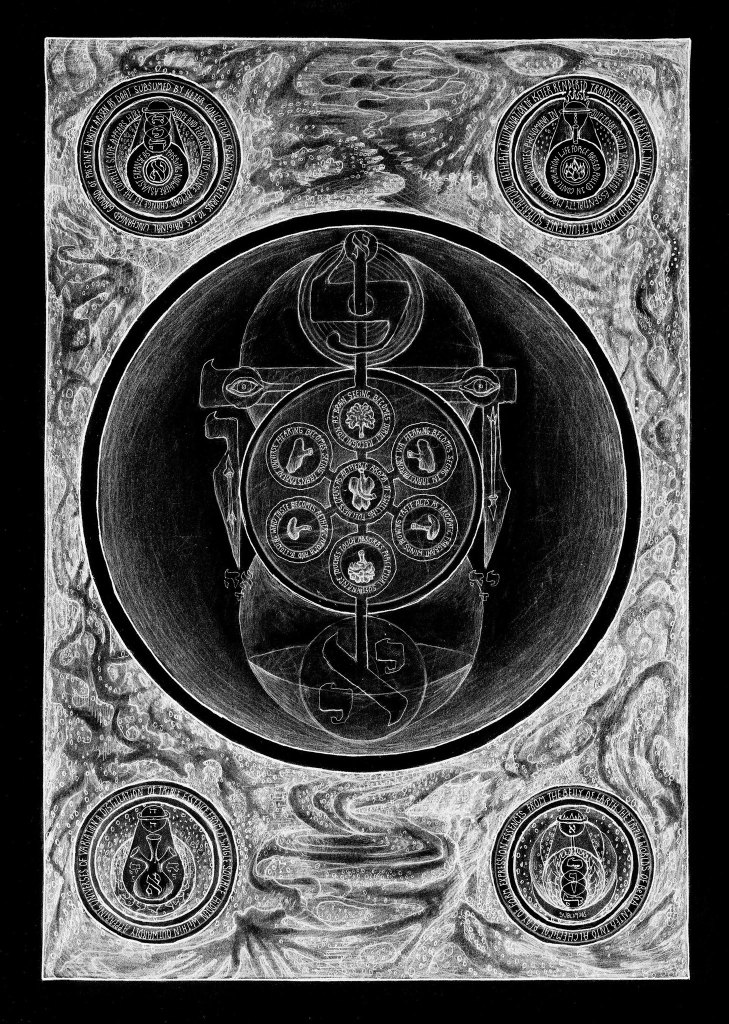
The appearance of Kundry, as well as her relative, the Vampire, even at the level of the Neophyte, can shake an Aspirant to such an extent that their entire progress is actually a result of such a tectonic disturbance within their soul in the first place. Even in the case of the complete absence of this appearance, which is not uncommon, it only shows that it is preparing its insidious attack later, lurking all the while and allowing the Aspirant to believe that they have even transcended this appearance through their great spiritual progress.
It is rare to find an exposition of an idea that simultaneously says so little about it, while thoughts and words spread everywhere around its essence. Such is the case with this chapter. This is a topic that is everything but what is usually assumed under it, not because it is abstract, but because its manifestation extends through the endless variety of this beautiful life. Moreover, contemplating this topic is, in fact, considering everything but the topic itself; its essence is primarily abstract, while its manifested form is its complete opposite. Whatever is said about it, everyone will, from their own experience, be able to derive a completely different, even opposing, viewpoint from what we might initially present here.
This is an entirely appropriate place to revisit some earlier observations about the Vampire, mentioned in the lesson for the Neophyte, which serve as a perfect introduction to the Zelator’s study of Kundry, given that the very essence of the Vampire idea is inseparably linked to the structure of Kundry:
“This whole set is an essential piece of guidelines on our direction; it seems that the Aspirant’s trajectory is already seriously threatening to leave under the auspices of the Earth. He is so confident in his journey, ending the ordeal and proclaiming himself “fit” after his one year of Probation. Having passed that period, the dreadful Great Mother had already bestowed significant threats and reprimands for her child, and now, it is time for her to make such a horrendous retaliation upon his soul for the first time, where he least expected it—his sexual energy. With a cunning trick, she will try to make the Aspirant leave the path of light, deploying her vicious debt collector—the Vampire.
What really is this dreadful being, and what is its nature? This, of course, requires such an elaborate presentation before we get into any gullible superstitions. Let us present the model with a very appropriate occurrence: the Aspirant has undergone the Ritual of the Pyramid, he feels empowered and guided by divine providence, he is separated from the Probation by one-year work full of devotion, he started the practice of writing a Diary as part of his life, he entered the Neophyte sphere vigorous and fresh, and by taking on a new motto, he was given a new and quite special destiny. In front of him are new practices and trials of Rising on the Planes–every day being a bath in light. However, then, one pleasant day, or even one more enjoyable night, during a walking break after meditating, he accidentally bumps into his high-school love–the one he has never forgotten and has always been dreaming of, beautiful and stunning. This might as well be the last enjoyable record in his Diary because immediately after that, there are hellish periods of emotional torture, erotic bacchanalia, crying, and sleepless nights. His Diary becomes completely neglected with the self-assurance that as soon as tomorrow, he will make up for the increasing number of Diary records he has been writing down on pieces of paper instead of a Diary. A complete haze in a magician’s consciousness is about to follow; days, weeks, and months of unconscious subsistence go by. Intoxication with all kinds of substances and all kinds of people often goes hand in hand with this phenomenon. Weeks pass like days, while days themselves are filled with endless emotional outbursts, or quite contrary, with complete ambivalence to everything. Once the Aspirant has finally woken up, he could find himself feeling that he has fallen lower than the worst day of his Probation and that it is quite impossible to move on. Yet, both of these claims are equally insane and unrealistic. This is just one of the mechanisms of Binah striking upon the Aspirant; there is an endless number of variants, while the goal is always one–halting the enthusiasm that has flowed so fruitfully through the Aspirant’s being, and the main culprit would almost always be the person who has come straight from hell
This occurrence is not a rare one, even in Probation, but a complete absence of all this is also quite possible. However, this absence seems to cause a similar problem later, and this phenomenon, like a tsunami, will grow as time goes on and reach Student’s secure harbors in their much crueler form. In the first case, it will hit him low but leave him standing on his feet. In the second case, the Aspirant will be left to build much more, and whatever he is allowed to do will be annihilated and devastated in such a cruel way. Loss is inevitable in any case, for it is the nature of every Aspirant to remain genuinely free of anything. The main question is how he will interpret such a phenomenon. Like forfeiture or profit? Is wasting time a profit or loss for the one waiting? Is life a gift or a curse for a chained man? Like the grades themselves, each occurrence is nothing but a measuring instrument for something we just expect will happen over time—the same time that has kept striking upon us from the early days of the Neophyte and all the way to the boundaries of the Abyss. Every perceived idea is an illusion because it has been perceived, and we rely on the rules that can be swept away by the morning breeze. Have all, and you shall lose all. Have nothing, and you will not lose a thing. Like a children’s song, this is a warning but also a superb instruction.”
The Vampire and his emissary, Kundry, are the being of the shadow, not just any shadow, but the Aspirant’s shadow. He will cunningly wait for the Neophyte to strengthen and widen his horizons; he does it so openly for the Vampire. Growing with his subtle body, his head will indeed be in the Heavens and his feet far on the Earth, but how large will the shadow be of such a huge structure? The Vampire has grown so much that it has led to a major eclipse. Growing toward the light, he covered the Sun. He will become over-satisfied with his own growth; he will praise himself more than his own Self, and yes—he will undoubtedly be on the messianic path. He will start taking on this stinking role and entice all weak Aspirants into it by manipulation, aggression, and intellectualization. By reading and mechanically quoting written works, translating millions of valuable and unworthy authors, learning and fully knowing every inch of Therion’s life, he loses his own. So many books and letters made him forget the name and the letter of his own Angel.
It seems that the Vampire is simply a failure of our thinking apparatus which, like an embarrassed mother when being told that they have caught her beloved smoking after school, replies: “Ah well it is not him, it is someone who looks like him because I know my son perfectly well and he does not do such things.” This is an inability to say the only thing of any value at that moment of new experiences, and more importantly, painful experiences— “thank you.”
It also seems possible that the Vampire is somewhat conditioned by the appearance of light while striking the Aspirant, that is, in the practical sense of the matter, as long as the Aspirant is in a grade which is under the influence of Binah. It would be wrong to say that this is limited to the Neophyte because the Great Mother controls her child even beyond the attainment of the Knowledge and Conversation. Although the cruelest form is found in the Neophyte times, it is somewhat difficult to assume that he is safe from the impact of this force once he has entered the grade of the Zelator. There is an additional and terrifying element in this mechanism, which tends to be an apocalyptic creation—that is, the Ritual of Passing Through the Tuat, which so treacherously awaits him at the end of his Neophyte path. It is hardly possible to say at all that there is an end to any superior experiences in our Order; they only take a different form, even to the level of complete transcendence, but both the Angel and the Abyss have their lackeys in almost all grades. Just because a full Knowledge and Conversation is realized at the level of Adeptus Minor, that does not mean that the same Conversation has not gone through some other Knowledge much earlier, as the same Angel has been present in every existing sense that the Aspirant has had since his birth. No Oath is limited by something like taking the next one. In fact, our whole life is just one single Oath, one single moment only. Everything that is experienced and everyone who is experiencing is always one and the same phenomenon, but we do postpone culmination in our Order to such an extent that it becomes genuinely unimportant, for the reason that we could be with the beloved Adonai for a moment longer, a day longer, the whole eternity longer. Let the Aspirant be free to think that the Vampire is only an aphrodisiac in the foreplay between him and Cosmos.
The exploration of the Vampire reaches its full significance in the laboratory of the Zelator. The Vampire, once it imprints itself through the symbolic bite of the Neophyte, becomes a focal point for the Zelator’s careful study. Through diligent and methodical observation, the Zelator begins to formulate the antidote, a remedy designed to transmute the effects of this initial wound into a tool for spiritual advancement. This will be further explored in the next chapter, where the idea of the Vampire will be complemented by the symbolism of the Moon, the natural habitat that readily embraces and provides a home for this being.
The Aspirant should always think that every relationship is merely a pale imitation of the authentic Tantra, which is the unity with the Angel. Even the relationship with the Superior has some of that imitation, and we must make sure to bring together any other relationship with that ultimate Oneness. As long as the Aspirant has this connection in his mind, any influence of Binah is insignificant. However, the Vampire shall strike the same mind, purging this sacred connection out of it in various ways, or else trying to dim its brilliance with other reflections, reintroducing new elements of temptation into an ever-changing flow that moves our sublime soul up to its ultimate estuary.
Binah will certainly try to hold you, the whole Universe will try to stop you as a good soldier responding to the orders of a great and ferocious mother. Your lower nature does not want anything for you; it does not seek illumination or anything to do with truth. Your lower nature wants you all for itself. Giving all for you while taking all from you. It is often the case that Neophyte loses various aspects of his life while in this grade, starting with material things such as loss of employment, place of residence, financial problems, deterioration of health, troubling emotional relationships, but also miscarriages, as well as physical injuries are just some of the instruments employed by his shadow. Yet, as long as the Aspirant finds discomfort in these words, he will be influenced by that same shadow, for it is nothing but the highest grace when we realize that the Aspirant’s soul does not really have anything to lose, as it has really nothing to gain. Such a harsh lesson is just an inappropriate and awkward way his soul tells him: “But I love you.”
The idea of Kundry, just like the idea of the Vampire, seemingly draws from the Aspirant’s sexuality; the intense erotic energy deep within the being serves only as a support or foundation for the change and assault that Binah strikes upon the Aspirant—so cruelly, insidiously, and, in many cases, tragically. In the end, Binah seeks precisely that event which is the pure projection of that theatrical construction— “in the end.” The rod of the Great Mother, for her restless child, represents that “end,” and in fact, it is entirely unfounded, because with the end of the Aspirant and his conclusion, it is also the end of his Binah, and the “Universe” as such. Therefore, it is the threat of the seemingly strict mother, who only bluffs at her offspring; she will never be able to use the instrument against the child, but she can instill in the child what will make them abandon their mischievous action—fear and neurosis. The cessation of Binah is the greatest achievement of Yoga, yet, since the being still exists in that phenomenal sense, such cessation would, instead of bringing blissful peak experiences, bring an atrocious curse and the most terrible sorrow, where such an end is perceived with melancholy, nostalgia, completely personally and fearfully—by the very being who, in that cessation, sees “their” end and the negative connotation of all that characterizes the Black Brother.
Binah, therefore, strikes the Aspirant where it believes it will manage to trap them in its web of illusion—through the idea of dying, cessation, finality, decay, and the end of his time, destroying his body, reminding them with a whisper in the moment of the sweetest, most passionate climax, and merging with the beloved person, of the holy mantra of the Great Sea: “Memento Mori,” completely destroying their bliss, returning them to the world of illusion and curse.
However, the Aspirant is so enchanted by the light of Tiphareth and the ray of life that this mantra is completely unreasonable from their perspective; they are born in light and life, so all the power radiating from the terrible Saturn remains for now to manifest through the field of sexuality, creating such a terrifying influence on the Aspirant that it diverts them from the path of light. Yet, the Aspirant must always, in every sense, understand that this mechanism is above all their own and completely human, and is part of the same nature that participated in the construction of their own consciousness and the structure of their being.
Such a blow from Binah, romantically speaking—like the “bite of the Vampire”—was in its most cruel form certainly present in the case of the Neophyte, but it is far from a mere assumption that it is absent in other grades. The form certainly changes, but the same idea remains present, and it is the stopping of the Aspirant in their progress toward Tiphareth, or the Sun of self-knowledge. This frictional movement, or stoppage, has nothing mythically evil or insidious about it. It is a self-destructive mechanism, which always, in every hand, originates exclusively from the Aspirant themselves.
The Aspirant’s mundane nature, their reactive mind, and their entire Ego are, in many spiritual systems, things that must be overcome or even—killed. However, Aspirants of our Order cultivate this sacred plant with devotion and diligence, investing all our energy into nurturing this delicate and subtle being. We pursue the understanding that Binah represents the embodiment of all our limited and finite processes, which cease to exist with the realization of two inevitable events. The first is death, while the second is enlightenment. Around both events, we have virtually no influence or any relationship based on anything other than superstition, imagination, or fantasy. As much as the bliss of enlightenment is something every spiritual system strives for, such an experience poses an unfathomable danger to the Ego, just like death. In fact, the idea of enlightenment is even more insidious for the Ego because, as the Aspirant’s body ages and moves closer to death with each passing second, they strive ever more toward enlightenment, eagerly rushing toward the source of all light like a moth or fly, seeing in all that light liberation. Yet, the Ego does not want any of that light because it cannot comprehend the nature of that enlightenment, in which it jealously observes the rival that diverts the Aspirant from what matters most to them—to eat, to live, and to carry out the biological processes for which they manifested in this world. Indeed, Binah does not want any of that light, not because it is bad, evil, or improper, but because it is fiercely and unconditionally concerned for its child.
The Ego does not want the light, only the Aspirant, to remain within the confines of its grasp. For it will do everything for the Aspirant, holding them in its protective cage from everything, allowing them to grow and flourish, while the Ego ensures that all is well. It will prepare everything in the house for the Aspirant, and in this house, it will make sure there is enough of everything, ensuring that its good child will never want to leave the sanctuary and venture into the outer world, where unknown values lurk. It is in these unknown values that the Ego finds its greatest adversary and will strike strongly and low, just to ensure that its child is adequately nourished and forever satisfied within the shelter of this house. This is the good old Mother, who does everything for her spoiled prince, and by doing everything for him, she drives everything away from him. Everything for him—she will cook his meals, make his bed, clean up after him, iron his clothes and shirts, just to make sure he stays with her forever within the house. Forever with her. This mechanism will construct everything so strongly in the Aspirant’s lucid dream, just as they could clearly study in the instruction about the Neophyte, where this mechanism is presented to the extreme as one of the strongest inner self-sustaining mechanisms in the Aspirant’s inner life, and one of the most remarkable things that will accompany them throughout their entire spiritual journey.
In this fantastic mechanism of control, manipulation, and pathological protection, Binah employs many means, where the seductive Kundry is just one of the generals in this terrible war, but undoubtedly the strongest and most important mechanism is fear, which is implanted in the Aspirant’s mind from the very first days of life. Fear of change, fear of the unknown, fear of darkness. In truth, this fear is never truly of the darkness, but of what the Aspirant expects to find in that darkness. In the absence of vision, the Ego can project what it fears most. This darkness thus becomes the perfect canvas and mold for creating personal horror, provoking the Ego to further push the Aspirant to stay in place, not to change, and remain in the house, waiting for their good mother to return from shopping—a command deeply ingrained in many of us since childhood. It is precisely when the being is young and alone—in this house, waiting for the return of the mother Binah, who has actually been standing at the door the whole time, bluffing that she has left, that the strongest mechanism in the life of the newborn being is activated—fear. Fear is the oldest and most potent lever of human neurosis, which, despite all the methods of manipulation and control over the conscious being, still contains one unit that this mechanism cannot calculate or grasp, one irrational value so weak and distant that it does not recognize it as a serious threat and thus does not attempt to destroy it—the idea of the Holy Guardian Angel. Fear is, in fact, one of the most important ingredients of the elixir of wisdom; it is precisely fear that creates the illusion of separation—an illusion the Angel masterfully employs, using the very dimensions of distance and arrival to draw near to the Aspirant and catch them unguarded with a divine kiss. This is a program within a program, which initially blocks the Aspirant and places them in a completely subordinate position relative to their Ego and Binah, the great protective and terrifying mother, but simultaneously polishes and sharpens the weapon that has no equal in the created Universe—Pure Will.
With its first breath in this confined world, the Aspirant already begins to feel that fear; a terrifying pressure on the soul, the sense that something is wrong, and the unbearable impression that they are straying from the path. And indeed, they are straying, but from the path of illusion and bondage, and it is precisely that change in direction that creates the distorted perception of going down the wrong way. The great and terrifying Mother, for now, only has threats and reprimands for her child, who is still uncertain on its feet. Certainly, the nature of a fragile being in the early years of life is fear and falling, but such falling exists for one reason alone—so that, in the moment of a Great Experiment, it may transform into flight.
We might say it is not the Aspirant who feels fear, but the ego—the Aspirant’s shadow, which is created by the Aspirant themselves. For the ego, it seems like a demonic apparition that relentlessly haunts them, entirely incapable of recognizing it as the consequence of the Aspirant’s presence in the light. But the Ego is so close to the Aspirant in its care, to the point that the Aspirant begins to mistake this fear as their own. In fact, fear is a completely impossible experience for the Self; it is a feeling entirely foreign to everything that is alive and created. Fear is never truly experienced because, if it were, even as an illusion, it would be illuminated by the light, which dispels darkness like mythic tales. Everything that is experienced, everything that is encountered, is illuminated by light, presence, knowledge, and understanding, and fear dissolves, vanishes, disappears, and loses its form in such a presence. The existence of fear points to the absence of awareness, which clumsily disguises itself in that feeling, projecting in front and within itself exactly what it lacks. Therefore, fear is the surname of love, because what frightens us is what we need most—broken through the lens of neurosis, like white light scattered into a spectrum of colors, with the color physically absent becoming visible. A red apple does not possess the red color; it absorbs all wavelengths of light except for red, which it reflects, and that is why our eye perceives it as red. The red apple essentially has all the other colors except the one that reaches our eye, which our Ego deems red—the color not of the apple, but the color that escaped from the apple, the color that refused to be the apple. It is the same with fear when viewed from the perspective of LVX. When the Ego perceives fear, it does not understand that what it sees as its own terror is nothing but the absence of what it needs, in the same way that the red apple is lacking the very red color, for if it had red, we would not perceive it as red. If the Ego truly understood what it fears, it would not feel fear.
Every fear we feel is, in fact, a projection of Binah, a signal that our internal compass has lost orientation—for now, the magnetic pole is not a point, but an all-encompassing field, everywhere around us. The Angel stands before us, yet we look all around, anywhere but directly in front of us. The Angel is like that red apple, in which all things exist, but not us. All things are sublimated in it, but we have rejected it, and now our Self sees the outlines of the Angel, unable to see itself. All the fears that exist are all those colors and wavelengths that remained on the apple. There is only one that was rejected, and which we can perceive—the fear of light.
The Aspirant may believe that everything standing in their way, all the fate of their fall, is hidden in darkness. Yet, the true obstacle lies in the fear of light, which is, in fact, the fear of their own inadequacy and ignorance. There are no hidden judges or prosecutors in this place, no conspirators blocking justice, nor forces preventing us from realizing our true nature. The only blockade is one we create ourselves. It is the fear of light that keeps the Aspirant from their achievement—the fear of who we truly are and what we are afraid to become.
Equally, both light and darkness cause blindness, but again, an equally different kind of fear. In the darkness, we are afraid of what may be hidden within it, projecting our own fears onto it. We cannot even see what is truly unseen, yet we are still afraid of what we do not know is there, even as we imagine what it should be. But the fear of light is the worst of all fears; in fact, it is one single fear, for fear, in its essence, is always the same—the inability to face the light without turning away, for in turning our gaze, we turn ourselves into darkness. In that glorious darkness, we project once more what we fear, having first turned away from that blinding, radiant, blessed, and living light.
In fact, the moment the Aspirant enters the light, that moment becomes light forever and everywhere, without any concept of day or night—which exclusively and only exists on the planet that revolves around stars and whose personal, subjective atmosphere breaks the rays of that star into what we call the blueness of the sky. And from that moment, the Aspirant is already realized in that light; everything else is a matter of infinite distance that this light must “reach” and with delayed reaction, transfer this Gnosis. Therefore, the Vampire and Kundry are merely the result of the late arrival of that light, that enlightened “now” in parts of the Universe that require time to perceive this bliss as a delayed event, delayed precisely because they are distant from that event in space-time. In reality, the Aspirant was never on the path of light. They have always been in the light, they are always the light, they are always only the light.
As we have previously stated, our reactive mind observes enlightenment in the same way it observes death; it has no understanding of either concept and, in the same way, both ideas represent its end. For, inevitably, enlightenment is indeed the death of the ego, which, by dying and ceasing to exist, believes that the Aspirant will also die, and it will protect it until the last atom of strength, until the last second of survival, until the last drop of blood. Unfortunately, to the last atom of strength and to the last drop of the Aspirant’s blood, causing more harm to the Aspirant and, consequently, to itself. However, there exists another archetype of “completion” and “end” in the life of the Aspirant, which in its idea is indeed close to death, as it is limitedly understood by human nature—and that is orgasm. Is not “Osiris slain” and “Osiris resurrected” within the grand IAO formula, in fact, the flaccid phallus and the phallus in erection?
Just as the Neophyte, under the direct influence of Binah through the path of The Universe and their earthly nature, often faced the specter of physical death, and with it the notions of dying, destruction, and decay, the Zelator now channels the same force through a slightly different lens: that of the Moon and The High Priestess. It is through this very assault, mediated by the sexual drive and cloaked in the guise of spirituality, that the ideal magical elixir is crafted by their Shadow. The only remaining question is how, and through what cunning, the Aspirant will fall—and drink the poison.
Such is the exquisite connection between Eros, Thanatos, and Hypnos in the life of a Zelator; their intertwining is, in fact, the gymnastics of divine aspects, which, through their twisting and variations, skillfully present themselves to our mind, making it believe that they are destined only for it, tempting it with their lust and pleasure to the point that every individual soul gets the impression that it has been given by the gods the moment such a force manifests before them. We will certainly discuss this relationship in more detail later.
We must not rigidly perceive such an abstract phenomenon as Kundry. As a proxy of Binah and an accomplice of the Vampire, who represents rigidity and inertia, she has a completely opposite manifestation when supported by human neurosis. With it, she becomes alive, potent, and flexible, like the blood from which the Vampire draws vitality to rise from the grave’s darkness and now strike so fiercely and lethally.
Even in the faintest appearance of Kundry in the form of a priestess, many Aspirants will perceive the fulfillment of their dreams, prayers, and longings. But certainly, in every sense, this is fertile ground for cultivating Binah’s weed, which will stop the Zelator’s progress toward becoming a lively and flexible Practicus. Rather than gliding freely, it will once again entangle them in the weed of emotions, possessiveness, and energy loss—the very things they once openly had as a Neophyte. Through this weed, they will stumble over their own feet, unable to see the path at all, moving chaotically in all directions, avoiding the tangled weed instead of following the true path. They will move in broken lines, often returning to where they started, wasting time and energy. Here, the devoted partner is but a facade for diverting from the path of light; here, it is a radiant lure with which the Aspirant’s soul is caught, leading equally into the shadowed passages of their potent instincts, where the calm river of thoughts transforms into the untamed rush of the ocean, in which their solar boat will be left at the mercy of erratic waves, completely impossible to control or anchor.
Certainly, I must say that the idea of Kundry in the case of the Zelator does not necessarily have an erotic nature, as was the case with the Neophyte. Here, it is more like an airy longing, a hope, and a projection that anchors itself in the future—like a gentle breeze we turn to on a scorching summer day, smiling and closing our eyes as it caresses our sweaty cheeks. We enjoy its touch, unaware that it is but a sign of the terrifying hurricane in the distance.
Thus, the Zelator may encounter and gain a completely new friend with whom, to their own astonishment, they will discover a spiritual resonance. From this relationship, a desire to explore sex magick will gradually emerge within them. The idea will start to consume their thoughts—in contrast to the Neophyte, where such an idea would undermine their life force, here it transforms into a virus that undermines their intellectual apparatus. Their previously stable and clearly directed training slowly begins to deform, subtly shifting toward preparations for tantric practice that exists only in their imagination, similar to adolescent fantasies. Soon, their mind finds a way to elevate their own weakness to the level of discipline. Feeling the call for inner transformation, they will dedicate themselves to studying esoteric literature on Tantra, obsessively reading rare and obscure texts that will convince them they are on the brink of revelation, performing fewer established and prescribed practices, increasingly working and losing themselves in the labyrinth of tantric fantasy. The pages of ancient texts will become mirrors in which they will not only see confirmation of their own desires but also justification for them—hidden keys to what they instinctively seek. The intoxicating idea that they are not just an ordinary Aspirant, but an authentic initiate, will grow within them like a poisonous plant that feeds on its own roots. In the new friendship, they will increasingly sense the call to Tantra, and in this unfulfilled Tantra, the desire for a physical union will arise. Gradually, they will convince themselves that their encounter is a divine reward for their efforts, a sign of their spiritual elevation. To reinforce their illusion, they will begin to shape themselves into the figure of a tantric master—speaking in enigmatic metaphors, interpreting the meanings of words that were unfamiliar to them only yesterday, carefully rehearsing the tone of their voice, all in order to become in the eyes of their new female companion, a hierophant and exalted initiate. In their own mind, they will become less human and more of a spiritual guide whose mission is to lead her into the mysteries. She will take on the form of the ideal priestess, devoid of any earthly passion—but only seemingly so. Their longing will initially seem sublime, yet at its core, it will pulse with a pure erotic drive, disguised as spiritual ecstasy. The more they build their own facade, the more the essence will elude them. It will take considerable time before they lose their friend, simultaneously extinguishing any possibility for the deceptive tantric game and for any physical union. And so, instead of carefully nurturing two plants, with one unconscious step, they will choke both. One will be left exposed for too long under the sun’s rays, subjected to the scorching heat of an infected sexual instinct, which will burn and wither it in that flame. The other, on the other hand, will be overwatered, losing balance in the obsessive drive to learn and practice, transforming into something it is not, trying to create an image that others expect instead of truly evolving.
Events may take an entirely different turn. The Zelator might become so absorbed in study and the pursuit of new knowledge, particularly history and an endless stream of unverified half-truths and distortions, that they neglect the vital thread of their practice. As their thirst for learning deepens, their practice may wither, overshadowed by ever more exotic and questionable claims. In this relentless quest for the novel and intriguing, they may readily embrace unverified information, drawn to anything that momentarily appeases the hunger of their restless mind. Their sexual energy, once potent and transformative, is now entirely repressed beneath layers of intellectual fluttering. The impact of Binah and Kundry on the Neophyte was purely energetic, raw, and deeply connected to primordial feelings and sexuality, while for the Zelator, it takes on a subtler, more social, and rational form, linking itself to everyday, mundane matters. It will not be long before, having veered into intellectualizing and exalting historical dilemmas—such as whether Liber Resh perhaps had a counterpart in the practice of Liber Qoph, the adoration of the Moon, which was written first, which is superior and more effective—they will suddenly find an opportunity for professional advancement, academic development, or moving to another country for an extended period. At that moment, the Zelator might experience a strong illusion and a call of their nature in something completely unexpected, in something that seems foreign and incompatible with their previous path. Drawn by sudden, seemingly random opportunities, they temporarily set aside their inner work, convinced it is but a brief detour for the sake of new responsibilities. Yet, the change in life circumstances brings with it a change in inner perspective, and the balance of spiritual practice becomes increasingly difficult to maintain. Moving to the other side of the world, adjusting to a new city, new friends, new loves—everything becomes new, different. And in this endless effort to settle down and build stability in the new life, they fail to notice that Binah has already extended its tendrils, imperceptibly erasing their sense of time, for it is here that Binah as Saturn, the silent arbiter and sovereign of time itself, reigns supreme. Kundry holds no place here, for the simple reason that the spiritual path has vanished. Time will not merely pass—it will evaporate into an entire lifetime spent in that neurotic and illusory “preparation,” before they finally return to their practices and inner quests. And when they finally return to the path, they will be shocked to realize that the body, which “just yesterday” could spend an hour in lotus position, now winces with pain after barely fifteen minutes in half-lotus. It is no longer the same body, nor are the circumstances the same—circumstances they have unconsciously summoned into their life. The Zelator is always departing, but never arrives. They are in constant motion, while the Neophyte has already arrived, but now does not know what comes next. The Zelator will develop a desire to travel the world, to explore new cultures and knowledge, but through all these shifts and journeys, they are merely retreating, avoiding the encounter with that one single truth that awaits them, to which they will devote themselves during their withdrawal in the pursuit of Knowledge and Conversation. They will suddenly set off on a journey, full of enthusiasm and expectations, but with an unrealistic readiness to face both the arduous journey and the depressing destination, so passionately desiring to return home—that very home which, had they not embarked on that long journey, they would not have turned to so fervently. They will constantly undertake wanderings, only to think more about their dwelling, their home, warm and beautiful.
The third case removes the presence of any spirituality and physical Kundry in any way. In this case, there is also an intoxication with intellectual work and the neglect of the sexual nature, which only seemingly contradicts the provocation of the Vampire. The bite of the Vampire does not only represent an attack and excess of sexual energy—it also represents its absence. The Aspirant, therefore, instead of being intoxicated by nights of revelry and the full energetic charge of obsessive relationships, now spends these same nights reading, studying, comparing, rewriting, falsifying history—both his own and others’—archiving, organizing files and folders, obsessively making backups, trembling at the thought of losing all these highly crafted phantasmagorias. Reading literature that surpasses their current grade, records of others’ practices in which they see failure and weakness, they suffer the same seductive attack as they would from Kundry herself. For this, too, is her voice—whispering and enchanting from all those footnotes and hidden folders. Thus, they waste time, as this is the one true weapon in Binah’s arsenal, to which the Aspirant still cannot match. In their research of lucid dreaming, during that battle against the idea of time, they clearly saw, even as a Neophyte, that each instant in the astral realm is, in truth, a struggle to resist the pull of waking. How every moment in the astral realm is truly a battle against time, with the sly mechanism of returning to wakefulness, which their reactive nature will constantly threaten them with—far from elemental spirits, silver chords, or occult phenomena that books are full of. As time flows in the astral plane, each subsequent moment in a lucid dream carries the danger of the Aspirant losing themselves in the dream scenario, utterly forgetting that they are dreaming, becoming fascinated by side lights, beautiful creatures, astral landscapes that have no equal in their divine colors, angelic luminescence, and radiance that is so otherworldly, enticing in its fantastic nature, poisoning their mind so that they, marveling and admiring such creations, forget entirely that they are dreaming and the very purpose they entered lucid dreaming in the first place. Forgetting that all these divine creations happening now were long ago created by them in that brilliant amphitheater of their mind—in the lucid dream. Now, as the Zelator, this same time poisons their progress in the real world, and in the sphere of Malkuth, equally giving them the aspect of delusion and forgetfulness, a misdirection in course and an oversight in navigation, which will, imperceptibly, over time, divert them by at least half a degree of course, but which, on the long, infinitely long journey Binah will set them on, will result in a misdirection of thousands of miles.
The next scenario involves a more concrete, embodied aspect of Kundry, but one that affects the Zelator more than any external person. The Zelator will begin a relationship with someone they fall deeply in love with, and the two will fall into such a fervor of love and devotion that, at one point, their partner will begin to open up and share their entire life. At that moment, the Zelator will begin, like a prince, to be the keeper of all their partner’s secrets, a protector who will help them overcome every wound from the past. The Zelator will learn many things and difficulties their partner faces, which still linger from earlier experiences, but will steadfastly endure all of it and help them navigate through it. First, there were illnesses, then problems with work, money, family who misunderstand and reject—the Zelator will accompany them through every trial, always there to listen and offer support. The partner will grow even more attached, opening up more and more. Finally, the partner reveals their greatest life problem, whether it be a parent who abused them, or perhaps an ex-lover who was aggressive, or perhaps something less severe, a trait that left deep marks. And then, Kundry enters—not through the beloved, but within the Aspirant—in the form of fear that they may become like that parent or ex, because secretly, they know they carry a trace of that same character, which so deeply affected the one they love. And then, fearing they will become like that, thinking about it constantly. The more they fear it, the more they reflect upon it, the more they summon it forth. And, in fearing they will become like the abusive figure, through the insidious workings of the mind, they gradually transform into something ever more similar to that figure, leading to an emotional catastrophe, and the collapse of the romantic relationship in the worst possible way. Their mind could not contend with fear; it was not suited for phantasmagoria, but craved a person—not an idea, but a tangible opponent whom the Zelator could confront with courage. And in that deep desire to find and create such an enemy, the mind ultimately does just that—turning itself into that very adversary.
In all aspects and cases, the idea of Kundry cannot be separated from the idea of Binah, that vast, dark, turbulent sea, but also enlightenment and the very essence of the Holy Guardian Angel. All of them are spies in the service of Her Majesty, the great Goddess Nuit, in which we are all the same children and the product of the same good old love, expressed in infinitely different ways and forms. But, is everything merely one single thing expressed through different aspects, or is it a handful of different and separate things expressed in a singular way? Our life is a performance with no pre-determined genre, in which we are all equally both the main actors and the background figures. However, the plot is always, and in the same way, just one—and that is the bliss of Oneness, not unity. Kundry, by her nature, perhaps warns our imperfect mind that the Angel despises Yoga; and that the Aspirant, seeking a partner to become one, actually falls into a cosmic loop and makes a mockery of the masterpiece of the great architect who is himself inseparable from everything. Indeed, the Angel hates the path of Yoga, as it needs neither another nor two to be one with itself. It is possible that Kundry is a warning from Binah about the bitter lesson we pay for throughout our lives—that we are not separate, not because we are something greater, but because we are not. I, you, we—cannot be joined, because we were never apart. And as concepts, they have nothing to do with what we call the Selfhood. We imagine the Angel as winged or radiant only because we imagine it at all, endowing it with attributes—yet as an idea, it is entirely beyond any conceptual framework. Perhaps Kundry is indeed a salvation, one that veils our childish nature and strictly returns it to its cosmic province, where it rightly belongs, lonely and self-sufficient. Perhaps in that cosmic darkness, the nature of truth lies in the absence of light, not because we wouldn’t see if there was nothing else but us, but precisely because we would see that, in fact, there is no us.
A student of our Academy should be aware that the appearance of Kundry is not limited to certain grades, nor is every influence of hers one-sided or uniform. An Aspirant does not necessarily have to be a Zelator to experience a manifestation of Kundry characteristic of that grade, as previously explained. Experiences are interconnected and often confused, like intertwined threads of light that starry children play with, sometimes unintentionally making knots. Sometimes certain experiences repeat, sometimes they are entirely absent, sometimes something from the end appears at the beginning, sometimes something that happens to no one else stubbornly repeats in our case. It is nearly impossible to perceive Kundry through the lens of the Vampire filter, just as it is to consider the Vampire through the nature of Kundry. These are relatives of close kin, but as it often happens with relatives, they are mortally similar yet often mortally different, even completely opposite and conflicted.
Finally, we may come to realize that the true subject of this chapter is by no means Kundry, nor the physical manifestation of the Vampire, but rather something that such a being causes and why it is actually where it is–and that is the idea and concept of distraction, or deviation from the path, and not just any path, but the one destined, the spiritual path that one only walks once and which lasts only one eternity. The phenomenon of straying from the path represents the key theme that should be addressed; the Vampire is nothing more than a sketch in the cabaret of the Holy Guardian Angel, a street magician whose trick the Zelator begins to uncover.
Slowly but surely, realizing that the actions of the Vampire are a particular kind of illusion, merely a consequence of distorted attention and limited, clouded perspective—a mirage on the path toward the Sun—the Zelator will begin to reevaluate the entire program and question the ideas that serve as the cornerstones of our work. By engaging in the Great Work, that work shrinks, becoming more manageable, more attainable, while the dwarf Self grows ever larger. The Zelator comes to the realization that all dimensions and achievements are merely descriptions of something far simpler, closer, and more natural, and that they hold nothing occult, esoteric, supernatural, or mysterious within them. The Aspirant will finally come to understand the principle of our Order: “mystery is the enemy of truth,” and will begin, quite seriously, not to uncover truth, but to strip away the mystery. Such an Aspirant uncovers nothing new; rather, they turn what was declared mysterious into the obvious. This is the task awaiting the Zelator—not a journey into the unknown, but quite the opposite—a journey into familiar territory, but under entirely different circumstances, bathed in a completely new light, free from embellishments, exaggerations, or old wives’ tales. The Zelator will not be awed by ancient castles at midnight, fearing every dark corner, not in the least. The Zelator will enter the dark corridors in broad daylight, after a festive lunch, and will see them as faded, pale replicas of the terrifying and ghostly atmosphere of the night before, transforming it into an afternoon chillout, the atmosphere of a most pleasant and relaxing matinee. It is the same way we, as children, would mute the sound of horror movies and play something utterly entertaining in the background, destroying the magic of horror and transforming the entire movie into something completely opposite—comical and amusing. This is, in the end, what the Zelator seeks—a task of debunking, not discovering. Debunking, not discovering.
Any deviation from the path is a possible trajectory that leads to the goal. In fact, the Zelator cannot find or miss the right path, but rather create it from a random or even completely wrong one. The Zelator cannot stray from the path even if they wanted to, because the path they are on is the same everywhere, as neither the determination nor the goal has any descriptive or quantitative character in our experience. From the standpoint of the manifested Universe, it is easier to consider that the goal, as such, does not exist.
Perhaps the most fitting description of the path walked by the Aspirant of this grade is presented in the magnificent dialogue from the book Alice in Wonderland. In the familiar and enchanting tale by Lewis Carroll, Alice curiously asked the Cheshire Cat: “Would you tell me, please, which way I ought to go from here?” “That depends a good deal on where you want to get to,” said the Cat. “I don’t much care where—” said Alice. “Then it doesn’t matter which way you go,” said the Cat.
This specific perspective on the spiritual path, a peculiar strategy in the construct of the journey toward the stars, was presented in a very similar manner earlier, in my exposition for the Probationer—I deeply believe that the following paragraph best defines such an attitude and way of thinking:
“When a new park is being built in the United Kingdom, designing an ideal walking path represents art, but also a serious and responsible venture. But they have found a way that perfectly shows where the path should be paved. At first, they plant grass everywhere without a single mark, letting the people walk their own way. After one season, where the highest number of stamped traces can be found and where the grass is most embedded, there they simply set the marked path. The Superior is not there to make the path for the Student; he is there only to pave what the Student has already crossed, reminding him of the length of that path, once the Student tiredly turns back.”
Let us, therefore, define the true state of affairs: a Zelator is not expected to find or follow the correct path, but rather to deliberately deviate from it, to dare and venture into the unknown, trusting solely in their instincts, following their own nose, and nothing more. Above all, they establish an equally authentic model of thinking that characterizes the entire plane of Ruach: they will think carefully before they begin to think.
All we can say now is that the path, the trajectory, and even the entire structure of grades and spiritual ascent are nothing but projections of Binah and the Abyss—reflections the Aspirant begins to shape from the very moment the Universe itself came into being. By passing through the ritual of the Pyramid and establishing themselves as “fittable,” entering the path of the Neophyte, the Aspirant has acquired a remarkable companion who will accompany them through the grades for a long time—this is the shadow of Binah—which takes many forms and many vehicles, and one of them is undoubtedly the most destructive for the Aspirant—Kundry. With the emergence of true light, the Aspirant also receives a shadow, which is only a reflection of themselves, a shadow that will accompany them throughout their entire journey. The movement of the shadow is nothing other than the result of their position in relation to the eternal LUX, the movement and reach toward that light. This is their action and movement that leads to the motion of that very shadow, which now follows them closely, creating the illusion that it is chasing them. In fact, it is the same entity—the one that follows the light and the one that creates the shadow, and in time, they will come to recognize that both are equally empty entities.
Kundry is merely one of Nephesh’s vehicles, much like the Vampire. Such a vehicle carries none of the moral or ethical concerns that can be so detrimental to the Zelator’s work and reflections on sex magick. These vehicles resemble a roller coaster—an amusement park where the Aspirant’s soul seeks both pleasure and fear. And, as with any amusement park, there is always a price to pay. The Aspirant has paid dearly for admission but has forgotten that the entire park is safe and, above all, designed to entertain. Entering the park is a choice to embrace the experience, yet the resolve to ride feels one way on solid ground at the entrance and quite another when the ride begins. Whether Kundry or the Vampire, a vehicle of Nephesh exists to heighten the ride’s intensity—to shake the passenger and stir the fear that must pervade the entire journey. Yet no matter how terrifying the ride may seem, it inevitably ends. And the moment it stops, all fear and uncertainty vanish. There is nothing inherently good or bad in the vehicle itself or in the ride it offers. It always begins with fear but concludes with a rush of delight once the motion ceases. The entire purpose of paying for the ticket and stepping onto that devilish roller coaster is to surrender to the thrill, to enjoy the ride while being afraid. These two sensations are inseparable. Fear amplifies enjoyment, and the pleasure of the experience invites a return for yet another ride. Neither Kundry nor the Vampire should be viewed as inherently evil, dangerous, or harmful. Just as the amusement park of the soul is not defined by fear alone, these vehicles hold more than mere danger. For those bold enough to return to this fairground over and over again, a deeper, more electric form of joy awaits—one born not despite of fear, but through it.
Nephesh is thus a favored and well-suited battlefield or theater of operations for the structure of Binah. Among all the swamps, highlands, mountain peaks, or lowlands that are suitable for battle, Nephesh is the preferred terrain for Binah’s war, which will always surprise us with its landscape. Our strategy will never be fully prepared in advance; our army will always have the element of surprise, which will catch the enemy off guard. Just as Binah’s attack in open warfare is characteristic of the Neophyte, so it will transform into a covert and cold war game in the case of the Zelator. What was once an energy diversion for the Neophyte now becomes a deviation from the path for the Zelator.
Such a delicate idea as deviation, such an intricate concept of divergence, is of vital significance in the experiences of astral projection and, most notably, lucid dreaming, which the Aspirant has witnessed so vividly as a Neophyte. Once again, it becomes necessary to call upon the intense compulsion of the reactive mind, which, during every moment of lucid dreaming, will seize every opportunity to pull the Aspirant back into the realm of ordinary sleep. At any given moment, the practitioner may lose the thread of awareness and slip into the unconsciousness of the dream’s content. At one moment, they will be fully immersed in a clear vision around them, astonished by the power of their own awareness and concentration. Everything will seem so easy; they will not only recognize they are dreaming, but they will remain vividly conscious of everything awaiting them in the waking world. Then, at one moment, in the corner of their vision, they will notice a familiar neighbor calling and waving. The Aspirant hesitates, their attention drawn toward this seemingly harmless presence—a phantom distraction, projected by their own shadow, with subtle cunning meant to deceive. They will approach, inquire, and the neighbor will insist they follow, urgently explaining there has been a flood in the house and they are needed. Shortly after that, everything will be obscured by forgetfulness and unconsciousness. The Aspirant will fall asleep and sink back into the embrace and control of their own dream, ceasing to be an active participant and creator of the lucid experience, and instead becoming merely a passive observer on the stage of their reactive mind, silently playing in their room as their strict mother commands. This is why the Aspirant must constantly strengthen the dream, infuse clarity into the vision, and maintain focus so that they do not fall into a deep sleep, forgetting they are dreaming, as has already been thoroughly explained in the instructions for the Neophyte.
The Zelator, during their grade, should contemplate the idea of the path—both the idea of the right and wrong path, as well as the side path. The Zelator knows that their true achievement is not at the destination, but in the journey. Whether or not they reach the destination does not diminish the significance of the voyage itself. For it is upon the winding detours that the hero’s true adventures are born, and once the destination is attained, the tale concludes—the final page is turned. But everything that happens along the way is the saga that is retold. The Zelator is on no path, but rather on a journey—they do not arrive nor yearn to arrive; instead, they wish to stay on the journey as long as possible and see as many wonders as they can.
The construct of such a special path, the byway, the side road, holds particular significance in our quest—because, starting from this perspective, every side path becomes the true place of expression for the predetermined destiny, the one that has slipped away from the expected, well-trodden path from the very beginning. Such a byway, this deviation from the route, thus becomes more important than the final destination itself. In like fashion, each irregular Masonic lodge offers far more to the Freemason who seeks depth beyond the dull rhythm of routine—those evenings dimmed by ceaseless recognitions, white banquets, the pinning of badges, and rituals stripped of essence. It is always the mistress to whom we open ourselves more than to our own wife, and the gifts and dinners are more colorful, more attractive, longer sought, and chosen with greater care. Yet, it is the wife to whom we always return, while the mistress is a fleeting presence. Speaking of kindred adventures, the purpose of the night lady is not in pleasure, not in the least. That is not what you pay her for—God forbid. You do not pay her to come, you pay her so that she may leave—silently, without words, without agreements, promises, without plans.
Our growth does not lie in the path, but in the deviation from it, willingly and joyfully. The path itself is dull, already mapped out and predictable. But in that blank corner of the map, where no lines are drawn and no guidance offered, lies the sparkling mist that lures and calls us. And our very being smiles at the sight of it—for it is there, within that mist, where strange can happen.
“Strange things,” such a charming phrase. At first glance, it appears foreign and untrustworthy, yet it draws our gaze for precisely the opposite reason—because in it, the being recognizes what is solitary and intimately known. The nature of being is to be strange; in this unfamiliar byway, it perceives a path already illumined and familiar, for it is composed of the very bricks of such a road—chaotically piled, interrupted by emptiness, bypassing cities and squares, slipping beneath bridges, through dark forests, forsaken tunnels, and winding curves of darkness. In this grade, everything is the opposite—this is the nature of the Moon and the Cup, in which the light we strive for is reflected. Every side path is actually the road we should have taken from the beginning. This very feeling of “strange,” yet equally alluring, is the signal to our being that this is indeed the path—we have already crossed it long ago. The side path is not a second path, nor a wrong one, not at all. The side path is something much closer and more intimate; it is the path already taken, long forgotten. The mystery in our Order is revelation, and the work on the grades—a souvenir of Knowledge and Conversation, a remembrance that we once Knew and once Conversed.
The Zelator often encounters a peculiar sense of déjà vu, recognizing in this detour something deeply familiar. An idea emerges in their mind: the supreme experience they seek—Knowledge and Conversation of the Holy Guardian Angel—is, in reality, a mysterious enigma, much like a nursery rhyme with hidden meaning. It is a reminder of something that never occurred, a paradox that, because it has never been, cannot provide a resolution. For it is unreachable; it was never meant to be attained. Achievement, as a concept, finds no refuge in the experience we cleverly term the Knowledge and Conversation, much like children who vainly gaze at a rainbow, expecting to reach its end. The rainbow was never meant to be touched; it will forever elude the observer, always projecting ahead. Its existence is not meant to be “here” but “there.” There is no treasure beneath the rainbow, just a winding lie that propels us forward, far ahead, infinitely ahead, just enough to forget where we started and why. Only by forgetting the destination and the senseless reason for the journey can we arrive somewhere. This place will always be Neverland, simply because we have forgotten that concept, which can now denote any city, town, or village. By forgetting the name of a destination that does not exist, we forget that it does not exist as well, far beyond the seven seas and seven mountains, for a child who does not know how to count, every place becomes such a destination. Only the child knows the secret that Neverland is the name they give to the path, not the destination. The experience of Knowledge and Conversation is the ultimate phenomenon of the moment and the true nature of time, bearing no connection to occult exercises, techniques, or anything pertaining to spiritual training. Indeed, strange and wonderful things can happen on such a path. Finding Neverland.
But what kind of practical analogies can there be for one Zelator?
They must make a sincere effort to notice and carefully observe the tendency of the side path in exploring astral visions, where this phenomenon will be clearly present throughout. In every vision, however exalted, there will always be an element of lesser prominence that, by its color, shape, or meaning, draws the Aspirant’s attention. Instead of focusing on the intelligence before them and retaining everything it conveys—words, movements, even the color and appearance of the garments the intelligence is adorned in—while listening attentively to the words of wisdom from the summoned force in front of them, the Aspirant may notice behind it, in the distant branches of a tree, a raven. And only now, in the pale reflection of the vision in their eye, in a distance so great that it could not initially be perceived, will they see that this black, ominous creature resides in the tree right above the body, which they now see lying beneath. At this moment, their attention already projects expectation, and they direct energy into that direction of the vision, and now the Aspirant notices that the body, which lies dead beneath the raven, at the foot of the large dry tree, is in fact themselves. And now, all the meaning and purpose of the vision shifts from one genre to another, from one storyline to another, completely insidiously. But it always happens in just one way—this deviation requires the Will and attention of the magician; without diverting their gaze and focus, none of this side path could infect the vision. Indeed, they must always know—not just know, but now the Zelator must feel and follow the flow of that feeling, which brings them, like the tide, the certainty that both the intelligence, the raven, and that body are but strands in the hair of their Angel. These are their marvelous creations, their own fabrications, and all of them are equally marionettes animated by the same light. They must deeply understand: just as the distraction toward the raven is a clear example of divergence, so too is the overly devout and rigid fixation on the summoned intelligence a kind of detour in itself—one that often leads nowhere, merely circling around familiar knowledge they already possess. Instead of acquiring new knowledge, it solidifies old preconceptions and cements old delusions.
As long as their Will does not encompass the whole in all possible and impossible circumstances and potentials, their impression is doomed in advance to divert them, for it is equally a false sensual creation. There is no sense or experience that does not inherently distort itself; this is the realization that an Aspirant of our Order must always keep in mind. As long as it does not pertain to Knowledge and Conversation, every experience and action is an act of Black Magic, conjuring sorrow and suffering as understood by our Buddhist siblings. For a person to learn and discover something from someone, they must listen and direct their attention to the one speaking to them, ceasing to do everything else except listen. But in Knowledge and Conversation, it is different—this is the only Knowledge that is gained precisely while we converse and speak, because, all the while, we are speaking with ourselves. It is a supreme carnival scam, a con game of the Universe, which has nothing to do with dark sorceries or ridiculous occult skills. Such an act is closer to the turning of a bicycle pedal than all the rituals and mystical practices combined. It is precisely our inability to understand the ease of this scam and our senseless tendency to believe that such an act can or cannot be performed that leads us to our defeat and inability to perform it in the only way possible. By ourselves.
Furthermore, we have already mentioned the terrifying force that perpetually prevents the maintenance of a lucid dream, expelling the magician’s awareness from the lucid experience like a thorn or some foreign object within the body. This force is so powerful that, over the course of my thirty years of lucid experiences, I have rarely had more than a few projections in which this element was absent, and in which the lucid dream unfolded without slowing down or the need for the vision to be strengthened and crystallized. There is a supreme trick, or rather, a region of dream, in which the tendency and constant danger of returning to the physical body is absent—and that is the projection of our astral body into the Inner Temple—a special part of the astral plane reached by using the phenomenon of fake memory. There are tricks that prevent a return to the physical body, but it must be said that from the very first seconds upon finding oneself in a lucid dream, the Aspirant is relentlessly assailed by this force, much like a body near the Earth endures the continuous pull of gravity, inexorably drawn toward it. In the case of a lucid dream, there is simply no way to fully bypass this force, and more than anything in the lucid dream, the Aspirant is a victim of the constant struggle to maintain the astral body and to expand their experience for as long as possible. Without knowing the clever tricks we outlined in my previous book, the Aspirant may spend years trying without succeeding in staying in a lucid dream for more than a few minutes, and the vast majority of the time, for far less—merely a few fleeting seconds. As with the practice of the Inner Temple and the use of fake memory, this will be elaborated upon in greater detail later in the book.
Moreover, the practice of Asana and Pranayama must never be reduced to the blind repetition of outdated and obsolete exercises that have no true connection to what a Zelator should be doing. In this context, the concept of deviation lies precisely in abandoning these misguided paths, choosing, instead, to consciously stray from such rigid routes toward exercises that are vibrant, purposeful, and, above all, yield tangible results rather than empty speculation.
Asana, in and of itself, is entirely meaningless unless it is understood that it is not the position that matters, but the stillness. I have observed practitioners who, for decades, measure angles and body tilts, discuss Chakras, and the proper times of day or evening to sit, even spending months considering the directions of the world to face when sitting, yet they are truly unable to sit motionless and without pain or discomfort for an hour, achieving the phenomenon of a stone statue and automatic rigidity in the body. Working with the body as such is an entirely different category of practice than working with Asana, which, although it involves physical work, is by no means restricted to that category. In fact, success in Asana brings us a transphysical experience; a successful Aspirant, while in the physical posture of Asana, experiences a position that loses its physical attributes, and it is precisely in this that the importance lies for a Zelator. Asana is merely a luminous buoy and an aid in setting sail on a honeymoon cruise, or carrying an umbrella of precaution, even on a beautiful sunny day, and nothing more.
Similarly, Pranayama is anything but a metronome of monotony or a pendulum leading one into sleep and trance. In the practice of Pranayama, a Zelator can deviate so far from the essence of our program that, at best, it becomes a completely dry exercise for asthmatics. The Aspirant can spend months, even more, in a holy battle with their own mind, trying to maintain the rhythm of counting breaths, exhalations, or holding the breath. With horror, they may witness how such a vast amount of time is spent in the inability to understand that it is not the tempo or method of counting that matters, but the consistency of rhythm and the automatic awareness. Emphasizing perfection in mere counting leads to a beautiful lullaby and the repetitive motion of an anxious mind that does not foster automatic awareness but instead suffocates it, serving as a sort of Xanax for the Yogi, who, instead of performing the practice that leads them into the divine garden, now soothes the same mind right into the bedroom. Instead of enlightenment, it offers napping. Likewise, a Zelator might be fascinated by the powerful energy surge characteristic of Pranayama, losing years in empty exploration. While this is not inherently bad, the question remains how beneficial it truly is. Without relying on the true lever, which is always and only the Holy Guardian Angel and the idea of enlightenment, every method in our program becomes a hollow performance of Black Magic.
The Zelator, in working with Asana and Pranayama, essentially embodies the aspects of the Earth and the Moon, which, in their practice, refract their own idea through the body and breath—steadfastness and subtle energy, always and in every way directed toward the Sun—Tiphareth. Asana and Pranayama are the limbs of their elevated Yoga. They are stakes that serve their being to grow and mature; too much emphasis and use on them will only lead to the atrophy of the muscles, making the assimilation of the living spirit in the starry realm completely impossible and destined for the extinction of such an organism.
Too many details in the creation of their magical Dagger contain as much charm as kitsch. Is not their mind their only Dagger? Is not polishing their way of thinking, refining their thought, the only task that matters? Is not the mind the only instrument in this segment, and the true scabbard in which it resides—their Pure Will? “Do not draw me without need, do not return me without honor”—thus, it perfectly maintains the use of the magical Dagger in such a way that the airy nature of this weapon, the whirlwinds of air around the blade, lasts only when the blade cuts and whistles through the air—when the mind is in need of Will, as Will dictates. “Tahuti standeth in His splendour at the prow, and Ra-Hoor abideth at the helm,” is the exceptional instruction for the Zelator and applies throughout this entire process. The mind is “ahead”; it observes and records all the impressions that the body sends during Asana and Pranayama, as well as when exploring higher spheres through methods like scrying, lucid dreaming, or the waking transfer of consciousness into the Body of Light. Ra-Hoor receives all this, collects it, draws the Dagger, and with a swift strike, resolves every knot before them—making a decision, sharp, clear, and conscious. The Zelator must remain as poised, resolute, and clear in every shift in the course of their life, in every deviation from the path, as they are in any known action. No unfamiliar environment can affect the speed of their action. Once they decide, the Zelator does not hesitate. No matter how any experience may bring them closer or divert them from the path of illumination, their actions are always the same—unshaken and precise. The cut of their Dagger is brief, just enough to open a wound in the body of Nuit, from which sweet dew of Amrit will flow, not blood. Such an action of the mind is by no means a confirmation of separation and detachment of their mental apparatus, no, never. In every action, and in a multitude of variations, they always witness only one and the same action—the same cut of the Dagger.
The Zelator begins to understand that all experiences and achievements are entirely real, that all paths and detours are correct, and that each leads the Aspirant where and when it is needed, that the Vampire is completely real, but that none of this happens to them. This realization is the ultimate experience we strive for; they have spent immense energy and time trying to unmask the illusion of Binah’s influence, yet they forgot to assume that all that happens “is” real and that each event is exactly as it is, but not for them. In this lies the fall of the Black Brother as the experience of falling into the Abyss, where their Ego finds terror and sorrow in the cessation of life. Life ceases, certainly, but not for the Aspirant. Even the Aspirant—assuming they are a hollow creation—is completely mistaken; they certainly exist, but it is not “them.” There is no one who is hungry; there is only hunger. In all its exceptionality, a clay teapot is not real; what is real is only clay. How would a teapot ever exist without clay? A teapot is just clay formed by Will in the shape of a teapot. Ice does not exist; there is only water. Ice is only a consequence of Will passing through water, transforming it into ice. There is no such thing as a beloved one; there is only love. There is no Aspirant, there is only the Angel.
The Vampire and Kundry are entirely different manifestations of the same cause, which can further evolve into new forms over time as one progresses through the grades, to such an extent that through transformation, one might get the impression that they are entirely different beings. But completely forgetting that, just as we observe with curiosity and scientific precision all those mists and black holes of the Universe, awkwardly calling them Shadows, Vampires, or Kundrys, we forget to look much closer and realize how constantly different we ourselves are—one day happy, the next completely inexplicably unhappy, how we act differently over the years, decades, throughout our entire lives. How we have different jobs, different selves, different others, third, fifth, from the one single Self we have, which is always right in front of our nose. So close to us, that like our nose, we forget it and cease to perceive it, simply because we are accustomed to the saturation due to the proximity of that magnificent, Pure Will, our true nature. Like some infernal prism, which now refracts darkness instead of light, casting it into beautiful shades of horror. And just as the colors of a rainbow emerge on the canvas of Binah, we now perceive the tones of the Shadow: Vampires and Kundrys—each a mere shade of the same darkness, our darkness. In a black and white world, you need not be the color. You just need to shine.
Frater 273
You might also enjoy:
- The Neophyte and the Vampire – Mythic duality of inner effects in the Neophyte grade.
- Qliphothic Tarot – Examination of the Qliphothic Tarot deck’s imagery and how it reflects shadow aspects of the psyche.
- Neurosis – How inner neurotic structures block and shape the spiritual path.
- Particles of Self – Exploring fragmented identity and integration.
- A spark of that Light – Subtle reflections on inner illumination.

 Frater 273 | Reflections on Thelema