
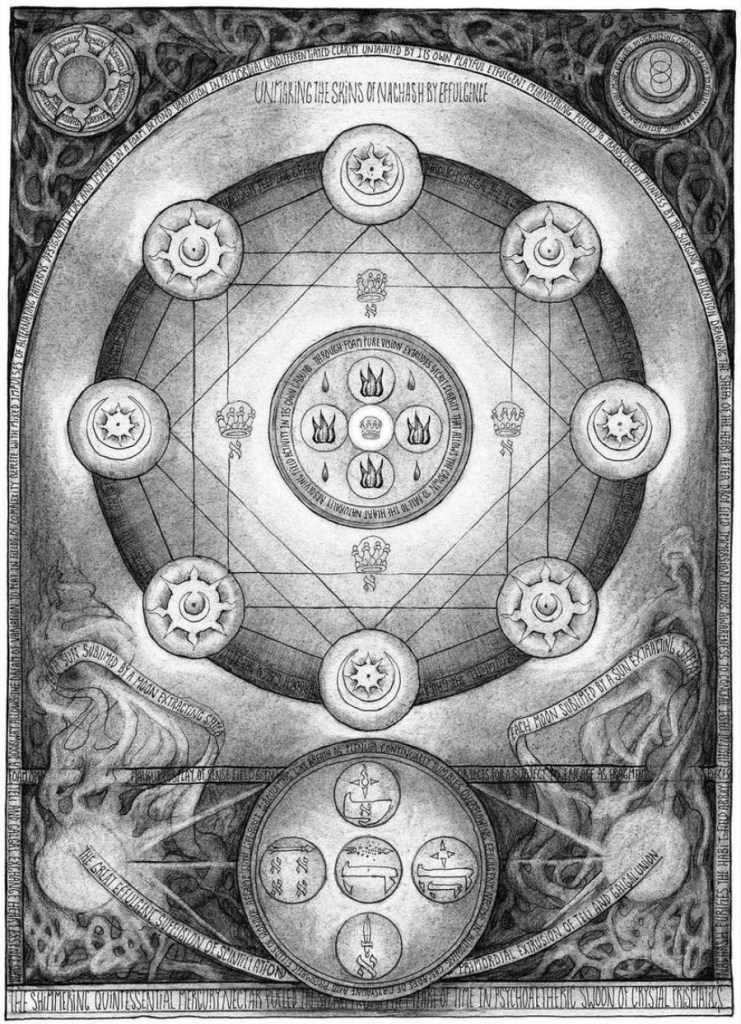
For such a tendentious attempt to present our program, the implementation of spiritual endeavors into the daily life of the Aspirant, as well as the integration of these living pulsations of the soul into one grand whole of life, it is not of particular importance to mention. It is crucial.
Inner work and the pursuit of spirituality come with a unique preoccupation, which, once it expels its poison into our being, remains within us forever. This is something that anyone involved in our art can feel deeply, and many of us align all aspects of life and work with this singular priority. Yet, a suitable Zelator questions this approach. In addition to reevaluating many other minor currents in their work, reassessing the significance and presence of spiritual questing in daily life represents an important and mature inquiry.
When observing art, one notices that the achievement of mastery in any field often entails a certain withdrawal from the realms of social or emotional life, and frequently from both. The flow of life seems to demand that we give up certain things and make sacrifices in exchange for perfection and mastery. Much like professional musicians or painters, devoted followers of spirituality also often display, sometimes in a sympathetic or humorous light, certain shortcomings, or rather, an absence of life skills that an average person manages with ease. For the average person, their understanding of history or politics might seem entirely naive, while social development appears distorted, trivial, and grotesque. Similarly, emotional and sexual lives often suffer from distortion, and we cannot help but ask—is this a necessary consequence of practicing our sacred art, or does it stem from an incorrectly framed approach to work from the start, an unfortunate, thoughtless strategy? What is it that connects many spiritual travelers, often emotionally and sexually immature, professionally inexperienced, and financially rather restricted to the point that Masters of the Temple live with their parents, and ritual work depends on their absence? Rearranging furniture, shifting dressers—these become key elements in many secret magical operations, while the vibration and ritual immersion are often carefully attuned to ensure that the neighbors do not hear.
Many Aspirants maintain fake accounts on social media, with false names and fabricated profile pictures, driven by the fear that their deviant and sinful routines might be exposed. Although the Inquisition has long since faded into history, the opinion of their boss regarding their recent post about the Bhagavad Gita—or heaven forbid, Liber Samekh, still holds weight. And when, after years of cursing our failures in lucid dreaming or feeling as though we are stagnating, growing increasingly neurotic and despondent as our spiritual path seems to yield nothing, we must ask ourselves: have we truly earned progress? Or, perhaps, are we receiving precisely what we have invested in our spirituality, expecting a return with interest on a principal we never truly offered?
Implementation and integration form the supporting pillars of our inner temple, without which any serious spiritual progress remains futile. Even the Neophyte must carefully manage their personal work and, above all, their relationship with household members during louder invocations. Yet, for a Zelator, the question of integrating spiritual experiences into daily life becomes particularly crucial. This lesson, in fact, applies to any skill in life: without it, growth and the joy of practice assume a darker guise. What once seemed like an ordinary task now turns life into a torment of difficulties and stress—a relentless, gnawing meaninglessness that irritates the soul like a pebble trapped in a shoe. And as the soul continues to push us forward, that pebble grinds ever deeper into our being, until the pain becomes unbearable.
The hardships of practicing the occult arts, besides the fact that most techniques fail, or at least fail for us, draw their power from a simple truth. This truth emerges when we ask ourselves: to what extent have we become what we once dreamed of being as children? It is that simple. When we dissect our longing for spiritual practice, we find it composed of the same spark that flickers when we close our eyes and remember childhood—the same question parents and playmates once asked us, which now echoes like a mantra: “What do you want to be when you grow up? What do you dream of becoming?” In truth, the process works in reverse: the younger we are, the more directly we engage with pure magick. As we grow older, we unlearn and forget. Real magick is not remaining the child, but becoming, and understanding this difference marks the gulf between performing the Abramelin operation and delivering lines in a foreign play we neither comprehend nor feel.
Recall now a scene from your childhood—a particular film, perhaps—one that filled you with wonder. There is always one. And within it, a moment that stirred something indescribable, something intimately personal, as if it had been written just for you. Even now, revisiting that scene, your entire being trembles, as if you are in contact with some supernatural, divine force. This might be a movie, or a cartoon that captivated your young imagination—a hero whose mere image instantly invokes something older than yourself, awakened by their presence. And because it arises from within you, it feels as though the power lies in the scene itself, altering your consciousness the moment you witness it. It might have been a particular toy, one whose significance only you perceived while others saw nothing remarkable. It might have been a place, a building, a handrail, a village fountain, or perhaps a neighbor you glimpsed only a few times, a beautiful girl whose face you can no longer recall but whose presence lingers vividly, never fading with time. Even as you read these words, thinking of that hero, that toy, or that scene, your mind shifts into a unique and heightened state of awareness, much like the altered consciousness evoked by invocation or meditation. In fact, memory itself is one of the highest faculties of the mind—closer to enlightenment in its essence than all the invocations you will ever perform combined.
Now that we have caught and recalled that scene from childhood again, we will notice that we do not even need to remember it clearly, nor is it necessary for that memory to have a sharp perception. Even now, you can feel that it existed in your life, even if you cannot recall a single detail. And simply thinking about that event, that film, that scene—very often just a fleeting commercial—you experience the same shift in consciousness and a particular kind of trance, as if your mind is already preparing you for the blissful memory of the path that led directly to your Selfhood. It feels as though all rituals are merely pale and cheap replicas of such a jewel—unique, authentic, and infinitely precious. Such a scene and that feeling do not need to be tied to a formally embodied or anthropomorphic form. On the contrary, it is often something as subtle as the scent of autumn or the crackling of the fire in your grandmother’s stove. It might be the crunching sound of leaves beneath your feet on the way to school, the magical stillness after a heavy snowfall, or even the distinct smell of old VHS tapes holding a beloved cartoon. Perhaps it is something even simpler—the smell of popcorn. Each of these is an ambassador of the Self from the only segment of life that both exists and does not— the past. They represent something much simpler; they are the emissaries of a nation that no longer exists. They represent and speak on behalf of “us.”
Many of us, as children, called upon spirits—a topic to be explored on another occasion. If you were among those who did, recall the feeling during childhood birthday parties when we would chant specific phrases to summon a particular spirit, or remember the unique method by which it was done—there was always one child who knew the process best, while the others followed with breathless excitement. Revisit that sensation, fully immerse yourself in the memory of it—the embodied anticipation as, after uttering the words “spirit, spirit, are you there?”, everyone would fall silent, freezing time itself in expectation, listening intently and transforming the sterile emptiness into something magical and full of wonder. It was through this very act of anticipation that we created the spirit, a reflection of our overwhelming desire for it to appear. Think back to those fleeting seconds, those brief moments when we held our breath, watching and waiting for something extraordinary to unfold. That magical sense of awe, the allure of the unknown, the mingling of fear and yearning for the spirit’s arrival—that feeling holds the key we so desperately need now. You must rediscover that trace, that singular stimulus that touches your soul in the same way, always evoking the same quiet thrill. Within that feeling lies the common thread binding us all in our spiritual quest. It is the same sensation as when we recall the hero we idolized in childhood; this primal fascination contains the essence of our being. The magician’s only true power lies in remembering themselves, in reclaiming how they once felt, reaching for things they always knew were “somewhere close by,” not in some distant realm but just there, at the edge of their room, waiting for them to turn and make contact. No rituals, no breathwork, no preparation, just the simplicity of remembering. “Again,” “once more,”—this is the highest form of invocation. It is not a matter of endlessly repeating something new, but of recalling and reawakening what you did yesterday in the fullness of today.
And today? Today, you need to do nothing but remember how and what you once wished for in some distant yesterday. Your present must dwell in that past—a past that sees today as a tomorrow which will never arrive, a future of adulthood that is endlessly far and dull compared to the divine brilliance of childhood, where you still remain. Did you once dream of being invisible, of flying, of speaking with animals, of changing your appearance at will? Did you imagine yourself as part of a secret society of superheroes fighting injustice, as a race car driver, as the captain of a spaceship? It does not matter what it was—what matters is how you felt, and how you feel now as you reconnect with the primal spark of the inner fetish that once ignited your soul. You will notice that, when you think of it again, the same feelings resurface. The same fervor, the same thrill—unchanged by the passing years. Time has not dimmed this fire, because it is not bound by time; it is an expression of Will—the true pendulum of the Universe, against which all other clocks are synchronized. It is as if everything you are now stems from that moment, when the child within you longed for that one secret thing, captivated by a single image, a scent perhaps, a quantum aphrodisiac of the soul. You may rediscover this feeling in an old commercial or a forgotten toy—its forms are endless, but the sensation within us is always the same.
Seek out images and relics from your childhood—posters of beloved films, cartoons, toys—discard those that merely interest you and keep the ones that awaken that strange spark of obsession, that inexplicable and irresistible fascination. The more you gather these fragments, the clearer and purer that feeling will become—emerging instantly, directly, without intermediaries, piercing to the core of your being. By recalling that special, primal memory, you will begin to flush your inner current, opening channels that have been blocked for years—even decades—and letting your mind’s force surge anew. Hold this scene in your mind, not as a visualization, but as a pure and unfiltered feeling. However faint or difficult to grasp, it will act as a potent intoxication—a divine nectar that alters your consciousness, drawing you into a singular trance that consumes the mind like a fever or, perhaps more accurately, like a drug. This feeling compels you to dig deeper, to uncover more traces of your childhood’s sacred obsession.
Many have called this unique force “Kundalini,” or used other grandiose terms in their attempts to explain what, as adults, they have distorted with occult or religious interpretations. But we reject such foolishness. We place our childhood—the real, tangible foundation of our being, upon the highest altar. For the God we seek has always been imprisoned within our memory, not in the imaginary projections of past incarnations or other mystical abstractions that diminish this radiant force. Whether you call it Karma, Samsara, angels, spirits, or the Tree of Life—it is far simpler, and far truer, to call it what every one of us possesses and, in the end, what we truly are: childhood.
As a child, I began having lucid dreams almost every night. Gradually, I learned to do fascinating things—extending my time within the dream, completing tasks that awaited me after waking, and eventually practicing skills while dreaming. Over time, I mastered the ability to dream within a dream, which stretched both the duration and the sensory richness of these experiences to their limits. My scrying practice also flourished, especially during my bus rides to music school. With my eyes open, I would project images before me, creating a reversed pathway of my return journey—a playful and effective exercise in concentration. I also began performing astral projection from a waking state with little difficulty. In the same spontaneous manner, I conducted invocations known only to me, summoning a variety of beings while altering my consciousness through invented languages. My work became a unique blend of art, improvisation, and play. As I grew older, I explored countless ways to reach various states of trance and awareness, experimenting with the cessation of thought and the emptiness that lay beyond. Transferring my consciousness into a Body of Light took no more than ten minutes, even at my slowest. By the age of twelve, I had such command over astral projection and lucid dreaming that they became as natural to me as riding a bicycle—perhaps the most effortless and instinctive of all the skills I had learned. By then, both music and astral projection had become my crafts, my specialties. Yet, as the years passed, I found myself drawn more deeply to the experience of consciousness transfer within dreams than to music—if I am to speak with complete honesty. I discovered faster and easier ways to succeed, not because I practiced more or tried harder. On the contrary, such efforts would only have distanced me from success. What I did was play more, and the more I played, the happier I became. My discoveries had nothing to do with failures or setbacks. I simply continued to play. Each attempt was a new game, a fresh experiment—never a failure. I eagerly anticipated each new beginning, because to me, every so-called attempt was merely another opportunity to play. And unlike practice, which eventually led to monotony and resistance, play remained vibrant and filled with delight.
Yet, what mattered most during those formative years was not my spiritual practice, though it consumed more and more of my life. Nor was it the transfer of consciousness into the Body of Light, which I performed almost every few hours. Something deeper and more vital emerged: I began to question. I questioned whether the endless stream of books I consumed, filled with techniques copied from one to the next, was anything more than an elaborate waste of time. Neither I nor my friends in the occult world had gained much from them beyond frustration. Were these books, I wondered, simply a cruel indication that I was untalented or, worse, too stupid for the occult path? At the same time, I started sharing my living practice with others. Unlike the arid repetitions of those books, my methods allowed people to achieve what they had secretly desired their whole lives, often in a remarkably short time. Those books, in contrast, began to feel like part of a deliberate scheme to mislead, as if some hidden and envious force wanted to complicate the path so thoroughly that few would ever reach the sea. The complexity left the shoreline free for a select few to enjoy the sun in peace. I witnessed the frustration of those who followed these written instructions, gaining nothing but disappointment. Meanwhile, I seemed to stumble upon techniques that worked like a charm—always precise, always reliable, cutting down the time it took to achieve results that others only dreamed of. I cannot forget the joy in my friends’ voices when, after I shared these instructions, they would call me breathless and tearful, exclaiming, “I did it! I finally did it, it is wonderful!” Even now, I can feel the thrill of those moments, the sheer ecstasy of a practitioner realizing the dream they had chased for so long. But these questions continued to haunt me. Were the other books, those that promised mastery of different skills, also traps of disillusionment and misinformation? Did every mystery conceal some simple lever that, when found, shifted the entire obstacle with minimal effort? I wondered whether all attainments shared a common thread: that they must be performed with ease and fluidity. Perhaps the difficulty and endless striving described in those books were not signs of spiritual wisdom but of a fundamentally flawed technique. Was the insistence on arduous effort simply a means to make seekers believe that divine favor required suffering and endless toil? Could it be that ease of execution, the grace with which one moves toward the goal, was the only true pattern to follow across all forms of our art?
I began to ask myself whether years of failure were merely a convenient excuse for the untalented to remain on the path, a self-deception that allowed them to believe they were chosen by divine providence simply because they persisted. Was it reasonable to continue doing something incorrectly for so long, under the illusion that perseverance alone was proof of spiritual worth? I questioned whether my childish, effortless approach might actually be a sign of failure in some grander test—one where only the most dedicated, those who endured decades of struggle, were deemed worthy of success. Had I fallen short by finding joy and simplicity where others found hardship? And, more unsettlingly, I wondered whether books truly conveyed knowledge, or if they merely preserved a kind of collective delusion.
The question stood before me, solid and unyielding like a fortress, and my struggle was never about lacking the answer. On the contrary—I knew it perfectly well. But the truth it carried was unbearable, devastating even, because I had clung so fiercely to the hope that new knowledge would reveal something I yearned for. Yet, instead of revelation, there was a bitter realization: these books conveyed a kind of music that had never truly been played, so distant from the beautiful improvisations and the secret notes known only to true masters. It was not just that occult writings misrepresented the techniques; they conveyed entirely wrong notes. Worse still, they radiated a disturbing truth—that their authors seemed to compete over who could plant a more insidious trap, the same ones they themselves had stumbled over long ago. An endless cascade of theories poured from their pages—about higher planes, subtle bodies, intelligences, silver cords, techniques for leaving the physical body—claims so far removed from reality that I would stake everything I had on the certainty that not a single person had ever experienced them except in their imagination and fantasy.
And yet, perhaps even more troubling than the books themselves were the readers who followed them blindly, finding a strange pride in their failures—relishing the idea that, at the very least, they had attempted these ancient techniques. But the most unsettling group was the one I avoided like the plague—those who maniacally lied about their supposed successes, describing in elaborate detail their visions and revelations. The moment they glossed over the intricacies of the method itself, stumbling through explanations of how they performed it, only to quickly pivot toward their grandiose experiences—I recognized it for what it was: nothing more than a fisherman’s tale. After all, anyone can fantasize effortlessly, but true mastery of a technique is something far more delicate and demanding.
In time, I began to see some of my dear friends and respected occultists fall into that same trap. They clung desperately to the practice outlined in LIBER O, endlessly performing that exercise while convincing themselves and others that they had ascended to higher planes. They debated whether there were three, seven, or thirteen levels, or whether the number was entirely arbitrary, drawn from the wells of their childhood imagination—and perhaps more truthfully, their childish longing. Yet, beneath all their words, we could always sense a quiet, pale hope—that maybe, after years or even decades of repeating these ineffective techniques, the gods might grant them a single moment of genuine transcendence. Deep down, they knew that moment would never come. And so, they did the only thing left to them—they invented it. Like a child caught in a lie, losing themselves in fantasy, they repeated the story until they believed it too. Rather than questioning the methods or, more importantly, their approach, they clung even more tightly to the very practices that caused their suffering—but now within the safe confines of imagination, far from the risk of real experience. Soon, endless discussions would follow—debating the origins of techniques, tracing obscure references, endlessly unearthing new and supposedly more accurate sources. In that circle of madness, they found a narcotic thrill—a prophetic fervor to persuade others. They became like those who have never traveled beyond their hometown yet eagerly offer advice on foreign journeys—what to avoid, what is dull, where the true marvels lie—criticizing others’ choices while never daring to take a step beyond their own familiar streets.
But the truth is so pleasantly painful—and that is, our happiness is often found in someone else’s experience and happiness—happiness that we would rather claim as our own than put in the effort to attain that happiness and experience for ourselves. The illusion of certain happiness feels nearer than the path to possible fulfillment. In our art, often no one truly strives to be an artist—everyone is a critic, a theorist. Few dare to step onto the stage and show what they know, to express what everyone feels should be performed, but no one knows how anymore. Here, everyone plays without instruments, knowing the notes only in silence. This gallery is filled with everything except the paintings. And in this strange exhibition, like modern art mocking the system with irony, we now present ourselves as a spectacle—ridiculing our own existence. Everyone laughs, except us. We no longer find joy in this art; the innocence and enthusiasm of childhood are lost. What remains is an overwhelming sense of envy, jealousy, and sadness. What is most curious is that the art furthest from live performance is, paradoxically, far easier than the technical weight attributed to it by the books and manuals on which we base our entire craft. It should always be, above all, a personal practice—playing, sketching, scribbling—and most importantly, the sheer enjoyment of it. Yet, instead of performing the work that others might one day write about, we read endlessly about how it should be done.
It was a strange time for me, and I often wondered—what’s the catch? Was I doing something wrong because everything was going so well? Perhaps I was not failing enough. Maybe I needed to make more mistakes to be on the right path. Or perhaps my apparent success was merely an illusion. Was I fooling myself, lost in self-deception? These questions eventually led me to the best approach in our art—to follow my own instincts and measure my achievements for my own sake. Even then, I realized that trusting my own nose was the surest path through the Universe. And that path was not a form of malefic manipulation but a kind of mindful masturbation with my own soul. In time, I understood that it was a solitary journey—not one of loneliness, but of being alone in the best possible company.
So, how important is the principle of integration and implementation in our work? How do we absorb something new—a fresh experience, knowledge, or technique? I realized that something even more essential exists: the re-integration and re-implementation of what we already know. Too often, we dismiss old insights as flawed simply because we are caught in the struggle toward what our minds project as the idea of enlightenment. We cast off parts of ourselves—our experiences and identities—as if they are the reason we remain unenlightened. Every sorrow becomes evidence that we are not happy; every failure proof that we are not successful. Our task is not merely to transform the knowledge we acquire but, above all, to radically transform the knowledge we already possess. From these familiar truths, we must forge magical instruments as powerful as any others we mistakenly believe will make us stronger, happier, or better than we are in our own essence.
Everything I had known before was, in truth, all I ever needed. All the knowledge we seek is self-knowledge. Every realization is self-realization. Every awareness is self-awareness. I rarely read about lucid dreaming techniques—I was simply fortunate enough to unlock the code, to cheat the game, and to invent a command using an algorithm already within me that led to complete success for one simple reason: the mind holds no counterbalance or counterstrike against such a command. It is not designed to resist or suspend commands—it is meant to execute them. And we are the only true opponents of our own happiness. My technique required no more than a few seconds. Like every trick I picked up along the path, methods that seemed miraculous to many practitioners, it was nothing more than a simple trick. I succeeded because I approached it playfully, forgetting the notion that the game could be unrealistic or unattainable. In that state of joy, my mind refused to abandon the game because, within it, the mind found its purpose—to follow the command, to play. Whenever I attempted something, I never feared failure because it was just another game. In fact, the more I failed, the better it was—I had even more reasons to keep playing. When a child is lost in play and a parent calls them to the table for lunch, even if the child is hungry, that call feels like an unwelcome interruption. My mind, immersed in the joy of play, reacted the same way—it simply wanted to keep playing.
The more advanced my magick became, the more playful I grew. The more serious magician I was, the more I became like a child. My magick contained fewer miracles and more tricks, phantasms, illusions, and appearances—but not the kind meant to deceive, bind, or mislead. There was only one purpose: to make me happy within the performance. There was only one purpose—to bring me joy through the performance itself. Because in that performance, there is nothing to achieve and nothing to lose. No one can lose a war fought with imaginary figures and clay soldiers. In that battle, all the figures are happy, delighting in the struggle, simply because I enjoy playing with them.
And the more complex the trick seemed, the easier and simpler it actually was. I applied the same approach to my piano practice. Performing the most virtuosic compositions often required using an unconventional fingering not written in the score, sometimes even switching hands mid-passage. Once mastered, this technique allowed for fluid, rapid execution impossible through standard methods. I wondered—could the same apply to the spiritual path? Was there an unseen, simpler approach that made the seemingly impossible feel effortless? I began to suspect that the Knowledge and Conversation of the Holy Guardian Angel might, in truth, be like an elegant sleight of hand—an apparent labyrinth of effort that is, in reality, nothing more than a profoundly simple, intuitive solution that exists outside conventional thinking. Do you do it, or does it do you? Is it your intention that brings the act into being, or does the act itself shape and carry you through its unfolding? How often does our limited nature perceive its own failure in such acts, only to declare it supreme, reserved for a select few, simply because it seeks to present itself as exceptional, for that is the extent of its reach? Yet the deepest truth lies in the exact opposite direction. Indeed, this was the true face of my path as a Zelator—that I mapped routes, shortcuts, and secret passages within the already well-charted territories of human development. In discovering these hidden bypasses and shortcuts through the alleys and backstreets of the soul, I realized that I had not merely uncovered new paths but an entirely new city—a new landscape of my Self.
As much as the Neophyte commands the path, the Zelator masters its course. Both degrees establish every grade in relation to the highest ideal and the ultimate destination—Tiphareth, the Sun, which remains equally distant for both grades. Tiphareth, Yesod, and Malkuth—like the Adept, Zelator, and Neophyte—as well as the accomplishments of Liber Samekh, Cadaveris, and Pyramidos, align on a single axis. They represent the aggregate states of a singular Universe, which only appears to manifest in varied forms. The Neophyte does not know who they are. The Zelator knows who they are not, while the Adept remembers who they have always been. It is precisely the implementation of these key awakenings that has brought the Adept to where they stand—the pinnacle of remembrance, which is the only true work in the operation of the Sacred Magic of Abramelin the Mage. We may debate what led to forgetfulness in the first place, so that something may even be remembered, but we must bear in mind that these concepts are merely faint indications, more or less successful attempts to compare to the actual experience unfolding within the Aspirant at the moment of the ultimate experience, known as Knowledge and Conversation, or the attainment of the Great Work. It is difficult to speak of a “moment” or time in the sense that it is perceived below the Paroketh, for both remembrance and forgetfulness are phenomena that can only be described by limited concepts, awkwardly attempting to articulate the incomprehensible, chaotic, and abstract experience of LVX in Tiphareth. This is much like a two-dimensional being searching for an Angel everywhere around it, only to realize that the search is futile until it learns to look both “above” and “below”—a direction entirely beyond its comprehension. The Adept’s remembrance operates similarly; it is nothing more than a clumsy category imposed by our limited dimension, which fails to grasp that the essence of enlightenment lies solely in understanding the phenomena of time and the present—a comprehension that, for now, holds value only in romanticized poems and nowhere else.
Among all this, the Zelator incorporates a principle so refined that it illuminates the path for every subsequent grade—the integration of spiritual experiences into the fabric of daily life. Just as the Neophyte observes how recording a magical event in their Diary alters the event itself, the integration of spiritual experiences outside the boundaries of the magical temple equally expands the temple’s reach.
I would like to mention an example that has always been dear to me, one that dates back to my childhood. Alongside attending regular school, I was also enrolled in music school, which meant spending long hours away from home, either in class or commuting between the two schools. My poor health often required my parents to give me money to buy snacks between lessons. I seized upon this opportunity—rather than spending the money on food, I saved it to purchase what mattered most to me in the world: books on occultism. At the time, my country was at war and under international sanctions. Both my parents worked in public service, and the rampant inflation meant that the money I painstakingly saved for weeks from my snacks just to afford one book could lose its value in a matter of days. Yet, I found this quite a charming circumstance, as it prolonged my pleasure in buying occult books, and all the while, this experience seemed to be infused with occult obsession, turning the waiting into a unique and exalted form of magic. Occasionally, I would come across a rare book in English through a friend, and that would give me a new reason to learn new skills—namely, to learn a foreign language, which I eagerly devoured with the intense desire to learn it as quickly as possible so I could read the titles I so desperately sought. Even the process of photocopying occult books took on a magical quality. Despite living in the capital, occult literature still evoked suspicion and disapproval, forcing us to find discreet ways to duplicate these “dangerous” texts while remaining unnoticed. I will never forget the day when, later in high school, I acquired a laser printer, a Hewlett-Packard 4L model. Though large and cumbersome, it offered what I needed most—the capacity to print an enormous number of pages on a single toner refill. At last, I could print the files I had meticulously preserved on my 5.25-inch floppy disks and the perpetually insufficient hard drive of my Pentium computer running Windows 3.11. I could now print these texts and pass them along to friends who shared my unquenchable hunger for occult knowledge.
While gathering money for books, I often went without lunch, and too frequently, dinner. Although it took an agonizingly long time to save enough for a single book, I visited the same bookstore every day after school—the only place where occult titles could be found. With unwavering dedication, I would return daily to gaze longingly at the book that grew closer to my grasp as I saved the remnants of my lunch money. It was during this time that I discovered something extraordinary: despite the gnawing hunger that came with physical exertion, from commuting between schools, practicing piano and increasingly demanding repertoire, the moment I stepped into the bookstore and encountered the book I longed for, every bit of that dreadful hunger would instantly vanish. As if some higher idea within me could dispel all bodily urges and deficiencies, my enthusiasm and joy upon entering the bookstore transformed my physical weakness and hunger into a curious kind of energy. It felt as though I were connected to an inner transformer, converting one type of sensation into pure sustenance. Often, I returned home feeling nourished and strong, which only deepened my passion for books. Soon, I began to organize my growing collection at home, cherishing that single bookshelf as if it were a beloved companion. I would frequently take out the books, not to read them, but simply to inhale the scent of their pages, which seemed to echo the essence of my soul. That fragrance became my only aphrodisiac, the sole driving impulse that sustained me throughout the day. My entire life at that time was a metaphor for that scent, which was always the same—an intimate, tangible experience whenever I pressed my nose to the middle of a book. I realized that when I engaged in something with a burning passion, it consumed every weakness and flaw that might otherwise hinder its manifestation. It felt as though an elite army within me crushed any internal resistance, subordinating my entire being to my deepest desire. Yet, I also noticed that not all activities produced this transformative energy. Only one pursuit held this power over me—my engagement with the occult, which seemed to unlock a hidden mode of my existence. This devotion to the most authentic aspect of my soul shifted my fate, steering my life in an entirely new direction. Not only did this passion grant me extraordinary energy, but in a strange and inexplicable way, everything I desired came effortlessly. I passed exams with ridiculous ease, often reading only one question the night before, only to draw that exact question during the test. Girls I admired would send whispers through their friends that I “had a chance,” without my even needing to ask. And I frequently found money on the street, so often that it became more comedic than surprising. These observations gradually solidified into undeniable truths about my spiritual work:
- Hunger is powerless against the surge of creativity, and the most potent form of creativity for me has always been my innate nature—the occult. There is no memory from my childhood in which I was not captivated by occult practices and books.
- Whenever I followed this inner obsession, I never lacked energy. A relentless wave carried me forward, always keeping me at the peak of strength, enthusiasm, and innovation.
- This singular pursuit became something fixed and tangible, just as my sense of “I” remains ever-present, regardless of what I do.
- The longer I remained devoted to my true nature, whether by buying books, reading those titles, or dreaming of future spiritual journeys—the more I witnessed events on the edge of the impossible. It was as if my dedication bent the Universe itself, allowing even my most improbable desires to manifest with surprising ease. Yet, I never pursued my innermost calling for the sake of these manifestations. On the contrary, they arrived as side effects, as rewards born from the fire of my passion.
- This inner impulse, which I always felt so vividly and which persisted even during other, more mundane phases of life, continued to bestow gifts and spontaneous successes along my spiritual path. I experienced the truths written in books firsthand, effortlessly, and without deliberate striving. It was as though the burning essence of my being ignited everything I touched, bringing to life whatever intrigued my mind. Lucid dreaming, astral projection, scrying, invocation, evocations, and even the highest states of Dharana and Dhyana came to me without struggle.
- The form of that fervor within my nature was always, and only, more of a game, always more a delight in imagining than any other or so-called “higher” intellectual effort. The shape of that mental striving was never about focus or seriousness but rather a childlike fantasy, so naive and absurd that I was unaware of how foolish it all might seem.
Very early in life, I became aware of the integration of spiritual training into my everyday existence—so much so that I no longer even defined it as such. Perhaps this is the crucial reason I moved so smoothly through our entire art. Life itself became the perfect ground for spiritual development, and I was so absorbed by it that the boundaries between the spiritual and the visible world, between the mystical and the ordinary, completely faded away. I never sought to make anything sacred, nor did I engage in any specific practices or, worse, exercises. I simply lived the dream I had as a child, continuing to be nothing other than what I had always been. Everywhere around me, I found reflections of my obsession with the spiritual—whether watching a film, which was always one connected to the occult, reading books, keeping company only with those who studied magick themselves, or listening to music that evoked the feeling of enchantment, like Enya or Dead Can Dance. Everything I did was merely a variation of one single thing, and that one thing had chosen me to manifest itself through the unity in which I existed. This notion of being “together” is a vital distinction—never as “One” or in “Oneness.” That, after all, was just a conceptual trick imposed by various dogmas that I never accepted and thus did not practice. I did not seek to become one with it—I wanted to be with it, together. And in that togetherness, the game became far more beautiful and fascinating. I simply loved to play, and in that play, I wanted to play with myself—the best companion in the game. It was all so simple, like discovering a cheat code in a computer game, an unknown algorithm unseen by anyone else, but so universal that I could win the game by any means, even without playing it. Such was the power of the universal key I possessed.
Even my present life is the result of this approach. Someone might assume I planned everything meticulously, as if following a devilishly clever and patient strategy, but the truth is entirely different. I planned nothing. I never thought ahead. I did not think at all—I simply felt. Only one sensation guided me, one singular fragrance that emanated from my own nature.
Everything I write about myself and my life serves no purpose of self-glorification. Rather, it is meant to explain and subtly weave together what follows, like some cosmic prelude. I deeply believe that the true work of the Zelator is to begin sketching the contours of their life and to trace that one sensation through all others, to find the single note of fragrance that permeates every hour of the day. This scent lingers in the morning, during the day, and through the night, yet it remains so delicate that it cannot be described in any concrete terms. Like the least common denominator in mathematics, it should function similarly with sentiments and sensations—to identify the most potent fetish from childhood, the one that still resonates now with the same intensity—exalted, mysterious, powerful, and unique. It is as though that object, hero, scene, or scent from childhood carries a secret message meant solely for them and no one else. In truth, through the language of childhood, this is precisely what we continuously break down through the grades in the same manner. Just as every Aspirant takes the Oath to:
PROBATIONER: To prosecute the Great Work: which is, to obtain a scientific knowledge of the nature and powers of my own being.
NEOPHYTE: To prosecute the Great Work: which is, to obtain control of the nature and powers of my own being.
ZELATOR: To prosecute the Great Work: which is, to obtain control of the foundations of my own being.
PRACTICUS: To prosecute the Great Work: which is, to obtain control of the vacillations of my own being.
PHILOSOPHUS: To prosecute the Great Work: which is, to obtain control of the attractions and repulsions of my own being.
DOMINUS LIMINIS: To prosecute the Great Work: which is, to obtain control of the aspirations of my own being.
It is, in fact, merely the refraction of one and the same light, as it would be seen and experienced by a certain aspect of being on a specific grade, in the most comprehensible way possible. Each grade, in its own way, approaches this “being.” In addition to the specific tasks each grade has, which differentiate it so uniquely from others, each grade also shares a common “being” in the Oath, in the program, and in the work. Each deals with the idea of one single, same being, which is the only shared attribute and spice across all grades. Without this spice, the work would be a bland and tasteless dish.
Let the Zelator make a list of all their childhood fetishes, old relics that stirred strange chills and feelings within them, old films, superheroes, music, perhaps even car models to which the Aspirant felt something special in their childhood, maybe a specific old advertisement. Let them search for and collect all such items; today, this is particularly easy through the internet, where there are special groups and forums where people share old photographs and nostalgic scenes from their childhood. No rituals are necessary to awaken this; simply reading this is a ritual in itself. Every rite or meditation is an amateur copy of the magical work that each of us has experienced simply by being born—by childhood. By simply being born, and by reading these words, every Aspirant is destined to, at any time, in any way, without any methods or preparations, here and now, experience one of two things:
By simply being born, every Aspirant has also secured one more thing—childhood, a crucial element that we often forget to capture in our practice. It is truly an immeasurable loss to pass by this segment of our lives, when we were in possession of the highest magick. I genuinely believe that the grades and all our practices are merely temporary crutches and prostheses for an atrophied muscle of the spirit, which, in itself, holds infinite possibilities—to forget, but also to remember. And for the Zelator, the latter is of immense and extraordinary importance.
Our progress in the program demands breadth, a constant migration of the Self, across things, far away, always somewhere beyond the horizon to peer in and search for itself, playing an elevated and advanced version of hide-and-seek with oneself. Yet, we leave that great enthusiasm, that spirit wanting to clear the weeds around the Tree of Eternity, to stagnate and do nothing. We teach it, like the school system, completely irrelevant things—all those things it already knows perfectly well. Instead of letting it teach us and show us the world, we force it to sit in an uncomfortable wooden chair, reciting the grammar of a language it will never speak with the stars, with whom it has long been the best friend.
Being a magician only within the circle, only in one’s room, for 5 minutes or 50 minutes a day, is a sad and very inconvenient thing. A magician must be equally a magician in a thickest traffic jam, at work before the boss, with children, and among neighbors. Can we really expect magic to respond to us and deliver its fruits when we so ardently advocate the principle: “as above, so below,” and firmly and clearly call upon the intelligence of the Aethyr to appear before us, when we are not even capable of asking our boss for a raise? The dawn of the New Æon will never experience its afternoon as long as we proclaim it as new. Far too much time has passed since the reception of the Book of the Law, all its words and verses are far too familiar, yet how many of us are truly aware of what our Pure Will is? How much is the most important trace in our lives, the key to unlocking the one most important gate of our understanding, perhaps hidden in the most ordinary, trivial things? We expect the fulfillment of our true nature to occur in sufficiently grand things, which we know we will never achieve, and thus we choose them, having a good enough excuse for not accomplishing the Great Work—here and now. Not tomorrow, over there, with the support of friends, in a new car, with the last installment of the mortgage paid. But right now, here, with all the burdens of yesterday and those that come tomorrow, alone with ourselves.
Every breath is Pranayama, every posture is Asana, every thought is Dharana that brings enlightenment, every step we take is a ritual, every phone call we make is a supreme invocation, as in every sensation our brain receives, there is always, in the same way, the presence of Knowledge and the Conversation of the Holy Guardian Angel. There is no action that brings this experience more or less; there are none that, in principle, do not offer this same enlightenment. Whatever we do, if we do it in the right way, alone with ourselves, experiencing that act as a verb, not a noun; if we stay with the present hunger without being hungry, or feeling thirst without becoming thirsty, that moment would appear as enlightenment without us being enlightened. The Zelator is certainly not expected to perform any of these disturbing thoughts, but just to think about them, relaxed and spontaneously, to develop a way of thinking that will turn their limited magic into a life full of wonders. He will not be a magician who only takes occasional private spiritual lessons from the Universe, twice a day for 45 minutes, with mandatory homework. On the contrary, while wandering through the very same Universe, constantly collecting and uninterruptedly gathering all spiritual wonders, they will create a universal herbarium of all experiences, all possible and impossible possibilities, all potentials and nothingness—constantly, continuously, without interruption, devoted and fulfilled.
This is the essence of the Zelator’s work: to cut through the boundary where their life and their practice either are or are not performed. Where doubt arises about whether something is valuable or not, and how much it needs to be before it is worthy of being written in the magical Diary. The whole range from the Zelator to the Dominus Liminis is polishing that Diary and improving not the page or manuscript or the font in which they write, but themselves. Through reviewing and recapitulating everything we have already listed, they seek that one event, one moment from childhood that will be the ultimate trigger for their Great Work. For that work does not require ritual, rites, or meditation, but only and exclusively one tiny moment that has already been lived and needs to be relived “again.” The Zelator is the youngest sibling of the Adept; although they always create the most problems and difficulties, the Adept always enjoys spending the most time with them, because they are a reminder of the Adept’s own childhood. For just like the Zelator, the Adept was once that very child, but unlike the Zelator who searches for their lost childhood, the Adept has reclaimed and awakened it. The Zelator almost ceases to be a child, while the Adept becomes a child—again. These are all wonderful ideas for the Zelator’s contemplation and active meditation, which can often do more than many practices their grade requires.
Just as a diet and new healthy eating habits often last only long enough to fit into a swimsuit for summer, so too will the weight in many cases quickly return. However, if you begin to pay attention to your diet while enjoying the new food you are eating, a good shape will come spontaneously, faster, and more beautifully than in any other way. The same goes for spiritual matters. You are not going anywhere on a journey; instead, you do what pleases you, and while doing what pleases you, you will realize that you have long arrived at the place where you are meant to be. The Zelator must implement occultism into the real world, making occult practices less occult, and making the real world less real. One relies on the other, but if you expect one without doing the other, you will never achieve either.
Yet, if you transform every act of life into what it truly is—and something much more significant by making it into something it is not—whether mundane or occult—make it alive, unique, belonging only to this moment and never to be repeated in all worlds and dimensions. If you immerse yourself in it fully, striving at first and pretending to enjoy it, even if you do not actually feel any of that pleasantness, you will set in motion a relentless avalanche, a tide that will sweep everything before it. All our ingrained habits will be swept away as though they never existed at all. From the perspective of the Self, they truly do not exist, after all—just like the Self itself, in the end.
Perform occult practices for the sake of enjoyment in life, and live life for your urge towards the occult. Let one not condition the other, and in doing so, you will transform both into pure success, into the stimulation of the Selfhood that will experience a cosmic orgasm, constantly, perpetually, as long as everything you do is done with playfulness, like a child, without a goal or purpose. Making a castle out of building blocks is no longer the point, but simply the act of building. And when the child finally finishes constructing the castle, they leave it behind and move on. The Zelator learns to move on in just such a way.
Certainly, Binah will always find a way to oppose this marvelous joy and extraordinary achievement. It is precisely in this world and reality, which now begins to radiate a completely different glow that nourishes and comforts the Aspirant, that Binah will find a close traitor who will strike at the Zelator. Thus, in all their desire to share their important experiences of lucid dreaming, visions, Asana, and Pranayama, their insights into the nature of the A∴A∴ through various social networks, with close friends and comrades in the Light, the Aspirant will encounter a strong dose of condemnation, misunderstanding, jealousy, ridicule, and well-argued opinions about their completely wrong executions and interpretations. The outer world, like a general of evil, will begin to spit on all the creative and devoted work they have done, while a sense of rejection and loneliness condenses within them. This loneliness begins to consume their enthusiasm, their inner light, which now starts to burn, to hurt, to push them back into the reality where they were accepted, where they were loved. The worst thing a Zelator can even think, is to turn back.
There is a special phenomenon that many children experience, which I call “the girl from the sea.” The whole story takes place during early puberty, when young boys are already openly expressing their affections, but still not enough to bring about any real action. The girls are much more mature at that age, but us boys have a habit, usually after the summer holidays, when everyone goes with their families to their favorite vacation spot, and now, when we return, eager for old company and gossip, each boy talks about his “girl from the sea.” Namely, each one will tell a story about meeting the girl of his dreams at the sea, a girl who embodies everything he believes his good soul deserves, something destined only for him from the heavens. This “girl from the sea” has a name, a hair color, and an appearance exactly as imagined by the boy telling the story. The problem lies in the fact that we only saw her then and never again, and others will never meet her or verify anything about her elevated beauty. In this insidious lie and transformation, the point is not that everyone will lie about their “girl from the sea,” but that everyone will accept the lies of others without any comment or questioning, because each boy knows they too are lying in this whole story. Everyone has their own “girl from the sea.” Thus, instead of expressing doubt or objection to the hollow story, each one congratulates the other on his dream girl, knowing full well that she is just as fake as his own. Everyone knows their own lie is false, and everyone enjoys the lies of others because, in doing so, they understand that others are enjoying the same company of the same girl—one who does not exist at all. This way, the cycle of deception becomes a spiral of strength and vitality—childish imagination that, in exactly the same way, now reveals to the Zelator the same mechanism in the world of occultism and spirituality, the same mechanism in their own life. They will be fascinated by the occult environment to which they belong so devotedly and fervently that they now begin to notice that there is more talk about experiences that did not happen than about those that did. And all this endless talk, thousands of books, revolve around the same thing—everyone has their own “girl from the sea.” Even among experienced occultists and spiritual practitioners—places where such things should not occur—the magic of childhood is so wonderfully powerful simply because we never stop being children. And as much as we are all happy while telling stories about our “girl from the sea,” we are equally lonely—because the moment we return home for dinner, after meeting with friends, we realize that not only has everyone gone back to their homes, but the girl from the sea is gone as well—the one who lived and had power only when we spoke of her in the group, when each boy brought his own, the same “girl from the sea.” We all have the same “girl from the sea” as much as we are all, in fact, lonely and longing for the spark of the same love. Yet, for the Zelator, this divine loneliness and childish game of exaggeration and fantasizing in such a serious and grown-up world of spirituality is an indicator of supreme virtue. No one is more or less lonely than they truly are—alone. On the spiritual journey, one is always in the best possible company, alone with oneself—therefore, whether this is loneliness or good company depends primarily on how pleasant you are to yourself. And needed, more than anything. How much does our Will need another for it to become whole? How much do we really need another opinion, or even help? How much do we need others? In what relation, in what role? Do we need them for money? Or do we need them for support? What kind of support? Emotional, friendly, do we want to appear this way or that way in front of others? Why? Do we want a sexual partner in the Mass of the Holy Ghost? How sexually active are we otherwise? How much do we enjoy ordinary, non-spiritual, mundane sex? Do we need to enjoy it more? Do we want to enjoy it more? Do we know, are we fully aware of what we should be doing in sex, and what is our role? Do we even have one, and have we earned it to the extent to which we experience and appreciate ourselves, to the extent we value others? We really do not need someone who will nod when we nod, who will follow us step by step, and who will only wave cheerfully when we do. Our shadow already does that perfectly well, every time we wave on a sunny day, our shadow waves too. Truly, on this journey, we will never be lonely. We will always be alone with ourselves, and that is the best possible company in the entire Universe.
The Zelator must follow only what they have already begun to feel as their true nature and avoid being swayed by Binah’s seductive calls. They have not fully awakened, but they have begun to yawn and stretch in the morning as they stir in bed. They do not know where they are going, but certainly, they are not returning to the dormant unconscious dream, to which Binah calls them so tenderly and fearfully, asking them to return to their good mother and remain in that beautiful kingdom where the Aspirant is a prince to whom everything is allowed. Everything except one thing—to leave the kingdom.
Be open to everyone. We are all children here, fumbling through the dark, each one haunted by their own monster. Sometimes, we sense another—someone like us—gripped by the same fear, and in that instant, as we feel them, they feel us. Both tremble, each projecting their dread onto what they touch but cannot see.
The path of the A∴A∴ Aspirant is never uniform; at every moment, the Zelator will always have a step before them, and whatever they do, there will always be two paths ahead. A step up or a step down, but whatever they choose, they must know that both steps lead forward. No matter which step they choose, they will always move forward, though in different dimensions and different magnitudes. What is above is for those below unfathomable and non-existent, but in the end, both reach the same achievement, because they both walk the same steps, taken by the same traveler.
Integrating the spiritual path into daily life and implementing the attainments of grades in the outer world must be subjugated to one sovereign alone—our life and our living. They are always a confirmation of one life, the entirety of one experience of time and space in which this incarnation has manifested, and no other. There is nothing before or after that could justify or explain any of this now; we want the Aspirant to dispel the thought of engaging with anything occult, or even engaging in anything except the single impulse that pulses and resonates within what their mind limitedly calls life, and which we understand as Pure Will. For a lawyer or mechanic, it is entirely unnecessary to waste time on Asana or Pranayama, as long as their play is not like a child looking for a toy to occupy themselves with. And for such play, it is sometimes necessary to sit for hours on the floor, in various poses with a twisted spine and bent legs. Sometimes the final word before the jury will require a strong and convincing voice, one that must be clear and persuasive for hours without stopping, for which they will need strong lungs and controlled, calm exhalations. This is the only possible and sufficient reason for us to include all these toys as methods of our Order, because at the moment the Aspirant enters the path, out of all possible and impossible opportunities for expressing true priority, we prepare the Aspirant to use, at the right moment, what they need for the Great Experiment. Our task is preparation, nothing more, like sterilization before a major surgical procedure. It is only up to us to keep the body alive, while the procedure is carried out gallantly and ready by no one but Pan, who, in his madness, may cut the main artery or grant health to a criminal. It is up to us to prepare and arrange the vast expanses of the Universe, politely and beautifully for the creative chaos of meaninglessness, but always and everywhere—with love, to accept every nature and every Will in that moment as the only possible outcome.
However, the Aspirant of any spiritual path and orientation already knows very well that in every joy there is the seed of future sorrow, and that all these pleasant affirmations will eventually be overshadowed by dark clouds of failure, decay, underperformance, and most of all—disappointment. It is certainly necessary to say a few words about this close relative of the bright enthusiasm in which we bathe through all our work—disappointment. Such disappointment is not a stray bag that clumsily tangled around our shoes during an evening walk, but something that has a much deeper impact on our being and will follow us through all advancements and grades. No matter how great our achievements are, how deep and important our experiences, how happy we are that we have finally mastered the assigned practice and achieved, for example, the long-awaited experience of transferring consciousness into the Body of Light, disappointment will always follow in the same way—however sure we are in executing the technique, a series of inexplicable failures will soon follow. We ask ourselves if the previous successes were perhaps accidental, after some time, we even wonder if we imagined or dreamed them, whether they were actually the result of our fiction driven by excessive desire. Disappointment is a special shadow that follows us through all our inner work, and the Aspirant of our Order must simply accept that the path of spirituality is not as they expected. No achievement is as it is portrayed in books or as others have said. No spirit is so clear that we can confidently assert that it is not an illusion or a shadow, no vision is so firm that it is an outline or silhouette similar to physical sight, and no astral projection experience is truly proof of any out-of-body experience, as it is always a reminder that there is much more within the mind than outside the body. Thus, a long-planned journey to the East will actually be filled with commercial trinkets all around the monastery, which will certainly not radiate the mystical aura we so eagerly longed for. When we enroll in a music school, it may take years before we truly learn to play the instrument we originally signed up for. Encounters with professionals from various fields often show them in a completely pale light, while the favorite childhood motorcycle in our hands becomes a completely mediocre contraption, suddenly a large and unnecessary life expense, which is soon sold for half the price of what we bought it for.
Disappointment is a completely natural process that reveals things are not as we expected them to be. But does expecting less mean we will be less disappointed? The Zelator must understand that the appearance of failure and disappointment on their spiritual path is a consequence of their growth and progress. Disappointment is a reflection of the soul in transformation, marked by the change of reality under their Will. As the soul grows—like an object approaching the light—its shadow lengthens behind it, cast upon the unmoving ground that resists change. No matter how real it seems, disappointment is only a shadow that grows alongside transformation, becoming darker as the light of awareness shines brighter.
The Zelator, like every other Aspirant of our Order, must celebrate equally both the shadow and the disappointment, because they will always know with certainty that they are on the path, a path that cannot be good or bad, right or wrong, but simply one single path, which sooner or later leads to the destination. Disappointment and the loss of enthusiasm are part of their growth, and as paradoxical as it may seem, the perception of darkness is actually the perception of the true nature of LVX, which awkwardly uses both light and dark as the nickname for the great and grandiose “I.” Disappointment, as an inseparable part of our spiritual journey, never tells us that we are wrong, but that we are seeing and perceiving wrongly, and that we are wrongly selecting priorities. It is the cry of our Self, shouting and warning us that we are looking at things from the wrong angle, and instead of seeing 6, we see 9. Instead of success, we misinterpret it as failure. Misinterpretation is actually the true nature of disappointment and failure, which appears not only in spirituality but in life. Misinterpretation is a spiritual oxymoron, for every interpretation is inherently flawed, limited, and shaped by a narrow selection of perceptions. Sooner or later, it leads to a distorted image of the light, which is not before us, but within us. It is like keeping one’s eyes tightly shut during a magnificent sunset. Yet, the absence of visible proof of light does not negate the existence of such brilliance, and it is precisely this that we pursue with such persistence and stubbornness.
Our nature expects the experience of enlightenment to be hidden, to be somewhere in the dark, buried, lost, covered by a multitude of other concepts that the mind must comprehend, the body must feel, to understand distorted meanings, or perhaps to be in a place so terrifying that one must not dare to reach it. Yet, in practice, many achievements become infinitely easier to attain once we simply get to work. Thus, the young driver believes they will never learn to drive and that they alone are struggling with this devilish task. Astral projection requires only a few minutes, or even seconds, when performed at the right moment and in the proper manner. The most exalted visions of angelic heavens demand no more than fifteen minutes of our work, provided one is gazing in the right way. Our mind operates under the logic that the more mythical an experience is, the harder and longer it takes to achieve, yet the truth is the exact opposite. The logic of assumptions is not part of the dimension of something as meaningless and abstract as enlightenment, or any exalted experience in our program.
The closer something is to us, the harder it is to perceive. We think that lucid dreaming is so distant, requiring methods that rarely, even by accident, lead us to it. Yet, in reality, it is right there before our eyes every night; we only need to understand the mechanism of how it occurs and how it works. The phenomenon of the Holy Guardian Angel, therefore, is not a distant concept that becomes closer with repetition. On the contrary, it is so close that our being merges with it at such a high current that we need fewer traces of the Angel, less of that unity to notice it, to perceive the pulse of the Angel. We need the Angel less in order to recognize it. We do not need to get closer to it because its contact is not conditioned by that idea. On the contrary, we must distance ourselves, and by changing the scale, we can perceive its dimension, which is simply impossible to grasp from our usual perspective. It is about the saturation of our spiritual senses from the constant irritation of the Angel, which are so overstimulated that they no longer perceive it.
There is a phenomenon in our life that is so close and in front of us that we do not notice it: our nose. Wherever we look, it is always there. No matter what we are looking at, we are always, above all, seeing that nose; this figure is so persistent in our field of vision, but we do not notice it in the slightest. Our mind has excluded it from perception precisely because it is so present and frequent. We do not perceive it because doing so would disrupt our perception of other things. The situation with the Guardian Angel is infinitely more common—it is the largest nose in all worlds, always so close to us that we no longer recognize it.
The entire point of the Abramelin operation is found in that realization—we do not require more of the Angel, but less. Its frequency is so prevalent that our perception cannot accept and process it. We need a cessation in perceiving the Angel for something like this to even be registered. We must reduce the rate of this exalted pulsation, introducing a zero, a pause, or a break in this unity in order to notice it. We do not need a path to the Angel, but a path away from it. We do not need unity or a way to unity, but a change in perception that transcends the experience of unity to such an extent that we cease every logical comprehension. Not, by any means, the perception of the Angel, but the perception of the idea of unity with it, because that is the only idea that truly separates us from the experience of Knowledge and Conversation. To establish contact with the Angel, we must be less with it; we must create a break in that wholeness so that the limited idea of “unity” can arise in the mind, as an infantile pantomime of an experience that occurs so quickly and constantly that its perception is impossible from the standpoint of the conscious “being.”
So, what does all of this practically mean for a Zelator? First and foremost, the Aspirant must loosen the conditions under which they define and perform their daily work, whether it is a ritual, meditation, or exercise. They must always focus more on perfecting their ability to perform the practice under all circumstances, rather than perfecting it in ideal conditions. For the Zelator, greater success lies in performing an average Liber Samekh in their mind while driving, rather than performing the same ritual in the perfect silence of their apartment, listening to favorite music, and surrounded by familiar incense. The Zelator must succeed through resourcefulness, more than through skill. You have nowhere to work, the house is full of family, and there is noise and chaos all around you. No worries, close your eyes and imagine the perfect temple for yourself. No time? Well, do it whenever, even surrounded by the noise of the thickest traffic—would not it be ideal to use that very noise and imagine the hustle and bustle of ancient Greece as you walk toward the temple of Pythia in Delphi, or perhaps the morning market chaos in Damascus, following the path to the Grail? Is not this a fantastic opportunity to practice Pranayama during lovemaking with your beloved, breathing more slowly with every inhale, or challenging yourself with an 8+8 cycle throughout the whole experience? How far can you go? How long can you last? Half an hour? An hour? Or more? How much more? You will be surprised by the magnitude of success and insight such a way of performing, such an attitude, can bring you. Before it, our mind has no immunity, as it does not expect something so different from the places where it is so well-accustomed, where it already knows how to handle what is entirely familiar and predictable, such as our usual work and routine. Learn to stop sometimes in ritual; see if everything is right, whether something is done too little or maybe too much. Pause simply to enjoy the break. Speak the name of God differently as if you are playfully teasing him. Skip one side of the world just to provoke it.
But if you plan the ritual days in advance, step by step, passing through each segment several times in your mind until you reach perfection, no matter how satisfied you are with the preparation, as soon as you utter the first sentence of the ritual, you will feel that something is missing. It is as if someone has completely frozen all enthusiasm with a fantastic blocker, extinguishing all the fire that was burning just minutes before the performance. Therefore, be flexible and prepared for short and very limited preparations, but invest more focus and dedication once the ritual begins. In fact, all rituals do not begin when the ritual begins, but much earlier. The entire effect lies in the time after the ritual, after we forget about it and start doing something entirely different, without any memory or focus on the meaning and purpose of the ritual. We can safely say that the weakest link in the ritual is the actual performance itself—everything that is important to us happens before and after the performance.
Often, our mind is burdened by routine and the repetition of practices, the number of Middle Pillar exercises or Ritual of the Pentagram performed daily, weekly, and monthly. Do we need to fill the quantity of practice to be a good magician? What number would that be? 5, 10, maybe 1000? Have you discovered that all rituals in the world use the same letters of the alphabet, all rituals are therefore the same? If you learn to perform one ritual, you will know all of them. By doing more, it only shows your weakness in facing the One. It is easier for your being to devise new challenges and adventures, only to fail to achieve a single success. If you have not succeeded in one ritual, you will not in any other. Do you think that the experience is obtained by a number? The experience is obtained by success, not by the successes. And success is only one; failure is all the other.
Why not expand the Liber Resh to include something entirely ordinary, yet so special, like drinking water? Let the Aspirant drink two glasses of water four times a day, each time after venerating the Sun. Just that. Let them train their being to do this, and they will see fantastic benefits for their physical and mental health. Every time they drink water, let them drink it with a gentle smile, imagining that this smile filters the water and consecrates it with the light that now resides within their body. Let them thank the water and greet it. Just this small action can significantly improve their health. They will see how much it will alleviate hunger and speed up metabolism, which is directly connected to the idea of the Zelator. The Zelator is, above all, vibrant with energy, and metabolism is the bearer of this idea, much more so than favorable blood results, pressure, or glucose levels, for example.
Let every posture during the day be a practice in Asana. This is a perfect opportunity for cinematic projections; most movies last an hour and a half—what better time to watch one without moving a single inch? The Aspirant may notice that in this way, their body and mind reach entirely different dimensions and depths than when they specially prepare for such work, experience it through regular training and procedures, and practice something according to a program with a fixed form.
Let the Aspirant carefully consider the nature of the work itself. Is not work constant, even during moments of inactivity and pause? Does not the soul still rush toward the stars with the same force, even in these times? Let the Zelator especially approach and examine the idea of a pause. Let them take time to stop their work and make a complete break, abstaining from all occult practices, including reading literature. But we are so desperately in need of that fine discomfort and neurosis that drives us to work, to avoid missing anything. Instead, we are supposed to miss work willingly, allowing it to progress in silence just as much as in action, in pause just as much as in work. We must not allow action and work to monopolize our progress. We will notice how each ritual and spiritual work, after such a pause, feels incredibly light and agile, as if we had never taken a break at all. But conversely, how an Asana that was perfect yesterday can be filled with new pain today, with weak attention and a general sense of failure—how many failures will we experience that do not depend on devoted practice? Lucid dreams, too, are nearly impossible when practiced every day in a row. Truly, the Zelator must loosen the cycle of breathing—not just the lungs but the mind, their entire soul. And when they inhale and exhale, their lungs move just as much whether they are present or not. They are always the same Self, whatever they do; they are always in the same unity with the Holy Guardian Angel. And when that diminutive Self is in silence, everywhere in the Universe, it is like the howling void behind all existence. Therefore, let them learn to enjoy the break, the pause. Does a pause truly exist? Is not the Great Work rather deep than great, and not work but rather working, the eternal continuation of the cosmic infinitive, the everlasting stimulation of the cosmic orgasm, which is always approaching but never quite reaching its peak?
Let the Zelator become accustomed to alternating work and pause. Let them learn to rest while working, just as they are fully active during the pause. Their mind must develop the ability to belong to neither one state nor condition. They must openly place themselves in a position to use both states simultaneously, as needed. They must not be in a magical retreat in such a way that everything in their life is withdrawn. They must be capable of the first moment of decision to step out of magical retreat, entering the outer world without hesitation, and instantly, as if nothing had happened, accept that role without preparation or adjustment. Many people have the habit of being awake at night, and one of the awkward things happens when they turn on the light and enter the bathroom: after turning off the light, their eyes have difficulty adjusting to the dark again, and the way back to bed often becomes a clumsy task as the light lingers in their field of vision. But there is a wonderful trick here: all wisdom consists of the fact that, before turning on the light in the bathroom, while still in the dark, we close one eye and keep it closed while the light is on and during the time in the bathroom. When we finish and turn off the light, the eye that was open will struggle to see because of the bright spot, but the one that remained closed will stay accustomed to the dark. When you open it, you will find it much easier to see where you are going back to bed. What I ask of you is to find a way in your work to use “both eyelids” as needed—both the closed and the open one. Your being must be open to both channels—both the aspect of work and the aspect of pause. Each aspect must be accepted only as a model for viewing things; once an Aspirant greets Ra in London, another Aspirant greets Khephra in Omaha. Your time passes the same, whether you are performing or pausing in the Great Work. Moreover, the Great Work is carried out, whether you are performing it or not. Whether you experience complete success or failure, it is always the same Great Work we speak of. Even if you do not perform it at all, it is the same transmutation of Gold in the Great Experiment of another Aspirant. Even complete failure in this is equally the same as success, as long as the failure is in the Great Work and nothing else. Both pause and work are just aspects of the same phenomenon. Success and failure, satisfaction and disappointment, are only illusions of states that do not, in themselves, have manifestation or process, nor a time dimension by which the Aspirant’s mind maneuvers, thus seemingly creating the mirage of the Angel, which awareness now perceives as Success or Failure, positioned somewhere far ahead, tomorrow rather than today, heading toward inevitable doom.
Whatever happens is good; everything else is even better. Binah will strive to stop the Aspirant’s movement, to divert him in such a way that he actually goes nowhere. The worst diversion of Binah is the absence of movement. The highest Tarot trump, “The Fool”, which contains both the element of Air and divine madness, depicts The Fool as always in motion, as traditionally shown, but this movement, this path, leads nowhere, for there is no one who is meant to take that path. The Great Mother Binah will always lead her child to stay under the protection of her beloved and worried mother—this pressure will appear in the Zelator as doubt, hesitation, and many burdensome thoughts: “Am I on the right path?” “Will I ever get anywhere?” “Will I lose my sanity on this spiritual journey?” “What if I fail, what if I miss, what if I go astray?” “Why am I going, why am I searching for anything?” These are hooks that tear at the wings of the Angel, who flies everywhere in the same way, without obstacles or difficulties—precisely because it does not plan to arrive anywhere. Flight is its only goal.
17. Also the Holy One came upon me, and I beheld a white swan floating in the blue.
18. Between its wings I sate, and the æons fled away.
19. Then the swan flew and dived and soared, yet no whither we went.
20. A little crazy boy that rode with me spake unto the swan, and said:
21. Who art thou that dost float and fly and dive and soar in the inane? Behold, these many æons have passed; whence camest thou? Whither wilt thou go?
22. And laughing I chid him, saying: No whence! No whither!
23. The swan being silent, he answered: Then, if with no goal, why this eternal journey?
24. And I laid my head against the Head of the Swan, and laughed, saying: Is there not joy ineffable in this aimless winging? Is there not weariness and impatience for who would attain to some goal?
25. And the swan was ever silent. Ah! but we floated in the infinite Abyss. Joy! Joy! White swan, bear thou ever me up between thy wings!
26. O silence! O rapture! O end of things visible and invisible! This is all mine, who am Not.
– LIBER LXV, chapter II
In all this mad wandering through the labyrinth of a drunken soul, we do not need a perfect map, we need to navigate flawlessly when there is no map at all. We do not seek perfection in ideal conditions, but perfect adaptability in the midst of sudden, uncontrollable chaos.
The Zelator is like a shark—if it stops, it dies. Therefore, wander everywhere a little bit. A little here, a little there, but never anywhere specifically. Never leaving too much behind, always on the move, never at the destination. Always choose the path that leads nowhere. Do not worry if your path is winding. Worry if it is not yours.
Wherever we go, the journey is always much more magnificent than the destination, simply because on the journey you are at the mercy of your illusion and projection of the goal. Once you reach your destination, whatever it may be, there is always a feeling of a particular kind of disappointment. The car you have longed for loses its allure the moment you own it. The girl you adored, the moment you won her. Just think about how disappointing it is when what we call enlightenment is achieved, although the experience itself bears little resemblance to it, except for one thing—it is always the same factor that creates it and makes it just as illusory and unreal: us. Our enlightenment is not enlightenment in itself; it is the idea, the thought you have now that in the same way, you thought you were unenlightened. There is no difference except in that one single thought—that you think it is so, and in this moment it becomes the same idea in the same mind, a concept that has no real value or measurement, except the one you think it has.
The only counterattack in this war is the right attitude toward pleasure. It is the natural enemy of disappointment and failure. Pleasure in the very act of engaging in spirituality, not in the consequences of that engagement. You must love the job you do, not the money you will make from it. When you do so, not only will you always make more money with ease, but you will also enjoy the process of getting it. If, however, you expect money from a job you do not love, you will never get the amount you expect, or you will get it in such a difficult way that it will make both the job and the money repulsive.
The implementation and integration of spiritual achievement and inner work must point to the satisfaction of life, not because we engage in things that satisfy us, but because we find satisfaction in life itself. Every moment of our life, every act—whether it is washing dishes or performing the Liber Samekh—is equally divine irritation and an unending masturbation of one single soul across all eons forever. Self-satisfaction with one’s own, pervading self-purpose.
There is no sufficiently correct advice on how an Aspirant should place their occult training against their ordinary life, how to completely erase even the thought that these two things exist separately. Just like in the outer world, with people who do not engage in occult training or inner work, we are all under the influence of struggle, disappointment, failure, and demons that bite us, push us off the path, and disturb us.
The main punchline and the whole point here is that you must pull your shit together and use your demons as dildos. In every occurrence, see the same dialogue between you and your God. There are no saints in the heavens. We are all the same children looking for the same good old love. And that’s it. That’s all.
Frater 273
You might also enjoy:
- Notes on the Ritual of Pentagram – A practical guide to the different techniques and variations for using the Pentagram to cleanse and sharpen focus.
- Treatise on Scrying – A look into scrying practice and its place in inner exploration.
- Magical Retreat – How retreat experiences shape inner work and understanding.
- Zelator and the Moon – Contemplation on the Zelator grade and the symbolism of the Moon.
- The Dreamachine – Lucid dreaming and projection explored with practical reflection.

 Frater 273 | Reflections on Thelema
One thought on “Implementation and Integration”