
Any comprehensive system must be based on certain principles ruled by universal laws, independent from the outer understanding. If based upon thinking of diamond clearness, such a system could be misunderstood by people only due to imperfections of their intelligence and knowledge.
If the object of interest of a particular system is abstract, it would demand a simpler methodological basis. However, it does not mean that simple branches would develop from such a simple base-trunk. Systems got the nature of mathematical progression, where every next step is higher than the previous one. If the basis is already, in its beginning, founded on an abstract model, how difficult will it be to follow its full development? If the object of a system is abstract, if the basis is abstract, then it is natural to assume that the ending of the system will be abstract of abstractness. Therefore, the key to any system that strives to abstractness and adjustability is in the gradual empowerment of nonsense that it tends to integrate. If we aim to extend the time of inhaling to more than a minute, then we definitely must start with as moderate a rhythm of breathing as possible, without force.
As a system that envelops reality in a single universal glyph, and as a map of all possible and impossible possibilities, Qabalah is one of the shining examples of a great foundation and a glorious crown. Its universality lies in the exact condition of any particular progress, and that is the wisdom of defining mutual relationships. Qabalah defines the whole Universe not by descriptions but by relations. It does not create new terms independent of itself but creates one universal way to integrate the terms into a whole.
If, by any chance, you were misfortune to have a stern literature teacher who demanded you to learn obscure literary works by heart, then you might understand what I am talking about. There are two ways to learn a poem by heart. One is by automatic repetition until exhaustion. The other way implies learning, or better to say, searching for relations that might be applied to the whole of the poem, which would be perceived as a simple mechanism – finding or, better to say, inventing patterns upon which the whole of the poem is based.
Such a search might often be imaginary, as the poem itself need not be constructed according to such a mechanism. To make it clearer, let us have a look at the numbers. If we look at the sequence of 1, 3, 5, 7, and 9, we could see a sequence of odd numbers. But if after 9 there appears some unsuitable number, it does not mean that all of the scheme of linear movement has been lost. If the next number, let us assume, is 132, then the whole sequence is divided into two groups. The first group is a sequence of numbers that follow an odd natural scheme, and the last number is simply 132. However, even for that number, there could be a scheme that attaches it to the first group, making that way one scheme, and not two. So, there is no need to learn every single number by heart. Such a way of learning is significantly slower, not to mention the duration of such learned data in mind.
The benefits of Qabalah are in its natural and straightforward way of defining the relations, which is applicable to all groups of items, regardless of the fact that some items might seem non-connectable. In other words, Qabalah has very clear content from which it is possible to deduce any context. In that way, there are no decently abstract phenomena that could not be classified. According to Qabalah, the glyph of the Universe is of an entirely tangible and pragmatic nature. To state once again, the perfection of the system is not in its complexity or its simplicity, but in crystal clear definition of relations.
Now we can move on to some more concrete things, finally looking at the glyph of Qabalah as it is. In fact, it is necessary to ponder that glyph as it functions in the same reality it wants to define, and not as it “is” or it “is not.” We do not attempt to define the historical authenticity of a certain model of thought, nor are we trying to discuss its different variants. Let us try to catch on the essence of the glyph, which could be modified endlessly, but would always remain the same essence. It is the only way to make a pragmatic system out of a dogma, a pure truth out of a theorem.
In order to succeed in this, you need time and eyes wide open. Actually, the most you need is to give it a decent try. And to try again. And again. Apply a scheme, this particular glyph, in all possible situations. As long as there is a single case where you cannot apply this scheme easily, it means you have to try harder. And again. Your tries cannot change the glyph but will only change your consciousness, becoming more flexible and sensitive to the glyph itself. Only then will you experience that way of abstract thinking, which is necessary to understand a map that describes reality.
Let us return to the glyph. It is generally known as the Tree of Life. Like any real tree, it has its growth process and specific morphology, which implies roots, trunk, branches, and fruits. In order to understand it, you must start from the roots, moving upwards. Take note that in this case, a perfect system must have perfect roots. We are not going to describe the structure of the Tree of Life here, as it would take us too much time, and there are already dozens of books published that deal with that subject. They mostly focus on the visual description of the glyph and its essential points.
Our presentation is focused on the basis of the Tree of Life, on examining the basis of this Universe. The basis of our tree is called Malkuth, and in order to understand the glyph or reality, you must understand the basis upon which the glyph is constructed. Once again, we are not to describe what Malkuth is or what the Tree of Life is. Anybody can learn that by heart. Here we want not to discuss but to ponder. Any average Aspirant could dedicate a few days of his life to study the basics of Qabalah and draw the Tree of Life on paper. And after a few more days of dry mental acrobatic, a new, learned Qabalist is being born. I am not going to write about what the Tree of Life is, but where it is around us, here and now. This exertion is dedicated to learning how to integrate knowledge and not how to acquire it. By the mere fact you can read these words, it means you are intelligent enough to acquire knowledge by mere persistence and willpower. But what we try to do here is to learn how to learn. Instead of studying the Tree of Life, we will learn how to water it and finally how to eat its sweet fruit.
As of this point, I am going to assume that the glyph of the Tree of Life is both theoretically and morphologically clear to you. If it is, and there is no reason why it would not be, the only thing you need to proceed further will be to have a list of analogies that might be related, from the symbolical world of the glyph to the world which is around you. In other words, it is necessary to create such a bridge between the world of the symbol and your own world that you can walk upon it safely, there and back again.
A universal dictionary of that kind does not exist, as each one of us perceives the terms in different ways. However, there is an excellent attempt in the form of a book called “Liber 777 and Other Qabalistic Writings.” It should be vital for you to understand under what conditions seemingly unrelated ideas could be joined together and for one simple reason so that you could do it for yourself. In other words, we will study all the existing analogies in order for you to set up your own. Whether you are going to accept the analogies from that book in their entirety or only in parts is totally irrelevant. It is crucial to develop a specific awareness that classifies ideas properly. In this lecture, we will deal with the basis of the Tree of Life, called Malkuth, which in translation from Hebrew term means “Kingdom.” It is quite necessary to perceive Malkuth around you, here and now. Leave this lesson for a moment and have a look at Malkuth. There is a huge possibility you will not do that, as you absolutely and under no circumstances have an idea of what it means. In other words, you miss the examples of practical attributes or the translation of the language of symbols used by Qabalah. Here, I am going to list some analogies traditionally attributed to Malkuth:
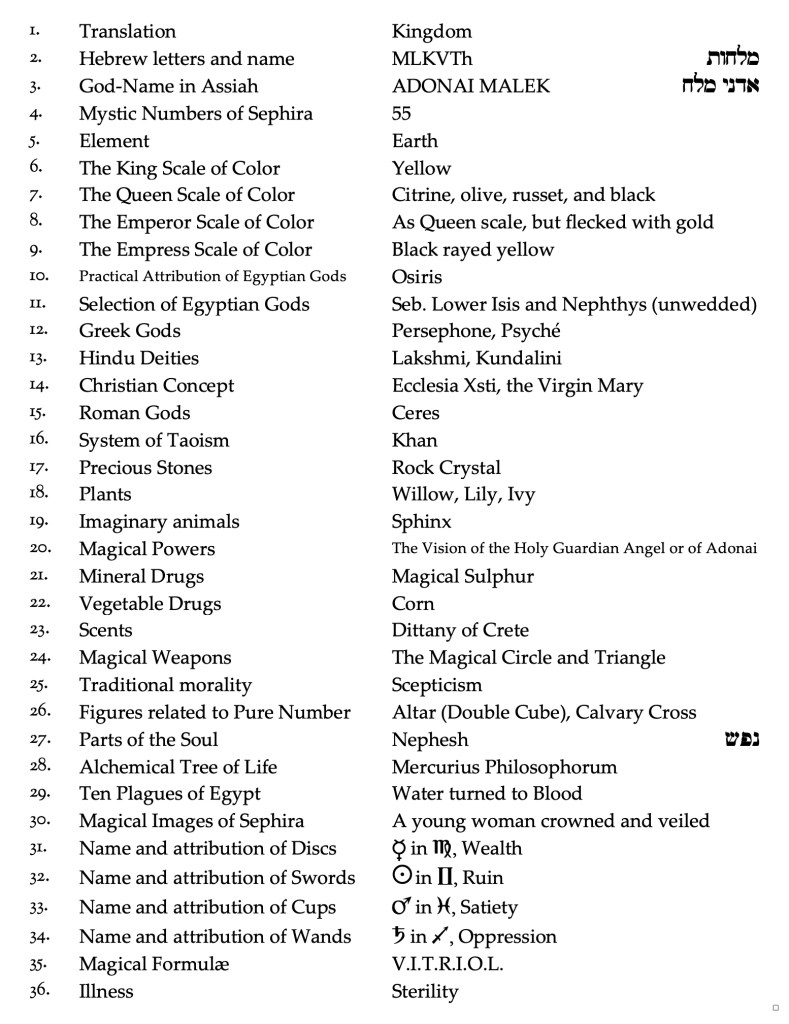
Malkuth is the basis, the support of the Tree of Life. It is the last emanation from the absolute. The wisdom of magick is the wisdom of defining proper relations; therefore, it is necessary to understand the idea of the basis. This principle is well presented in mathematics. If we come across the following equation with two unknowns, like 30x + 40y = 180, there is not much we can do to solve it. But if we come across another equation, where the same x and y are represented like 5x + 8y = 34, it will help us to find the solution, as we can compare relations.
Similarly, you will seemingly replace Malkuth by its given synonyms, and through understanding the synonyms, you will understand the Malkuth.
The basis as support must be stable and firm. If you look at line number 5 in the column above, you will definitely see that there is something important in the idea of firmness. The name MLKVTh means Kingdom, and every Kingdom must be founded on the King’s firmness. Compare other items and find an essence which is common. Although I will briefly comment on the analogies given in the table, I do not intend to obstruct your model of thinking.
I partly explained the first line, while the second one is sheer technical data on how to write the name itself in Hebrew, as you will need it later on if you adopt the Qabalistic method. MLKVTh is spelled by Hebrew letters Maim, Lamed, Cheth, Vau, and Tau.
Now we come to the third line. It is the divine name of Malkuth. Some might wonder what it is for. If on the street you start yelling a name, there are chances that somebody having that name will turn around, although you did not have that particular person in mind. It could even happen that several people turn around simultaneously. Try to do that at some glamorous reception, and as much as it is stupid, somehow, I feel great enjoyment every time I do that. Therefore, if you call Malkuth by its divine name, there is a possibility you might be taken seriously and that it will turn towards you for few moments – giving you enough time to mark it in your mind. The divine name of Malkuth is Adonai Malek, which, when translated, means “my Lord the King.” Here we have a full association with the Kingdom and everything related to that idea.
The fourth line is represented by number 55. Malkuth, as the last emanation of the absolute, is manifested as the tenth Sephira (the word Sephira implies singular, while Sephiroth relates to plural). The sum of all the numbers from 1 to 10 is number 55. It is an affirmation of that number as the wholeness of the sequence from 1 to 10. It is also good to remind that 5 + 5 = 10, Malkuth. Both halves of that number are equal and well balanced. The right balance is the condition of firmness.
The fifth line is the elemental attribution, and in the case of Malkuth, it is Earth. In fact, none of the others, “higher” spheres, includes Earth. This fact emphasizes, even more, the idea of firmness and similar implications.
Lines 6 to 9 give scales of color. The reasons for these colors were explained very nicely in the book “777.” For now, I think it is enough to notice the analogy between those colors and the colors of Earth. Later on, after we move through all the other spheres, we can return to this. As I mentioned earlier, you are here to learn how to practically deal with Malkuth and discover why exactly those analogies were used. The reasons will reveal themselves to you in due course of time. Not to mention how many reasons and arguments simply do not apply for some people, considering their mental structure and nature. In the beginning, it is necessary to define basic outlines, to work on a draft, and not on the final product.
Lines 10 to 15 show analogies with various divine principles from different pantheons. There is not too much speculation. It is necessary to study mythologies and understand the nature of a particular deity. Thousands of books were written about it, and you can find them in any library. Study those deities until they become really close to you. Book “777” has the following to say on that topic:
On Egyptian gods
Seb as the god of Earth. Lower Isis and Nephthys as imperfect until fertilized. Sphinx, as it is comprised of four elements or cherubim.
On Greek gods
Persephone, virgin Earth. See legends about her. She is Malkuth of Demeter and Binah. Adonis is a suspicious attribution, maybe the connection with Adonai as Lord of Earth. Psyche is the unredeemed soul.
On Roman gods
Ceres, goddess of Earth.
Line 17 gives attributions of precious stones. Stone crystals are of earthly nature, as they embody the quality of firmness. There is more to say on this, but we will live it until we have reviewed other parts of Tree of Life as well.
On line 18, or herbs, the book “777” says the following:
Willow is a traditional tree of an abandoned virgin, unredeemed Malkuth. Lily implies the purity of the virgin, and ivy its adhering and slender nature.
The obvious presence of the Virgin asks for having some time to study astrology. Virgin or Virgo is a pure earthly sign of Zodiac. Of course, nobody forbids you to study this area further.
Line 20 mentions the vision of the Holy Guardian Angel as one of the magical powers. The Holy Guardian Angel is your Adonai or Lord (in translation). If you relate this to the Divine name of Malkuth, you could find interesting analogies: Adonai Malek, or My Lord the King. Malkuth as Kingdom.
Lines further mention sulfur, wheat, etc. It is not hard to find relations to earth. Now, you can easily find that the surname of Malkuth would be Earth. It also has lovely nicknames like Firmness, Basis, and Kingdom.
Line 24 mentions magical weapons. In the case of Malkuth, those are the Circle and the Triangle. Triangle is the place in which the Spirit manifests itself, according to the magician’s Will, while the Circle, roughly speaking, represents the magician’s protection. Manifestation is the final goal of creation, the densest form, and a representation of an idea in the solid, material form. Therefore, these weapons were attributed to Malkuth with a reason. We could say that protection, as an idea, finds its justification in it. The Circle of protection must be concrete and firm, or otherwise, it will not be good protection.
Line 25 mentions skepticism. What is it about? Roughly speaking, skepticism is based on insistence upon the irrevocable proofs. The nature of such proofs must be concrete, firm, and tangible, from the standpoint of a skeptic. Aren’t these the attributions of Earth, that is, Malkuth?
In a similar fashion, try to solve the other “riddles.” The last one, sterility, refers to what Malkuth is not. And that is bareness, the impossibility of manifestation.
I hope that after all this, it is clearer to you what Malkuth is. Now, we have tremendous work in front of us, which is to recognize places where we can find Malkuth. Only in that way can Qabalah demonstrate a certain purpose, and you will turn a dogma into a true map that you can safely travel by and experience what it refers to. Let us emphasize this: Qabalah in itself does not explain how, as much as it explains where. It directs the human spirit in specific directions, but it does not tell that much about exact methods of how to reach the goal. If the Aspirant has crystal clear awareness of the destination, the object of his attention will determine the method itself. Therefore, you will hardly reach an island on foot. Under the condition that you know where the island is and that you got the will to travel there, a trip by boat becomes self-evident as a method.
There are two diametrically opposite ways in which you can find Malkuth. The first one is to find a concrete thing that represents it. That way asks for directness and resoluteness. There is an issue of intrusion of other associations, as it is challenging to find something that represents only one thing. The other way is to analyze one thing and recognize in it all those aspects that correspond to Malkuth. Generally speaking, anything could be Malkuth, just because it is a thing, but nevertheless, look deeper into the essence of the idea that stands behind that thing and because of which it is what it is.
Let us take one object as an example. Let it be a teapot. Is it Malkuth? Try to bring it into relation with analogies described in the table and with other analogies that could come to your mind and that you consider being Malkuth. If your answer is affirmative, then you must know with perfect certainty why it is so. Maybe you could discover the analogy of a teapot as an object that contains something. A solid object that contains liquid. It might be a connection with Malkuth. Or, for instance, its purpose of making tea. Tea is being made of dry plants. If that tea is being made of plants specifically attributed to Malkuth, then it could be Malkuth. I wonder what tea made of willow tree leaves would be like?
Let us take some other object – for instance, a brick. The first analogy that comes to our mind is that bricks are used to build houses. It definitely represents Malkuth. By its shape, it could be represented as a double cube, demonstrating firmness and durability.
Now, let us have a look at a tree. The tree as a living being that takes its energy from the Sun and gives us oxygen to breathe? Not so obvious. Tree swinging on the wind? The tree that delivers fruit? The tree that was cut? Peach, apple, cherry? It is not so clear, is it? But if we consider wood as construction material, maybe there should be some connection. For instance, a wooden house, a cottage. That is much better. A boat seems to be a decent connection, but as it is primarily related to the idea of water and not to earth in the first place.
Have a look at the knight’s armor. As a method of firm defense, it might represent Malkuth. Especially the armor that protects the lower parts of the body, legs. We could consider legs as the basis of the human body, which corresponds to the concept of Malkuth.
Now, try to find aspects of Malkuth in some things that do not seem to be Malkuth at first sight. Let us try to develop the second method of searching.
What about a pillow, for instance? Could it be Malkuth, and in what aspect, if it cannot be Malkuth in its entirety? Pillow serves for sleeping, and sleep does not represent Malkuth, but if we consider a pillow to support the body, analogies are not too far away. I just remembered those funny small pillows for feet that you get for free when you buy a giant armchair on sale. Yes, such a pillow could be Malkuth. Support to a grown, firm body. Then, there are legs that are placed on that pillow. All those are analogies that could be related to Malkuth.
A stale tuna sandwich? Something it is stale if not used for long. It became inert. Also, sandwiches are made of bread, and bread is mostly made of wheat, so it could be Malkuth. Tuna fish is not a proper analogy, but it does not matter anyway as we definitely would not taste that sandwich.
Now, let us consider a bicycle seat. The seat as support for the buttocks is Malkuth. And now I remembered a story I heard from some sports fans, that banana bicycle seats are very unhealthy as they allegedly might cause sterility. This is ideal to find a connection with Malkuth, taking into consideration line 35 of our table.
Let us proceed further.
Find a domestic animal that represents Malkuth. Would it be a dog, a chicken, a sheep? In India, an elephant is a domestic animal. So robust, big, and firm, it might be attributed to Malkuth.
What cosmetics would be appropriate for Malkuth? Pedicure tools, as well as toilet paper, although it is not related to cosmetics in a strict sense. Let us use the scale of colors. For instance, black nail polish tinged with gold. Or even better, black stockings embroidered with gold. Stockings are being related to legs, and legs to Malkuth. Talking about legs and feet, black dirt under nails is clearly Malkuth too.
It is interesting to mention what construction material is used in villages, being excellent for thermal and other isolation. It is cow shit. It is definitely a good Malkuth.
The class at school? Geography, but also could be biology, physics, even a sports class. It all depends on what aspects you find and how much those aspects relate to the attributions of Malkuth.
Cars? Maybe Volvo or Saab, definitely. Mercedes got a logo sign that points too much to the symbolic of number three, so we will leave it for some other occasion.
Could a radiator represent Malkuth? Although it is there to produce heat and make life in a household easier, its essence is in heat and not in the home itself, so maybe it is not an appropriate presentation.
What about drinks? Beer would surely come across your mind because of its Malkuth complexion, especially dark beer that got an appropriate corresponding color.
All right, we dealt sufficiently with simple nouns. Now try the same with verbs. Also, analyze the sentences.
For instance, in the sentence: “Edward Famous lost over 30 pounds while he was writing his new book on human rights,” find a word or place where you can find Malkuth. At first glance, it might be a book as something which is the base and fruit of Edward’s labor. However, that could be pounds, too. Something happened to Edward; he lost his pounds. It is heaviness, mass, firmness, in other words, Malkuth. You need not seek perfection; it is enough to follow the thoughts in this way and find an answer which is satisfying.
Have a look upon an object that you know the best – have a look upon yourself, and find where there is Malkuth. Maybe your legs were not developed enough; maybe Malkuth manifested more at some other part of your body? Find some talent you got that represents Malkuth, as well as some of your defects or drawbacks related to it.
This is a kind of magical puzzle. All you need to do is to go out and make an inventory of Malkuth. When used as a practical tool, Qabalah is excellent for the mind, and it will not be too long before you notice that you started to view things differently and that you started to find deeper meanings in them. It is necessary to approach this with a certain subtle spirit of playing a game, as intuition and imagination express themselves in this wonderfully, and being too serious or stern would ruin your efforts. It is not necessary to create connections; just put the emphasis on defining the already existing ones. And when you do that, you will need childish enthusiasm and sense for a game more than anything.
This is true Qabalah. Go outside. That is the most important step; you have to find something to enter Malkuth. So, where is Malkuth on the street? Look around you. The tram is coming – great! Try to find line number 10; get inside. Then get off at the station where divine providence takes you. Your Adonai will construct coincidences. You do not need intention in the least. You need a coincidence. You do not need order; you need pure chaos. Only in that environment can the germ of your Will give birth to a young plant that will grow to heaven, with its roots in the halls of hell.
Note: I wrote this article at the age of 20, it is a little bit naive and old-fashioned but it attracts to my being a pleasant and good energy.
Frater 273
You might also enjoy:
- Student – Contemplating the student’s journey and inner focus on the path.
- Implementation and Integration – Applying spiritual lessons in everyday life and practice.
- The Magical Diary – Viewing the diary as a living reflection of the Great Work.
- The Neophyte – Understanding the Neophyte grade and its deeper symbolic meaning.
- Superior – Considering the Superior as mentor, guide, and mirror in one’s work.

 Frater 273 | Reflections on Thelema
3 thoughts on “Malkuth and Foundation of Qabalistic Dogma”